
REGISTRO DOI: 10.69849/revistaft/ar10202508251210
William Silva Carvalho
Abstract
Depression is a multifactorial mental disorder affecting over 280 million people worldwide and poses a significant public health challenge. Traditional biomedical models often fall short in addressing the complex and heterogeneous nature of depression, particularly in treatment-resistant cases and comorbid conditions. This article proposes an integrative framework that considers biological (body), emotional and cognitive (soul), and spiritual (spirit) dimensions in depression treatment. Drawing on recent neuroscientific, clinical, and epidemiological evidence, the review highlights how combining pharmacological interventions with lifestyle modifications, psychotherapy, and spirituality-based practices can enhance recovery outcomes. The evidence underscores the role of inflammation, early-life trauma, maladaptive cognition, and spiritual well-being in depression’s pathogenesis and prognosis. Integrative approaches—such as mindfulness, forgiveness therapy, physical exercise, and meaning-centered interventions—demonstrate efficacy in improving symptom remission, emotional resilience, and overall quality of life. By addressing depression holistically, this model aims to transcend symptom management and promote sustained healing and personal transformation.
Keywords: Depression, integrative therapy, spirituality, emotional health, neurobiology.
Depression is a complex and multifactorial condition that affects more than 280 million people worldwide, according to the World Health Organization (2023). In the United States alone, data from the National Center for Health Statistics indicate that 21.0% of adults aged 18 or older experienced a major depressive episode at some point in their lives, with 11.3% reporting symptoms in the past year (CDC, 2023). Traditionally addressed through a biomedical lens, depression has often been treated with antidepressant medications. However, only about 33% of patients achieve remission after their first antidepressant trial, as shown in the Sequenced Treatment Alternatives to Relieve Depression (STAR*D) trial (Rush et al., 2006). These numbers reflect the limitations of a purely pharmacological approach and suggest the need for broader models of intervention.
This flowchart illustrates the integrative framework for depression treatment as proposed in the article. It begins with a multifactorial diagnosis, acknowledging that depression arises from various biological, emotional, and spiritual sources.

Source: reated by the author with AI assistance (ChatGPT/DALL·E), 2025.
The model is structured around three core axes:
- BODY (Biological Axis): Focuses on regulating neurotransmitters through pharmacotherapy, exercise, and dietary changes.
- SOUL (Emotional-Cognitive Axis): Addresses maladaptive beliefs and unresolved trauma using cognitive-behavioral therapy (CBT) and trauma processing techniques.
- SPIRIT (Spiritual Axis): Emphasizes restoring meaning and purpose in life through spiritual counseling and mindfulness practices.
All three axes work synergistically to promote improved outcomes, including emotional resilience, symptom remission, and overall well-being.
From a biological perspective, depression involves dysregulation of neurotransmitters such as serotonin, norepinephrine, and dopamine, as well as hyperactivity of the hypothalamic–pituitary–adrenal (HPA) axis, leading to increased cortisol levels (Otte et al., 2016). Additionally, approximately 30–40% of the risk for major depressive disorder is attributed to genetic factors (Sullivan et al., 2000). Yet, even with optimized medication protocols, more than 50% of patients experience residual symptoms, including fatigue, lack of motivation, or emotional numbness (Fava et al., 2007).
The emotional and cognitive layers of depression—referred to here as the “soul”—highlight maladaptive beliefs and unresolved psychological wounds. According to a meta-analysis of cognitive-behavioral therapy (CBT) by Cuijpers et al. (2013), CBT is significantly more effective than placebo or waitlist control, but its efficacy tends to plateau in cases involving deep-seated trauma or chronic existential distress. Moreover, studies indicate that approximately 60% of people with depression also meet criteria for comorbid anxiety disorders, further complicating emotional regulation (Kessler et al., 2003). Emotion-Focused Therapy (EFT) has demonstrated significant success in helping clients process core affective experiences, especially in populations with histories of neglect or relational trauma (Greenberg & Watson, 2006).
Recent data further affirm the growing importance of spirituality in mental health recovery. A longitudinal study of over 1,700 adults found that those with higher levels of spiritual well-being had 40% lower odds of developing clinical depression over a 5-year period (Salsman et al., 2015). Another study conducted by Pearce et al. (2015) revealed that spiritually integrated psychotherapy reduced depressive symptoms by 30–35% more than standard therapy in patients with moral injury or existential grief. Forgiveness therapy, specifically, has demonstrated a strong impact on emotional health: Toussaint et al. (2015) reported that forgiveness was associated with a 28% reduction in depressive symptoms and increased overall psychological resilience in both clinical and community samples.
This multidimensional understanding of depression lays the groundwork for a more integrative care model. The interrelation of biological, emotional, and spiritual factors is illustrated in figure 2, which summarizes the core pillars of the integrative framework discussed throughout this article.
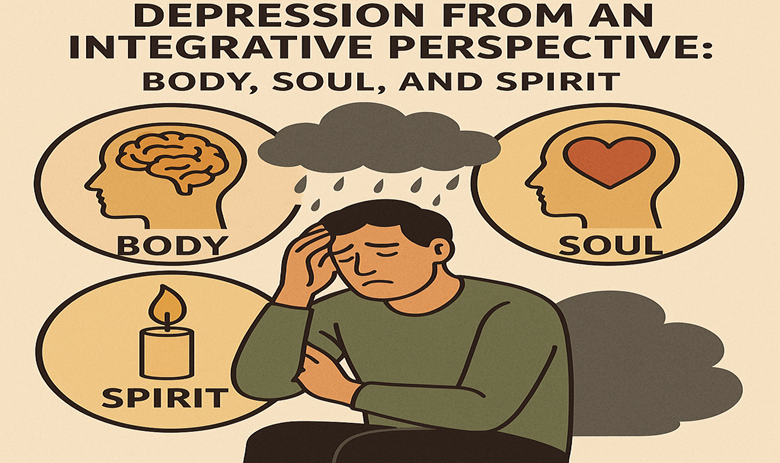
Source: Created by the author with AI assistance (ChatGPT/DALL·E), 2025.
In recent years, the role of chronic stress and social determinants in the onset and perpetuation of depression has gained prominence. Individuals exposed to prolonged financial insecurity, social isolation, or adverse childhood experiences are significantly more likely to develop major depressive disorder (MDD). A large cohort study published in The Lancet Psychiatry found that people facing economic hardship had a 2.5 times higher risk of developing depressive symptoms (Lund et al., 2010). These findings suggest that effective depression care must also consider environmental and socio-economic dimensions, aligning with the broader “body-soul-spirit” framework.
Neuroscience has also uncovered links between depression and chronic low-grade inflammation. Meta-analyses have shown that people with MDD exhibit elevated levels of inflammatory markers such as C-reactive protein (CRP), interleukin-6 (IL-6), and tumor necrosis factor-alpha (TNF-α) (Dowlati et al., 2010). These biomarkers are associated with fatigue, anhedonia, and psychomotor slowing—symptoms often resistant to standard antidepressants. Anti-inflammatory interventions, such as omega-3 supplementation and physical activity, have demonstrated modest but significant antidepressant effects, reinforcing the idea that somatic health cannot be separated from mental well-being (Miller & Raison, 2016).
Diet and physical activity also exert significant influence on depressive states. In the SMILES trial, a 12-week dietary intervention focusing on whole, unprocessed foods resulted in greater reduction in depression scores compared to social support controls (Jacka et al., 2017). Similarly, meta-analyses have confirmed that moderate-intensity aerobic exercise, performed at least three times per week, yields reductions in depressive symptoms equivalent to pharmacological treatment in mild to moderate cases (Schuch et al., 2016). These results support a “body-first” approach that integrates lifestyle medicine as a therapeutic foundation.
The neurobiological impact of trauma adds another layer of complexity. Exposure to emotional neglect, abuse, or violence in early life has been shown to alter hippocampal volume, amygdala reactivity, and the functional connectivity of the default mode network—all brain systems implicated in depression (Teicher & Samson, 2016). Furthermore, individuals with a history of childhood trauma respond less effectively to medication alone, highlighting the need for emotionally reparative therapies that address unresolved affective memory.
Despite its importance, the spiritual dimension of healing is often underrepresented in conventional psychiatric care. Logotherapy, developed by Viktor Frankl, places existential meaning at the center of recovery and has shown strong promise in depression treatment. A randomized controlled trial with Iranian college students demonstrated that logotherapy significantly reduced depressive symptoms and improved life satisfaction compared to a waitlist control (Kimiaee & Ehteshamzadeh, 2011). Meaning-centered interventions allow individuals to reinterpret suffering and reclaim agency, promoting long-term recovery.
Forgiveness-based therapies are one of the most studied forms of spiritual intervention. A meta-analysis by Wade et al. (2014), which included 54 randomized studies, found that forgiveness interventions had a medium-to-large effect size in reducing depression, anxiety, and hostility. Forgiveness allows for the release of toxic emotions like resentment and shame, which are often at the core of chronic depression. These results align closely with spiritual frameworks that emphasize liberation from inner burdens as a path to psychological and existential health.
Spiritual practices such as meditation, contemplative prayer, and gratitude journaling have also demonstrated neurological and psychological benefits. Research using fMRI has shown that mindfulness and prayer can increase activity in the prefrontal cortex and decrease amygdala reactivity—changes associated with improved emotional regulation (Tang, Hölzel, & Posner, 2015). A study published in Psychosomatic Medicine found that an 8-week mindfulness-based cognitive therapy program led to a 44% reduction in relapse rates among previously depressed patients (Segal et al., 2010).
An exciting area of research is the role of neuroplasticity in depression recovery. Studies have shown that both psychotherapy and meditation can induce structural and functional changes in the brain. For instance, regular mindfulness practice has been associated with increased cortical thickness in regions related to attention and emotional regulation (Lazar et al., 2005). Such findings suggest that integrative approaches can help rewire maladaptive neural patterns, enabling long-term resilience.
From a clinical standpoint, integrative care models are gaining traction. The Collaborative Care Model (CCM), which combines primary care, psychiatry, and behavioral health, has demonstrated a 30–40% greater improvement in depression outcomes compared to usual care (Archer et al., 2012). When spiritual care providers such as chaplains or spiritual counselors are included in the team, patient satisfaction and adherence also improve (Fitchett et al., 2015). These models exemplify the body-soul-spirit framework in action—interdisciplinary, person-centered, and outcomes-driven.
Finally, hope plays a crucial role in depression recovery. The Herth Hope Index has been used in studies to measure the relationship between hope and mental health, showing that higher levels of hope are consistently associated with lower depression scores (Herth, 1992). Integrative therapies that promote hope—through connection, insight, forgiveness, and faith—offer more than symptom relief; they enable the reconstitution of identity and purpose.
References
Archer, J., Bower, P., Gilbody, S., et al. (2012). Collaborative care for depression and anxiety problems. Cochrane Database of Systematic Reviews, (10), CD006525.
Cuijpers, P., Berking, M., Andersson, G., et al. (2013). A meta-analysis of cognitive-behavioral therapy for adult depression, alone and in comparison with other treatments. Cognitive Behaviour Therapy, 42(1), 1–17.
Dowlati, Y., Herrmann, N., Swardfager, W., et al. (2010). A meta-analysis of cytokines in major depression. Biological Psychiatry, 67(5), 446–457.
Fava, M., Rush, A. J., Trivedi, M. H., et al. (2007). Background and rationale for the sequenced treatment alternatives to relieve depression (STAR*D) study. Psychiatric Clinics of North America, 30(1), 19–36.
Fitchett, G., Murphy, P. E., Kim, J., et al. (2015). Religious struggle: Prevalence, correlates and mental health risks in diabetic, congestive heart failure, and oncology patients. International Journal of Psychiatry in Medicine, 49(1), 1–19.
Greenberg, L. S., & Watson, J. C. (2006). Emotion-Focused Therapy for Depression. American Psychological Association.
Herth, K. (1992). Abbreviated instrument to measure hope: Development and psychometric evaluation. Journal of Advanced Nursing, 17(10), 1251–1259.
Jacka, F. N., O’Neil, A., Opie, R., et al. (2017). A randomised controlled trial of dietary improvement for adults with major depression (the ‘SMILES’ trial). BMC Medicine, 15(1), 23.
Kimiaee, S. A., & Ehteshamzadeh, P. (2011). Effectiveness of logotherapy on depression and meaning in life. Procedia – Social and Behavioral Sciences, 30, 765–769.
Kessler, R. C., Berglund, P., Demler, O., et al. (2003). The epidemiology of major depressive disorder. JAMA, 289(23), 3095–3105.
Lazar, S. W., Kerr, C. E., Wasserman, R. H., et al. (2005). Meditation experience is associated with increased cortical thickness. NeuroReport, 16(17), 1893–1897.
Lund, C., Breen, A., Flisher, A. J., et al. (2010). Poverty and common mental disorders in low and middle income countries: A systematic review. The Lancet Psychiatry, 378(9801), 1502–1514.
Miller, A. H., & Raison, C. L. (2016). The role of inflammation in depression. Nature Reviews Immunology, 16(1), 22–34.
Otte, C., Gold, S. M., Penninx, B. W., et al. (2016). Major depressive disorder. Nature Reviews Disease Primers, 2, 16065.
Pearce, M. J., Haynes, K., Rivera, N. R., & Koenig, H. G. (2015). Spiritually integrated cognitive processing therapy. Global Advances in Health and Medicine, 4(5), 34–38.
Rush, A. J., Trivedi, M. H., Wisniewski, S. R., et al. (2006). Acute and longer-term outcomes in depressed outpatients. American Journal of Psychiatry, 163(11), 1905–1917.
Salsman, J. M., Brown, T. L., Brechting, E. H., et al. (2015). Spiritual well-being and mental health outcomes in cancer survivors. Psycho-Oncology, 24(7), 796–803.
Schuch, F. B., Vancampfort, D., Richards, J., et al. (2016). Exercise as a treatment for depression: A meta-analysis. Journal of Psychiatric Research, 77, 42–51.
Segal, Z. V., Bieling, P., Young, T., et al. (2010). Antidepressant monotherapy vs sequential pharmacotherapy and mindfulness-based cognitive therapy. Psychosomatic Medicine, 72(6), 555–561.
Sullivan, P. F., Neale, M. C., & Kendler, K. S. (2000). Genetic epidemiology of major depression. American Journal of Psychiatry, 157(10), 1552–1562.
Tang, Y. Y., Hölzel, B. K., & Posner, M. I. (2015). The neuroscience of mindfulness meditation. Nature Reviews Neuroscience, 16(4), 213–225.
Teicher, M. H., & Samson, J. A. (2016). Enduring neurobiological effects of childhood abuse and neglect. Journal of Child Psychology and Psychiatry, 57(3), 241–266.
Toussaint, L., Worthington, E. L., & Williams, D. R. (2015). Forgiveness and health: Scientific evidence and theories. Springer Science & Business Media.
Wade, N. G., Hoyt, W. T., Kidwell, J. E., & Worthington, E. L. (2014). Efficacy of psychotherapeutic interventions to promote forgiveness. Journal of Consulting and Clinical Psychology, 82(1), 154–170.
World Health Organization (WHO). (2023). Depression Fact Sheet. https://www.who.int/news-room/fact-sheets/detail/depression.
Freitas, G. B., Rabelo, E. M., & Pessoa, E. G. (2023). Projeto modular com reaproveitamento de container maritimo. Brazilian Journal of Development, 9(10), 28303–28339. https://doi.org/10.34117/bjdv9n10-057
Gotardi Pessoa, E. (2025). Analysis of the performance of helical piles under various load and geometry conditions. ITEGAM-JETIA, 11(53), 135-140. https://doi.org/10.5935/jetia.v11i53.1887
Gotardi Pessoa, E. (2025). Sustainable solutions for urban infrastructure: The environmental and economic benefits of using recycled construction and demolition waste in permeable pavements. ITEGAM-JETIA, 11(53), 131-134. https://doi.org/10.5935/jetia.v11i53.1886