
REGISTRO DOI: 10.69849/revistaft/ar10202508251204
Andressa Rodrigues Lopes
Abstract
Oral health is a vital component of general well-being and is closely linked to systemic health outcomes. Despite its importance, oral diseases such as dental caries and periodontal disorders remain among the most prevalent noncommunicable diseases worldwide. This article outlines five practical and scientifically grounded recommendations to support the achievement and maintenance of optimal oral health. These include daily oral hygiene practices using fluoride toothpaste and interdental cleaning, the adoption of a tooth-friendly diet low in free sugars, the avoidance of tobacco and excessive alcohol consumption, regular dental check-ups for preventive care, and the promotion of oral health literacy. Each recommendation is supported by current scientific evidence and public health guidelines. Implementing these strategies contributes not only to the prevention of oral diseases but also to improved overall health and quality of life.
Keywords: Oral hygiene, dental caries prevention, fluoride toothpaste, dietary habits, health literacy.
Oral health is a fundamental component of general health, well-being, and quality of life. The World Health Organization (WHO) defines oral health as being multifaceted and includes the ability to speak, smile, smell, taste, chew, and express emotions through facial expressions without pain or discomfort (WHO, 2022). However, oral diseases such as dental caries, periodontitis, and oral cancer remain widespread and are among the most common noncommunicable diseases globally. According to the Global Burden of Disease Study, untreated dental caries in permanent teeth is the most prevalent condition worldwide, affecting an estimated 2.5 billion people (GBD 2019 Diseases and Injuries Collaborators, 2020). These data underscore the importance of accessible, effective, and evidence-based preventive strategies.
One of the most crucial strategies is the establishment and maintenance of consistent oral hygiene habits. The accumulation of dental plaque—a biofilm of bacteria—on tooth surfaces is a key etiological factor in both dental caries and periodontal diseases. Brushing teeth twice daily with fluoride-containing toothpaste significantly reduces plaque accumulation and the risk of demineralization (Walsh et al., 2019). Fluoride has been shown to enhance enamel remineralization and inhibit the metabolic activity of cariogenic bacteria such as Streptococcus mutans (Fejerskov et al., 2015). Moreover, interdental cleaning using dental floss or interdental brushes is essential for removing plaque from proximal tooth surfaces where brushing is less effective (Slot et al., 2012). The adjunctive use of antimicrobial mouth rinses containing chlorhexidine or essential oils can provide additional benefits in plaque control, particularly in individuals with gingivitis or limited dexterity.
Nutritional habits are another major determinant of oral health. A high frequency of consumption of fermentable carbohydrates, particularly sucrose, is closely associated with the development of dental caries due to acid production by plaque biofilm bacteria (Moynihan & Kelly, 2014). Conversely, a diet rich in fiber, dairy products, and water can promote oral and systemic health. Dairy products, such as milk and cheese, are sources of calcium and phosphate, which are essential for enamel repair. Fibrous fruits and vegetables increase salivary flow, which acts as a natural buffering system and helps in mechanical cleansing. Importantly, water fluoridation remains one of the most effective population-level interventions to reduce dental caries, supported by decades of scientific evidence (Griffin et al., 2007).
The avoidance of tobacco and excessive alcohol use is equally critical. Tobacco use, whether smoked or smokeless, is a well-established risk factor for periodontal disease, tooth loss, delayed wound healing, and oral malignancies (Warnakulasuriya et al., 2010). Likewise, chronic alcohol consumption has been associated with xerostomia (dry mouth), increased susceptibility to caries, and synergistic effects with tobacco in the development of oral squamous cell carcinoma (Petti & Scully, 2005). Prevention strategies must, therefore, incorporate behavioral interventions that support cessation, including motivational interviewing and pharmacotherapy when appropriate.
Routine dental visits play an indispensable role in preventive care and early intervention. The American Dental Association (ADA) recommends individualized recall intervals, typically ranging from three to twelve months, depending on a person’s risk profile (ADA, 2023). Regular dental assessments enable the detection of early-stage pathologies, such as incipient carious lesions or pre-cancerous oral mucosal changes, which can be managed conservatively when identified early. Professional prophylaxis procedures remove calculus and biofilm that cannot be eliminated through home care alone and reinforce the importance of adherence to preventive behaviors.
Finally, promoting oral health literacy and patient engagement is essential to achieving sustained behavioral change. Oral health literacy—the capacity to obtain, process, and understand basic health information to make appropriate oral health decisions—is strongly linked to better self-care practices and outcomes (Divaris, 2013). Educational interventions delivered through schools, community health programs, and digital platforms have shown promise in improving hygiene practices, dietary habits, and dental service utilization. Moreover, caregivers play a pivotal role in shaping children’s early oral health behaviors. The first dental visit is recommended by age one, and early parental guidance is associated with a reduced incidence of early childhood caries (Nowak & Casamassimo, 2002).
The flowchart titled “Evidence-Based Strategies for Achieving and Sustaining Optimal Oral Health: Five Practical Recommendations” visually summarizes the core pillars of effective oral health management. At the center is the goal—Optimal Oral Health—which is supported by five interconnected strategies: practicing daily oral hygiene (including brushing and interdental cleaning), adopting a tooth-friendly diet low in free sugars, avoiding tobacco and excessive alcohol consumption, attending regular dental check-ups for preventive care, and promoting oral health literacy. These components are based on scientific evidence and public health guidelines, emphasizing a holistic and preventive approach to reducing oral disease and enhancing overall well-being.
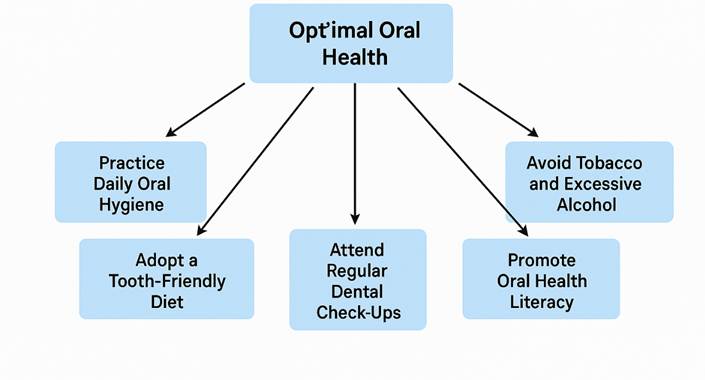
Source: Created by author.
In summary, optimal oral health is achievable through the integration of evidence-based daily hygiene practices, a diet low in free sugars, abstention from tobacco and alcohol, regular professional dental care, and increased health literacy. These five pillars serve not only to prevent disease but to promote holistic well-being, supporting the individual’s ability to function socially and physiologically. The implementation of these strategies—grounded in public health research and clinical evidence—should be encouraged at both the individual and community levels to address the global burden of oral diseases.
References
American Dental Association (2023) Oral Health Topics: Preventive Care. American Dental Association. Disponível em: https://www.ada.org
Divaris, K. (2013) Predicting Dental Outcomes in Populations: A “Big Data” Approach. Journal of Dental Research, 92(2), 107–113.
Fejerskov, O., Nyvad, B., & Kidd, E. A. M. (2015) Dental Caries: The Disease and Its Clinical Management (3rd ed.). Wiley Blackwell.
GBD 2019 Diseases and Injuries Collaborators (2020) Global burden of 369 diseases and injuries in 204 countries and territories, 1990–2019: a systematic analysis. The Lancet, 396(10258), 1204–1222.
Griffin, S. O., Regnier, E., Griffin, P. M., & Huntley, V. (2007) Effectiveness of fluoride in preventing caries in adults. Journal of Dental Research, 86(5), 410–415.
Moynihan, P. J., & Kelly, S. A. M. (2014) Effect on caries of restricting sugars intake: Systematic review to inform WHO guidelines. Journal of Dental Research, 93(1), 8–18.
Nowak, A. J., & Casamassimo, P. S. (2002) The dental home: A primary care oral health concept. Journal of the American Dental Association, 133(1), 93–98.
Petti, S., & Scully, C. (2005) Oral cancer: The association between nation-based alcohol-drinking profiles and oral cancer mortality. Oral Oncology, 41(8), 828–834.
Slot, D. E., Dörfer, C. E., & Van der Weijden, G. A. (2012) The efficacy of interdental brushes on plaque and parameters of periodontal inflammation: A systematic review. International Journal of Dental Hygiene, 10(1), 15–23.
Walsh, T., Worthington, H. V., Glenny, A.-M., Marinho, V. C., & Jeroncic, A. (2019) Fluoride toothpastes of different concentrations for preventing dental caries in children and adolescents. Cochrane Database of Systematic Reviews, 3.
Warnakulasuriya, S., Dietrich, T., Bornstein, M. M., Peidró, E. C., Preshaw, P. M., Walter, C., Wennström, J. L., & Bergström, J. (2010) Oral health risks of tobacco use and effects of cessation. International Dental Journal, 60(1), 7–30.
World Health Organization (2022) Oral Health. World Health Organization. Disponível em: https://www.who.int/news-room/fact-sheets/detail/oral-health.
Freitas, G. B., Rabelo, E. M., & Pessoa, E. G. (2023). Projeto modular com reaproveitamento de container maritimo. Brazilian Journal of Development, 9(10), 28303–28339. https://doi.org/10.34117/bjdv9n10-057
Gotardi Pessoa, E. (2025). Analysis of the performance of helical piles under various load and geometry conditions. ITEGAM-JETIA, 11(53), 135-140. https://doi.org/10.5935/jetia.v11i53.1887
Gotardi Pessoa, E. (2025). Sustainable solutions for urban infrastructure: The environmental and economic benefits of using recycled construction and demolition waste in permeable pavements. ITEGAM-JETIA, 11(53), 131-134. https://doi.org/10.5935/jetia.v11i53.1886