
REGISTRO DOI: 10.69849/revistaft/ra10202512141446
Antonio Clareti Pereira1
Abstract
Refractory and double-refractory gold ores continue to challenge conventional hydrometallurgical processing due to the combined effects of sulfide encapsulation, carbonaceous preg-robbing, and complex gangue mineralogy. This review integrates mineralogical diagnosis, pretreatment technologies, leaching systems, recovery methods, operational constraints, economic factors, and environmental considerations to provide a comprehensive framework for flowsheet selection. Pressure oxidation, biological oxidation, roasting, ultrafine grinding, and emerging hybrid strategies are examined with respect to their oxidation mechanisms, process intensities, residue characteristics, and compatibility with cyanide and non-cyanide lixiviants. Leaching routes—including cyanidation, thiosulfate, halide systems, and glycine-based processes—are critically evaluated with respect to gold complex stability, impurity tolerance, and downstream adsorption or electrowinning performance. Operational challenges in water chemistry, process control, reagent stability, gas management, and arsenic immobilization are identified as key drivers of industrial performance. A comparative economic assessment outlines trade-offs between capital intensity, operating costs, energy consumption, reagent use, and environmental liabilities. Finally, a decision matrix is proposed to guide the alignment of ore characteristics, regulatory constraints, and sustainability requirements with feasible processing routes. The synthesis emphasizes the growing importance of integrated approaches that balance metallurgical efficiency, process robustness, and longterm environmental stewardship in treating increasingly complex refractory gold resources.
Keywords. Refractory gold ores; Double refractory ores; Pressure oxidation (POX); Biological oxidation; Roasting; Ultrafine grinding; Cyanidation; Thiosulfate leaching; Halide leaching; Glycine leaching; Pretreatment; Gold recovery; Preg-robbing.
Highlights
- Integrates mineralogical diagnosis, pretreatment, leaching, recovery, and environmental management
- Critically compares POX, bio-oxidation, roasting, ultrafine grinding, and hybrid pretreatment technologies
- Evaluates cyanide and non-cyanide lixiviants
- Identifies operational bottlenecks—water chemistry, process control, reagent stability, arsenic handling—as significant determinants of industrial performance.
- Proposes a decision matrix linking ore characteristics, economic boundaries, and regulatory constraints
Graphical Abstract

1. Introduction
Refractory gold ores pose some of the toughest challenges in modern extractive metallurgy because of the physical and chemical processes that prevent gold from being released and dissolved. In many deposits, gold is present as very fine inclusions or solid solutions within sulfide minerals like pyrite, arsenopyrite, and pyrrhotite, which hinder proper exposure of the metal to leaching solutions even after extensive crushing (Ahtiainen et al., 2021; Li et al., 2022). In other geological settings, organic carbon or graphitic material strongly interacts with dissolved gold complexes, trapping them and reducing overall recovery through preg-robbing (Afenya, 1991; Miller et al., 2005; Amanya et al., 2017). When an ore contains both encapsulated gold and significant preg-robbing capacity, it is called double refractory, requiring carefully planned pretreatment methods before cyanidation or any other leaching process can work effectively (Carson et al., 2021; Lee, Gibson & Ghahreman, 2021).
Over the past decades, the metallurgical community has developed a wide range of technologies to overcome refractoriness, including roasting, pressure oxidation, nitric acid oxidation, biological oxidation, and various hybrid chemical–biological treatments (Cole & Doll, 1991; Iglesias & Carranza, 1994; Thomas & Cole, 2005; Hao et al., 2010; de Carvalho et al., 2019; Konadu et al., 2019). These methods aim to break down sulfide matrices, expand pore networks, remove passivation layers, and modify or deactivate reactive carbonaceous components that interfere with gold dissolution (Konadu et al., 2020; Lin et al., 2023). Concurrent advances in analytical mineralogy and microstructural characterization have uncovered the complex relationships between mineral textures, oxidation pathways, and reagent accessibility, enabling more selective, energy-efficient, and environmentally friendly processing solutions (Li et al., 2022; Ospina-Correa et al., 2018).
Between 2020 and 2025, the significance of refractory and double refractory gold ores grew substantially as mining companies faced lower ore grades, deeper deposits, and increasing demand for gold in jewelry, investment, electronics, and advanced technologies. Simultaneously, global expectations for environmental performance became more stringent, with increased scrutiny on cyanide management, sulfur dioxide emissions, arsenic stabilization, tailings safety, and water governance (Akcil, 2010; Environmental Law Alliance Worldwide, 2010; GISTM, 2020; Schoderer et al., 2020; Newmont, 2023; Responsible Jewellery Council, 2012). These pressures have driven the development of cleaner, more sustainable flowsheets involving cyanide-free or cyanide-lean lixiviants, improved flotation– preoxidation combinations, more efficient bio-oxidation systems, and new chemical oxidants that reduce reagent consumption and environmental risk (Ahtiainen et al., 2021; Soto-Uribe et al., 2023; Espinoza-Martínez et al., 2025; Barbouchi et al., 2024). Despite these advancements, there remains a clear need for integrated frameworks that connect mineralogical descriptors with pretreatment options, downstream leaching behavior, residue management, and overall process economics (Costa et al., 2020; Barbouchi et al., 2025).
This review synthesizes the significant advances made between 2020 and 2025 in the understanding and processing of refractory and double refractory gold ores. Particular emphasis is placed on the role of mineralogical and textural features in controlling gold refractoriness, on recent developments in pretreatment and leaching technologies, on the evolution of environmentally driven constraints, and on the economic implications of adopting modern metallurgical strategies. The central motivation is to consolidate the rapidly growing body of knowledge into a coherent perspective that can support both industrial decision-making and future research. The following section describes the methodological approach used to gather, select, and analyze the literature that forms the foundation of this review.
2. Methodology (PRISMA 2020)
This review adheres to PRISMA 2020 principles and employs a structured, transparent, and reproducible research approach. The literature search was carried out from January 2020 to September 2025 across scientific databases, technical repositories, and patent archives. The central databases included Scopus, Web of Science, and ScienceDirect, supported by targeted searches in Google Scholar and selected patent offices to find emerging technologies not yet indexed in journals. Search strings aimed to cover refractory gold mineralogy, pretreatment techniques, leaching methods, residue behavior, and economic considerations in flowsheet design. Search queries combined key terms related to pressure oxidation, bio-oxidation, roasting, ultrafine grinding, non-cyanide lixiviants, arsenic stabilization, process mineralogy, and double refractory materials. Variations were tested to ensure sensitivity to both established terminology and new keywords in recent research.
Inclusion criteria focused on original research, pilot studies, reviews, theses, industrial case studies, and patents that presented precise experimental or operational data for refractory or double refractory gold ores. Exclusion criteria removed works lacking methodological detail, duplicate reports, conference abstracts without sufficient information, and studies outside the time frame or scope of metallurgy. Quality assessment considered clarity of experimental design, analytical rigor, reproducibility indicators, and transparency of reporting. Data extraction was performed using a standardized template that captured ore characteristics, diagnostic mineralogy, pretreatment conditions, leaching chemistry, performance indicators, environmental controls, and techno-economic observations.
A PRISMA-style flow diagram outlines the screening process, showing the number of records identified, screened, excluded, and retained. This process yields a curated, consistent body of evidence that supports interpretive synthesis in the following sections. This methodological foundation ensures that the discussion of mineralogical controls and process routes is based on reliable, comparable information.
A total of 1,246 records were initially identified through database searching and additional sources. After automatically removing duplicates (n = 412), 834 records moved on to the screening stage. Title and abstract screening resulted in the exclusion of 596 records that did not fit the scope of refractory gold processing. The remaining 238 full-text articles were evaluated for eligibility. Of these, 169 studies were excluded for insufficient mineralogical details, lack of pretreatment assessment, or the absence of quantitative performance metrics. In the end, 69 studies met all inclusion criteria and were included in the final qualitative and comparative review.
Although the methodology employs a structured and transparent PRISMA-based approach, several limitations must be acknowledged. Database indexing tends to favor English-language publications and may underrepresent regional innovations or industrial reports with limited circulation. Search strings, though comprehensive, cannot fully encompass the diversity of terminology used in both academic and industrial contexts for describing refractory behavior and gold liberation mechanisms. The quality assessment also depends on the level of methodological detail provided by authors, which varies significantly across sources. These limitations introduce potential bias in the dataset and highlight the need for greater standardization in reporting process conditions, ore mineralogy, and performance metrics in the field of refractory gold processing.
The following section explains the mineralogical features that influence refractoriness and determine all subsequent processing decisions.
3. Mineralogy and refractoriness diagnosis
The mineralogical characteristics of refractory gold ores determine how gold is hosted, how it can be liberated, and which pretreatment strategies are necessary for effective extraction. Sulfide minerals such as pyrite, arsenopyrite, and pyrrhotite often form the primary matrices in which gold exists as inclusions, intergrowths, or submicrometric particles, thereby restricting permeability and slowing oxidation kinetics (Barbouchi et al., 2024; Wang et al., 2019). In many deposits, the gangue mainly consists of silicate or carbonate minerals that influence breakage behavior, oxidation reactivity, and the formation of passivating films that hinder leaching (Adams, 2016). Organic carbon and graphitic matter contribute to refractoriness through preg-robbing, where dissolved gold complexes are adsorbed onto carbonaceous surfaces, reducing overall extraction efficiency (Afenya, 1991; Amanya et al., 2017; Rees & Van Deventer, 2000).
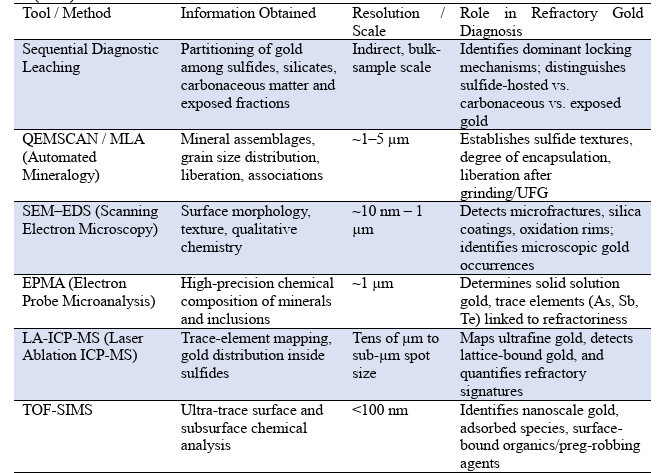
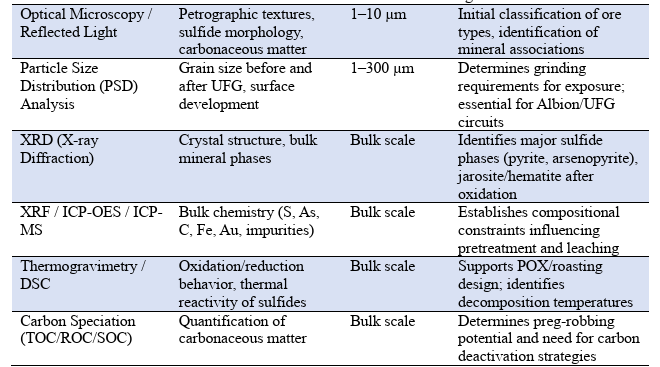
A thorough diagnosis of refractoriness requires combining mineralogical, microanalytical, and chemical tools that pinpoint gold distribution across various spatial scales. Table 1 summarizes the primary analytical methods used to characterize refractory gold, emphasizing the type of information they provide, their resolution, and their specific roles in identifying gold-locking mechanisms.
Together, these complementary methods enable the creation of a multi-scale diagnostic framework that differentiates true mineralogical refractoriness from operational or chemical limitations. Automated mineralogy and microanalysis reveal liberation and encapsulation features, while chemical and thermal techniques assess compositional constraints that affect pretreatment efficiency. By combining these datasets, practitioners can choose pretreatment procedures based on sulfide texture, carbon content, and the distribution of exposed versus locked gold.
Table 1. Diagnostic tools used for refractory gold characterization. Adapted from Adair et al. (2020); King et al. (2021); Marsden & House (2022); Li et al. (2023); Valdivieso-Bermeo et al. (2020); Guo et al. (2017).
Gold can exist in several distinct forms, each presenting unique processing challenges. Ultrafine inclusions smaller than one micrometer resist liberation even with intense grinding, while surface-bound gold in microfractures may be partly exposed but still influenced by local mineral chemistry (Iglesias & Carranza, 1994; Cole & Doll, 1991). In some ores, gold is present as a solid solution within sulfide lattices, necessitating thermal or oxidative breakdown before dissolution (Barbouchi et al., 2025). These differences highlight the importance of thorough mineralogical analysis early in flow sheet development to guide pretreatment methods and forecast downstream recovery (La Brooy et al., 1994; Marsden & House, 2006).
To guide the interpretation of these mineralogical controls, Figure 1 summarizes the diagnostic workflow typically used for refractory and double refractory gold ores, connecting sample preparation to bulk mineralogy, automated mineralogy, microanalysis, and diagnostic leaching.
This structured progression guarantees that liberation characteristics, mineral associations, and gold speciation are precisely identified before choosing pretreatment strategies. The advanced analytical stages (automated mineralogy and microanalysis) supply the quantitative information needed for modeling oxidation behavior, preg-robbing potential, and leaching response.
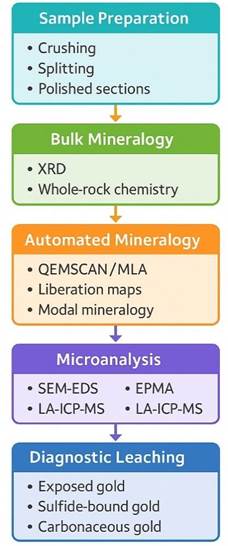
Figure 1. Mineralogical diagnostic workflow for refractory gold ores, integrating sample preparation, bulk mineralogy, automated mineralogy, microanalysis, and diagnostic leaching. Adapted from Adams (2016), Costa et al. (2020), Li et al. (2022), and Iglesias & Carranza (1994).
A comprehensive diagnosis of refractory ore requires analytical tools that can resolve mineral associations, textures, and gold distribution at fine scales. Sequential diagnostic leaching provides an indirect method to evaluate gold partitioning among exposed, sulfidebound, and carbonaceous fractions (Pereira et al., 2016, 2017, 2019). Automated mineralogical systems like QEMSCAN and MLA generate quantitative data on mineral liberation and create maps that support process modeling and grinding optimization (Costa et al., 2020). Highresolution microanalytical techniques—including SEM–EDS, electron probe microanalysis, LA-ICP-MS, and TOF-SIMS—enable visualization and measurement of micron- and submicron-scale gold particles, as well as arsenic and sulfur species that influence refractory behavior (Li et al., 2022; Jin et al., 2022). When ultrafine grinding is incorporated into the flow sheet, characterizing particle size distributions below 20 μm becomes critical, since oxidation efficiency and leaching kinetics greatly depend on the increased reactive surface area (Cheng et al., 2013; Lin et al., 2023).
Based on mineralogical diagnostics, refractory ores are typically classified as sulfidehosted, carbonaceous, or double refractory. Sulfide-rich ores require pretreatments that break down the sulfide matrix, carbonaceous ores need methods to prevent preg-robbing, and double refractory ores demand a combination of oxidation and carbon deactivation or alternative lixiviants (Barbouchi et al., 2024; Ahtiainen et al., 2021). Ultimately, the mineralogical signature of an ore greatly influences the selection of pretreatment methods, the design of the flowsheet, and the overall economic performance of the operation (Adams, 2016; Cole & Doll, 1991).
To illustrate these diagnostic categories and their key mineralogical features, Figure 2 summarizes the three main classes of refractory gold ores and their defining characteristics.
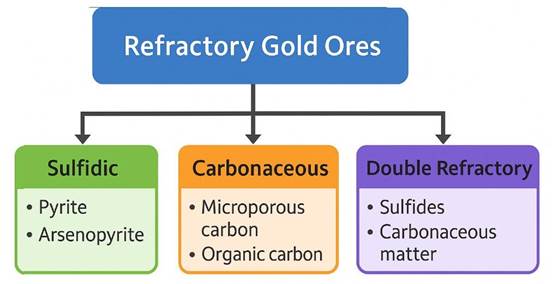
Figure 2. Classification of refractory gold ores into sulfide-hosted, carbonaceous and double refractory types, highlighting the dominant mineralogical features that control gold encapsulation and pregrobbing behavior. Adapted from Adams (2016), Iglesias & Carranza (1994), and Afenya (1991).
This classification informs the choice of pretreatment, as each category responds differently to oxidation levels, reagent chemistry, and downstream leaching conditions.
Recent research has shown that specific organic additives, such as maltodextrin, can effectively prevent preg-robbing by coating reactive carbon surfaces and stabilizing dissolved gold species (Valdivieso-Bermeo et al., 2020).
Although mineralogical characterization provides a crucial foundation for understanding refractoriness, several practical limitations remain. Analytical campaigns often rely on small or unrepresentative samples, thereby underestimating the heterogeneity typical of gold deposits. Excellent gold particles below detection limits can lead to misleading liberation assessments, while interpreting diagnostic leaches may oversimplify complex mineral relationships. Automated mineralogy, though powerful, is limited by resolution, segmentation algorithms, and sample preparation artifacts. As a result, classifications such as “sulfidic,” “carbonaceous,” or “double refractory” may not fully capture transitional behaviors or interactions between mineralogical domains. These limitations highlight the need for integrated mineralogical, chemical, and process-based diagnostics to enable more reliable and predictive processing decisions.
The following section provides an overview of the main processing routes, linking the diagnostic insights discussed here to the structure and logic of metallurgical flowsheets.
4. Processing routes – Overview
Processing routes for refractory gold ores follow a structured sequence that integrates comminution, pretreatment, leaching, gold recovery, and refining (Adams, 2016; La Brooy et al., 1994). The flowsheet begins with crushing and grinding, which aim to expose mineral surfaces and reduce particle size to the level necessary for subsequent oxidation or leaching. Conventional grinding is often insufficient for refractory ores because gold may remain locked within sulfide minerals or be entrapped in wonderful textures, so comminution mainly prepares the material for downstream oxidation rather than acting as an entirely liberating step in itself (Adams, 2016; Iglesias & Carranza, 1994; Pereira et al., 2025).
Pretreatment is essential in refractory gold processing. Sulfide-hosted ores need oxidation of the mineral matrix, carbonaceous ores require suppression of preg-robbing, and double refractory ores need a combined strategy to address both issues (Afenya, 1991; Konadu et al., 2020; Miller et al., 2005). Technologies like roasting, pressure oxidation, nitric acid oxidation, and bio-oxidation alter the chemical and microstructural environment of the ore, enabling reagents to access gold particles that were previously unreachable (Cole & Doll, 1991; Espinoza-Martínez et al., 2025; Muravyov, 2019; Takimoto et al., 2025). The success of these steps largely influences the performance of downstream leaching and the overall economic feasibility of the process (Barbouchi et al., 2024; Wang et al., 2025).
Choosing the right pretreatment technology requires a clear understanding of how each method disrupts sulfide matrices, alters arsenic speciation, and influences downstream leaching effectiveness. Table 2 summarizes the main pretreatment options used for refractory gold ores, outlining their operating principles, benefits, and environmental impacts. The comparison highlights not only how effectively they liberate minerals but also their residue stability, gaseous emissions, and compatibility with cyanide and non-cyanide lixiviants.
Table 2. Pretreatment technologies for refractory and double refractory gold ores Adapted from Thomas et al., 2019; Adair et al., 2020; King et al., 2021; Marsden & House, 2022; Valdivieso-Bermeo et al., 2020; Li et al., 2023; Guo et al., 2017; Canales et al., 2002
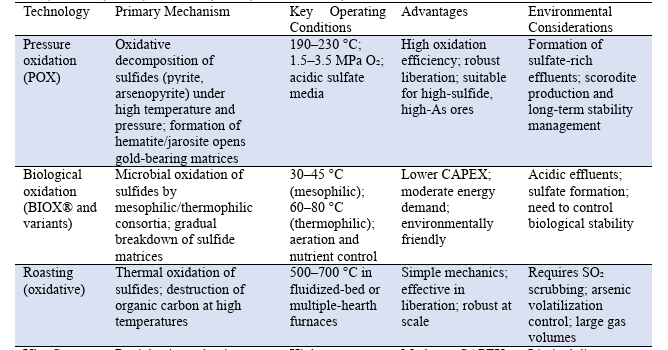
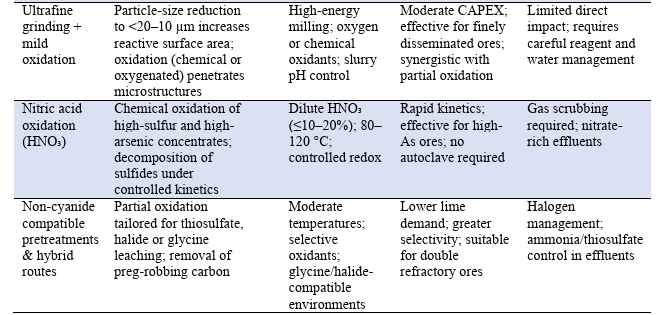
As shown in Table 2, no single pretreatment technology universally satisfies metallurgical efficiency, operational simplicity, and environmental performance. Pressure oxidation remains the benchmark for highly sulfidic and arsenic-rich ores, but imposes demanding autoclave infrastructure and sulfate management. Biological oxidation provides a lower-capital, environmentally aligned alternative, though its kinetics and sensitivity to operating conditions can limit throughput. Roasting remains effective where gas-cleaning systems can handle SO₂ and As₂O₃ emissions. Emerging approaches—such as ultrafine grinding combined with mild chemical oxidation and selective pretreatments compatible with thiosulfate, halide, or glycine leaching—are increasingly attractive for complex double refractory ores. These trends underscore the importance of integrating pretreatment choice with downstream lixiviant selection, residue stabilization strategies, and site-specific environmental constraints.
Leaching then dissolves gold from the pretreated solids. Cyanidation remains the industrial standard because of its maturity and high selectivity, but it is sensitive to residual sulfides, reactive carbon, solution chemistry, and competing metal ions (Adams, 2016; Rees & Van Deventer, 2000). Alternative lixiviants—including thiourea, thiosulfate, thiocyanate, halides, and glycine-based systems—have been developed to improve performance when cyanide becomes ineffective or environmentally restricted, especially for carbonaceous and double refractory ores (Ahtiainen et al., 2021; Azizitorghabeh et al., 2021; Guo et al., 2020; Li et al., 2023; Lin et al., 2023; Zhao et al., 2020). The choice of lixiviant is strongly influenced by ore chemistry, pretreatment results, and the current regulatory environment (Akcil, 2010; International Cyanide Management Institute, 2002).
Gold recovery technologies, including activated carbon adsorption, resin-based systems, electrowinning, and precipitation, operate on clarified solutions obtained from leaching and must address the stability of dissolved gold complexes and the presence of impurities carried over from pretreatment and leaching (Adams, 2016; Marsden & House, 2006). After recovery, refining produces a high-purity gold product suitable for downstream markets.
Choosing a processing route requires balancing technical factors such as sulfide content, organic carbon levels, oxidation demand, and grinding energy with economic and regulatory considerations (Costa et al., 2020; Wang et al., 2025). Environmental expectations, energy availability, reagent logistics, and residue management requirements increasingly influence flowsheet designs, making process planning a multidisciplinary effort that combines mineralogy, chemical engineering, sustainability, and risk management (Global Industry Standard on Tailings Management, 2020; International Finance Corporation, 2007; Schoderer et al., 2020).
Although flowsheet overviews show the general structure of refractory gold processing, they often conceal the complexity and interdependence of individual stages. In practice, each unit operation imposes constraints on the next, and slight deviations in ore mineralogy or operational controls can cascade through the system, reducing overall recovery. Many studies assess pretreatment, leaching, or recovery independently, without fully accounting for how they integrate in an industrial setting. This fragmentation reduces the predictive accuracy of isolated laboratory results and can lead to flowsheets that perform well in controlled experiments but poorly in full-scale operations. A more holistic approach that combines mineralogical diagnosis, pretreatment kinetics, leaching chemistry, and residue behavior is vital for developing robust, adaptable processing routes.
The following section examines each pretreatment technology in depth, emphasizing advancements from 2020 to 2025 and their impact on refractory gold processing.
5. Pretreatment Methods
Pretreatment is the critical stage in processing refractory and double refractory gold ores because it changes the mineralogical barriers that block gold dissolution. The available technologies vary in their mechanisms, operating conditions, environmental impacts, and compatibility with downstream leaching systems (Adams, 2016; Iglesias & Carranza, 1994).
Pressure oxidation uses autoclave reactors that operate at high temperatures and oxygen pressures, converting sulfides into hematite, jarosite, or related phases while sulfate ions accumulate in solution. This process exposes gold that was previously encapsulated but can also produce silica-rich layers or passivating residues, which require careful management (Cole & Doll, 1991; Espinoza-Martínez et al., 2025). Its advantages include high oxidation efficiency and reliable performance, while its disadvantages involve high capital costs, acid production, and the need for subsequent neutralization and arsenic stabilization (Adams, 2016; Thomas & Cole, 2005).
Earlier research already highlighted the use of bacterial oxidation to release gold trapped in pyritic and arsenopyritic materials, laying the groundwork for current bio-oxidation methods (Urquizo Valdívia, 2003).
Biological pretreatment provides an alternative method where specific microbial consortia oxidize sulfides at moderate temperatures. Mesophilic and thermophilic cultures function through different biochemical pathways, allowing flexibility to various sulfide compositions (Breed, 2000; de Carvalho et al., 2019; Muravyov, 2019). These systems generally require lower capital investment and less energy, but they need precise control of residence time, aeration, heat balance, and potential toxicity from dissolved substances (Canales et al., 2002). Their final product is usually suitable for cyanidation once the sulfide matrix has been broken down, although residual carbonaceous material may still hinder gold recovery (Konadu et al., 2019; Wu et al., 2018).
Roasting is a thermal process where sulfides are oxidized at high temperatures in fluidized beds or multiple-hearth furnaces. The method is mechanically simple and highly efficient but produces gaseous emissions that require extensive treatment, especially when arsenic or mercury are present (Thomas & Cole, 2005; Adams, 2016). Calcines produced by roasting can attain high gold recovery, yet environmental and permitting regulations increasingly limit its use. Managing off-gas and handling volatile species are key considerations (Mizouho Bank, 2013; Environmental Law Alliance Worldwide, 2010).
Ultrafine grinding combined with oxidative treatment forms another pretreatment method. Reducing particle size to tens of micrometers or less greatly increases the internal surface area, boosting oxidation rates under acidic and oxygen-rich conditions (Adams, 2016; Li et al., 2022). Although capital costs are generally lower than those for autoclave technology, grinding energy requirements can be high. Oxidation efficiency depends on maintaining optimal relationships among particle size, slurry chemistry, and oxygen utilization (Costa et al., 2020).
Chemical oxidation using diluted nitric acid has also been shown to effectively decompose high-sulfur, high-arsenic refractory concentrates under controlled kinetic conditions (Cai et al., 2009; Pereira et al., 2025).
To clarify how different pretreatment technologies break down sulfide- and arsenicbearing minerals, Figure 3 illustrates the main reaction pathways governing the conversion of pyrite, arsenopyrite, and related phases during roasting, pressure oxidation, bio-oxidation, and nitric acid oxidation.
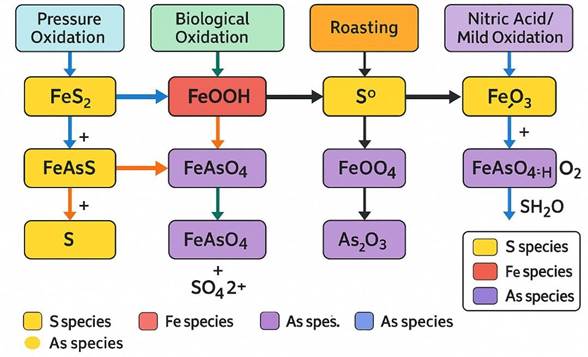
Figure 3. Pretreatment reaction pathways for sulfide- and arsenic-bearing minerals (S–Fe–As). Adapted from Adams (2016); Thomas & Cole (2005); de Carvalho et al. (2019).
Non-cyanide pretreatments and alternative lixiviants have gained prominence in recent years. Ammoniacal thiosulfate systems show reduced sensitivity to preg-robbing behavior and operate efficiently with catalytic copper species (Guo et al., 2020; Lin et al., 2023; Zhao et al., 2020). Halide systems, including chloride, bromide, and iodide, offer strong oxidative and complexing properties but require corrosion-resistant materials and careful management of volatile species (Wang et al., 2019). Glycine-based processes operate under mild alkaline conditions and integrate well with partial oxidation strategies, potentially reducing lime consumption and improving selectivity (Cheng et al., 2013). Additional reagents such as thiourea, persulfate, and mixed oxidants are used in specialized or emerging applications (Barbouchi et al., 2025; Ray et al., 2022), though their wider adoption is limited by stability, toxicity, or reagent cost. Integrated flowsheets combining partial bio-oxidation with thiourea leaching have demonstrated enhanced dissolution kinetics for refractory ores with moderate carbon content (Guo et al., 2017).
Process refinements, including stabilizing additives and redox-controlled environments, have markedly improved the selectivity and stability of thiourea leaching systems (Li, K., et al., 2023).
Among all these options, choosing a pretreatment route depends on mineralogical constraints, infrastructure, environmental regulations, and economic factors. Each method offers a different balance of efficiency, operational complexity, and sustainability (Barbouchi et al., 2024; International Finance Corporation, 2007; Schoderer et al., 2020). Understanding these trade-offs is crucial for designing flowsheets capable of processing the increasingly complex ores mined today.
Despite significant progress, pretreatment technologies still face challenges related to ore variability, operational complexity, and rising environmental demands. Many studies show promising lab results that do not scale well due to heat transfer issues, gas–liquid mass transfer limits, or mineralogical differences. Sometimes, pretreatments cause secondary problems such as excessive sulfate formation, silica passivation, or unstable arsenic phases, which complicate residue management. Alternative lixiviants often require highly controlled conditions or expensive corrosion-resistant materials, restricting their industrial use. These issues highlight that technological progress has outpaced the development of integrated frameworks that link pretreatment options with long-term environmental stability, process economics, and operational risks.
The following section discusses gold leaching and recovery, analyzing how pretreatment results affect gold behavior during dissolution and subsequent recovery.
6. Gold leaching and recovery
The dissolution and recovery of gold are central to hydrometallurgical processing and heavily depend on effective pretreatment. Cyanidation remains the most established method, operating under controlled alkaline conditions where dissolved oxygen and free cyanide enable gold dissolution (Adams, 2016; Marsden & House, 2006). However, its efficiency is highly affected by residual sulfides, reactive metals, and the persistence of carbonaceous material, which can trap dissolved gold through preg-robbing mechanisms (Afenya, 1991; Miller et al., 2005; Rees & Van Deventer, 2000). Even after oxidation or ultrafine grinding, incomplete exposure of gold surfaces or the formation of interfering species can hinder the process, emphasizing the importance of carefully controlling pH, dissolved oxygen, and cyanide levels to maintain stable dissolution rates (Adams, 2016; Iglesias & Carranza, 1994).
As environmental expectations evolve, non-cyanide systems increasingly attract attention. Thiosulfate leaching offers an alternative for ores with strong preg-robbing tendencies or complex mineralogies and benefits from catalytic enhancement of gold dissolution (Guo et al., 2020; Lin et al., 2023; Zhao et al., 2020). This method requires adsorption systems compatible with thiosulfate complexes, often favoring resin-based technologies over activated carbon (Adams, 2016). Halide lixiviants, including chloride and bromide, provide strong oxidative and complexing capabilities that enable gold dissolution under controlled conditions. However, their industrial application depends on strict corrosion control and reagent recycling (Wang et al., 2019). Glycine-based leaching has recently gained interest due to its moderate operating conditions, lower lime demand, and potential compatibility with partial oxidation strategies (Cheng et al., 2013).
To demonstrate the operational windows and ore-type selectivity of different gold lixiviants, Figure 4 summarizes the compatibility ranges of cyanide, thiosulfate, halides, glycine, and thiourea across key mineralogical and chemical constraints.
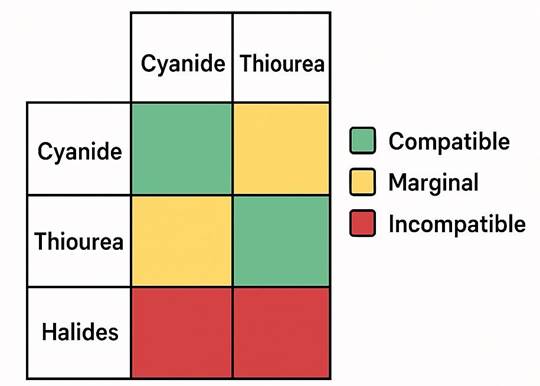
Figure 4. Gold lixiviant compatibility map showing the relative suitability of cyanide, thiosulfat,e, halide systems, glycine and thiourea for ores exhibiting sulfide encapsulation, carbonaceous pregrobbing, fine encapsulation or high-impurity water chemistry.. Adapted from Adams (2016); Guo et al. (2020); Ahtiainen et al. (2021); Lin et al. (2023); Zhao et al. (2020).
Ultrasound-assisted thiocyanate leaching has been shown to improve mass transfer and accelerate dissolution rates in refractory ores, enabling more competitive extraction kinetics (Li et al., 2023).
Gold recovery relies directly on the chemistry of the leach solution and the stability of the gold complexes formed. In cyanidation, activated carbon remains the primary adsorbent because of its strong affinity for aurocyanide complexes and its flexibility in carbon-in-pulp and carbon-in-leach flowsheets (Adams, 2016). In non-cyanide systems, resin adsorption becomes more important as thiosulfate, halide, and other complexes interact differently with solid adsorbents (Adams, 2016; Ray et al., 2022). Electrowinning and precipitation processes provide complementary recovery options, though their effectiveness depends on impurity levels, solution conductivity, and plant setup (Marsden & House, 2006).
Table 3 summarizes the main non-cyanide lixiviants currently studied for refractory gold processing, highlighting their dissolution mechanisms, operational ranges, process benefits, and compatible gold recovery methods. These systems—from ammoniacal thiosulfate to halide leaching and emerging glycine-based processes—vary considerably in redox conditions, reagent stability, impurity tolerance, and capital costs. By linking each lixiviant to its mechanistic drivers and suitable adsorption or extraction techniques, the table offers a structured framework for integrating alternative leaching options into flowsheet development, especially when preg-robbing, carbonaceous matter, or incomplete oxidation hinder cyanidation.
The transition from leaching to recovery creates the final bottlenecks in the metallurgical process. Small changes in solution chemistry, impurity levels, or residual solids can impact adsorption, stripping, and refining stages, affecting both efficiency and operability (Adams, 2016). Proper integration of pretreatment, leaching, and recovery is therefore essential to maintaining high extraction rates and ensuring that industrial circuits stay stable amid increasingly complex ore mineralogy and regulatory constraints.
Table 3. Alternative lixiviants and gold recovery systems. Adapted from Adams (2016); Marsden & House (2006); Senanayake (2020); Guo et al. (2020); Li & Xia (2023); Zhang et al. (2019).
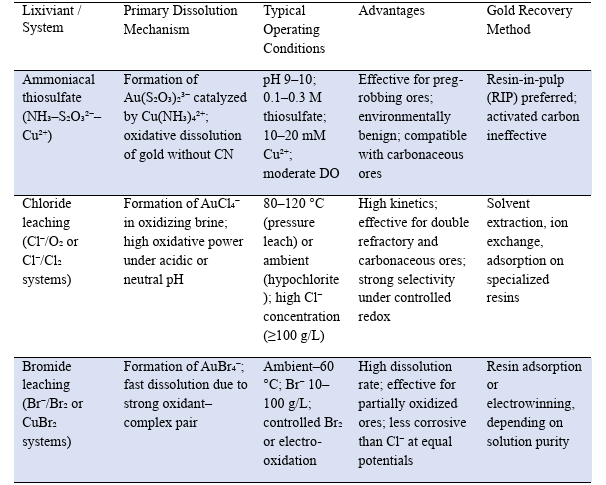
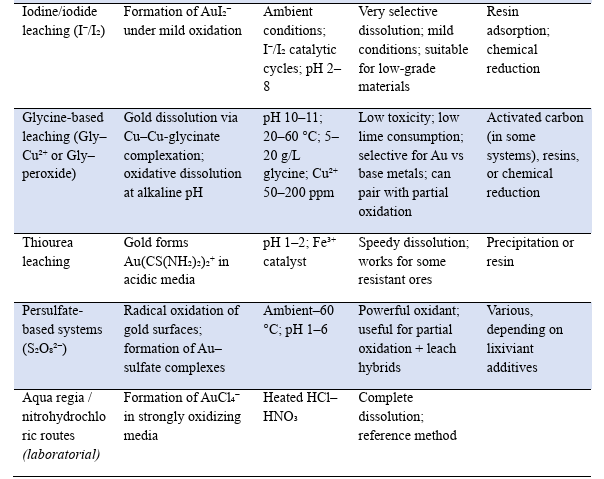
Although a wide range of lixiviants and recovery technologies are available, their performance remains limited by an incomplete understanding of the interactions between mineralogy, pretreatment outcomes, and solution chemistry. Cyanidation continues to dominate mainly because of its predictability, yet its limitations in refractory ores often reappear even after extensive pretreatment. Alternative lixiviants show promise but frequently depend on narrow operational windows, complex reagent regimes, or specialized adsorption systems that increase cost and complexity. Industrial-scale demonstrations are still scarce, and many laboratory studies overlook the effects of solution recycling, impurity buildup, and integration with residue-management strategies. A more thorough evaluation of leaching and recovery is needed to bridge the gap between experimental results and sustainable large-scale applications.
The next section explores the operational challenges that occur when scaling laboratory or pilot-scale results up to full-scale production environments.
7. Operational challenges
Operational challenges influence the real performance of refractory gold processing and often determine whether a flowsheet remains technically feasible under plant conditions. Double refractoriness, where sulfide encapsulation and carbonaceous preg-robbing coexist, exemplifies this complexity and requires coordinated strategies that address both limitations simultaneously (Afenya, 1991; Miller et al., 2005; Rees & Van Deventer, 2000). Even when pretreatment successfully oxidizes sulfides, persistent organic carbon or partially altered surfaces may continue to lower gold recovery by adsorbing dissolved species or changing leaching kinetics (Amanya et al., 2017; Ofori-Sarpong & Osseo-Asare, 2013). Balancing these interactions demands precise control of upstream stages and ongoing monitoring of mineralogical variability (Adams, 2016; Iglesias & Carranza, 1994).
Operational evidence also shows that organic fouling and catalytic degradation of activated carbon can considerably decrease adsorption efficiency under certain pulp chemistries (Mendoza et al., 2021).
Scale-up introduces additional constraints not always visible in laboratory studies. Biological pretreatment systems must maintain strict control of temperature, aeration, and residence time to ensure stable microbial activity; deviations can significantly reduce oxidation efficiency (de Carvalho et al., 2019; Mubarok et al., 2017; Muravyov, 2019). Pressure oxidation circuits must manage heat release, acidity, and gas–liquid equilibria while keeping uniform autoclave conditions despite fluctuations in ore composition (Espinoza-Martínez et al., 2025; Wang et al., 2025). Roasting technologies require mitigation of undesirable surface coatings and robust offgas treatment to handle volatile species such as arsenic and mercury (Thomas & Cole, 2005). Ultrafine grinding circuits often face challenges related to power consumption, wear, slurry rheology, and classification efficiency, which can affect oxidation behavior and leachability (Adams, 2016; Lin et al., 2023).
Water chemistry plays a decisive role in downstream stability. High concentrations of dissolved ions—including calcium, magnesium, chloride or sulfate—can interfere with leaching performance, adsorption efficiency and detoxification processes (Akcil, 2010; Adams, 2016). Cyanide management requires meticulous control to prevent volatilization and minimize the formation of weak-acid-dissociable complexes, supported by operational guidelines and international codes of practice (CyPlus GmbH, n.d.; International Cyanide Management Institute, 2002). Increasingly, online sensors and process-control systems for dissolved oxygen, oxidation–reduction potential and mineralogical characterization support operational stability, though their reliability and integration into plant control strategies remain critical (Adams, 2016).
Residue management adds a layer of complexity. Stabilizing arsenic-containing solids, sulfate-rich effluents, and fine slurries requires dedicated parallel systems and ongoing environmental supervision (IFC, 2007; Global Industry Standard on Tailings Management, 2020). Poor handling of residues or effluents can threaten environmental compliance and sustainability, even if metallurgical performance is high (Environmental Law Alliance Worldwide, 2010; Schoderer et al., 2020). Consequently, many operations assess challenges not just in gold recovery but also in water balance, reagent reuse, emissions, and long-term residue stability.
These operational constraints collectively influence equipment choices, reagent strategies, and flowsheet design. Understanding how these challenges interact helps engineers create systems that can handle ore variability while maintaining metallurgical efficiency and environmental standards.
Operational challenges remain one of the least standardized aspects of refractory gold processing. While many studies highlight technological advances, fewer recognize the inherent variability of ores, the unpredictability of scale-up, and the sensitivity of processing routes to water chemistry and environmental conditions. Experimental work often idealizes feed characteristics, ignoring fluctuations in sulfide content, carbon reactivity, or mineral liberation that can disrupt continuous operation. Additionally, residue management is often considered an afterthought, despite its potential to impose constraints more restrictively than the metallurgical steps themselves. A key insight shows that long-term success depends not only on metallurgical efficiency but also on a thorough integration of mineralogy, process control, sustainability, and plant-wide stability.
The following section emphasizes economic factors, examining how capital and operating costs influence decision-making and assessing the practical viability of each processing option.
8. Costs (CAPEX/OPEX) and performance indicators
Capital and operating costs significantly influence the choice and long-term viability of processing options for refractory gold ores. Each pretreatment technology has a unique cost structure driven by equipment complexity, energy requirements, reagent use, and environmental management considerations. Pressure oxidation generally requires high initial investments due to the need for autoclaves, oxygen plants, and extensive neutralization systems, with operating costs mainly linked to heating, oxygen supply, and acid production (Adams, 2016; Espinoza-Martínez et al., 2025). Biological pretreatment involves lower upfront costs but requires large reactors, aeration systems, and precise temperature control, which can raise operating expenses, especially when ore mineralogy or sulfide content varies (de Carvalho et al., 2019; Mubarok et al., 2017; Muravyov, 2019). Roasting technologies are moderately capital-intensive but incur operating costs for fuel and off-gas systems designed to control sulfur- and arsenic-emissions (Thomas & Cole, 2005).
Ultrafine grinding methods allocate their costs differently, focusing expenses on highenergy milling and mechanical wear. Although these flow sheets avoid the high-pressure vessels needed for pressure oxidation, the continuous power demand required to produce fine particles often becomes a key operating cost factor (Adams, 2016). Processes that use alternative lixiviants, such as thiosulfate or halides, shift costs toward specialized materials, corrosion-resistant equipment, and reagent-recycling systems; their economics depend on achieving selective dissolution while reducing reagent degradation or loss (Guo et al., 2020; Lin et al., 2023; Li et al., 2023).
To contextualize the economic contrasts among pretreatment technologies, Figure 5 provides a qualitative CAPEX/OPEX landscape positioning POX, roasting, bio-oxidation, ultrafine grinding, and alternative lixiviant systems along axes of capital intensity and operating cost.
These contrasts emphasize that economic feasibility depends not only on pretreatment efficiency but also on how capital structure, reagent demand, and energy consumption interact throughout the entire flowsheet.
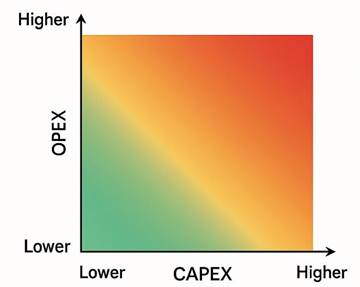
Figure 5. Qualitative CAPEX/OPEX landscape comparing major pretreatment technologies for refractory gold ores. Adams (2016); Thomas & Cole (2005); de Carvalho et al. (2019); EspinozaMartínez et al. (2025).
Cost behavior is heavily influenced by process integration. Choices in pretreatment directly affect neutralization loads, reagent consumption (both cyanide and non-cyanide), adsorption efficiency, and the complexity of residue stabilization. In many cases, water management, gas handling, and waste treatment become significant costs, especially in jurisdictions with strict environmental and social regulations (Akcil, 2010; IFC, 2007; Global Industry Standard on Tailings Management, 2020). Assessing a single unit operation alone can therefore hide the true financial impact of the entire flowsheet.
Robust economic evaluation depends on indicators that measure both metallurgical efficiency and sustainability. Energy use per ton of ore, reagent requirements, water consumption, and overall gold recovery provide a basis for comparing flowsheets under consistent conditions (Adams, 2016). Financial indicators such as cost per ounce of gold, operating margins, and capital intensity support strategic investment choices. Environmental metrics—including greenhouse-gas emissions, cyanide management, and water footprint—are increasingly incorporated into economic analyses because they impact permitting, social acceptance, and long-term compliance (Akcil, 2010; Responsible Jewellery Council, 2012; Schoderer et al., 2020).
Economic considerations ultimately decide which processing strategies stay viable as ore qualities change and regulatory demands grow. Understanding the financial landscape helps turn metallurgical innovations into real industrial solutions and ensures that processing methods remain strong despite technical and environmental uncertainties.
Economic assessments often overlook the full process context, leading to overly optimistic projections that ignore hidden costs in water treatment, residue stabilization, or emission controls. Many studies highlight improvements in gold recovery but do not quantify their economic trade-offs, such as increased energy demand, higher reagent consumption, or more complex environmental management. Variations in local infrastructure, energy prices, and regulatory frameworks further complicate comparisons between different routes and limit the transferability of cost models across regions. A critical view reveals that the viability of refractory gold processing depends not only on metallurgical efficiency but also on how well technological choices align with environmental obligations and ongoing financial performance.
The next section explores the nature of solid, liquid, and gaseous residues produced through these routes and discusses the environmental controls needed to maintain stable and responsible operation.
9. Tailings, Effluents, and Environmental Control
Residues, effluents, and gaseous emissions pose central challenges in the processing of refractory gold ores and often determine whether a flowsheet meets environmental and regulatory expectations. Solid wastes originating from pressure oxidation, roasting, biological pretreatment, and ultrafine grinding reflect the mineralogical transformations imposed during processing. Oxidative routes typically yield iron-rich residues containing hematite, jarosite or stabilized arsenic phases, while roasting produces calcines that may retain unreacted sulfides or volatile-element associations depending on temperature control (Thomas & Cole, 2005; Espinoza-Martínez et al., 2025). The geochemical stability of these solids depends on their mineral structures, residual acidity, and exposure to oxygen or water, making post-treatment characterization essential for predicting long-term behavior in storage or disposal facilities (Adams, 2016).
Liquid effluents generated in these processes vary significantly in acidity, sulfate concentration, dissolved metals, and residual reagents. Neutralization systems must remove acidity while also controlling the solubility of arsenic, antimony, and other minor elements released during oxidation stages (Adams, 2016; de Carvalho et al., 2019). In systems using alternative lixiviants, extra care is needed to manage ammonia, thiosulfate, halides, and organic complexants, as these can complicate treatment processes (Guo et al., 2020; Lin et al., 2023). Effective water-treatment strategies combine neutralization, solid–liquid separation, and, when necessary, advanced methods like ion exchange or reverse osmosis to help balance site water and minimize environmental discharge (IFC, 2007; Schoderer et al., 2020).
Gaseous emissions mainly originate from roasting, detoxification reactions, and accidental volatilization of cyanide species under poorly controlled pH conditions. Managing sulfur dioxide, nitrogen oxides, and halogen species relies on robust gas-scrubbing systems and continuous monitoring to keep emissions within acceptable limits (Thomas & Cole, 2005; Akcil, 2010). In roasting flowsheets, capturing sulfur dioxide and converting it into sulfuric acid can create value but requires additional infrastructure and operational oversight. Circuits handling chloride or bromide species must also address corrosion and worker exposure, as halogen volatilization increases under high-temperature or low-pH conditions (Adams, 2016).
Arsenic remains a critical component in environmental management for refractory gold operations. Converting arsenic into stable forms, such as scorodite or ferric arsenates, reduces its long-term mobility, but achieving consistent stability requires strict control of pH, redox conditions, iron availability, and temperature (Adams, 2016; de Carvalho et al., 2019). Improper treatment of arsenic residues can threaten tailings facility integrity and lead to regulatory violations, highlighting the importance of integrated environmental design aligned with international standards such as the Global Industry Standard on Tailings Management (2020). Besides technical challenges, broader environmental, social, and governance factors increasingly influence plant operations, affecting decisions about residue storage, closure planning, water recirculation, and emission reporting (Responsible Jewellery Council, 2012; Schoderer et al., 2020).
As environmental obligations tighten and stakeholder expectations increase, control strategies must evolve alongside metallurgical improvements to ensure that processing routes remain both compliant and sustainable.
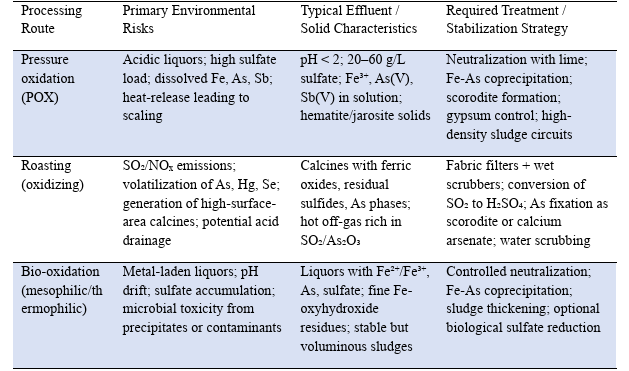
Environmental performance is a key aspect of refractory gold processing, especially for pretreatment methods that produce acidic liquors, sulfate-rich solutions, volatile substances, or complex residues containing arsenic and other metalloids. Since these risks span the entire process—from pretreatment to leaching, detoxification, and tailings disposal—a thorough understanding of the specific effluents and solid phases associated with each technology is crucial.
Table 4 offers a comparative overview of the main environmental risks, effluent characteristics, and stabilization needs for the primary processing routes discussed in this review.
Table 4. Environmental risks, effluent profiles and stabilization strategies associated with refractorygold processing routes. Adapted from: Marsden & House (2006); Adams (2016).
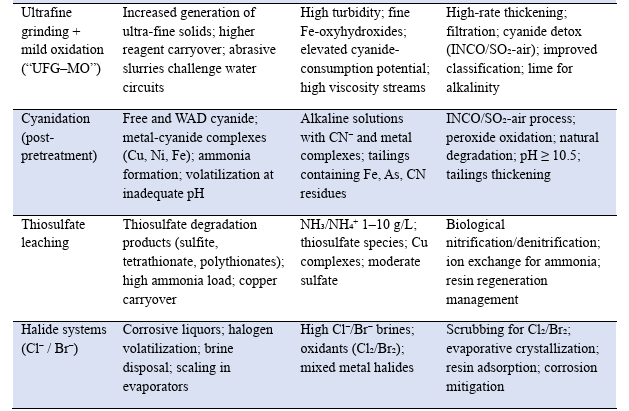
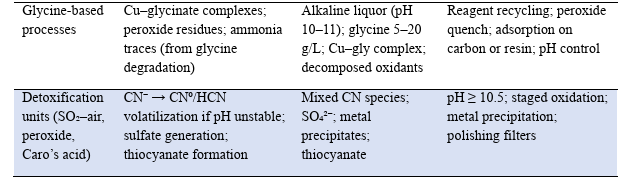
Environmental management remains one of the most overlooked Determinants of process viability in refractory gold operations. Studies often focus on metallurgical efficiency but neglect the complexities of stabilizing arsenic, managing high-sulfate effluents, or controlling volatile species under changing conditions. Many laboratory investigations create residues that appear stable in the short term but may deteriorate unfavorably when exposed to operational water chemistry or long-term weathering. Additionally, regulatory frameworks vary significantly across regions, forcing operations to adapt treatment strategies that may not always be directly applicable from published studies. A critical analysis shows that sustainable refractory gold processing requires integrated design approaches in which metallurgical choices, residue stability, and environmental safeguards are inseparably part of the overall system.
To complement the comparison of residues, effluents, and gas emissions discussed in this section, a multidimensional visualization is included to show how different pretreatment and leaching technologies distribute their environmental impacts across key categories. Since refractory gold processing involves diverse thermal, chemical, and biological steps, no single indicator can fully represent its environmental footprint. Therefore, a radar chart (Figure 6)combines six vital dimensions—air quality, water use, energy consumption, reagent use, greenhouse gas emissions, and land disturbance—providing a clear overview of the trade-offs associated with each method.
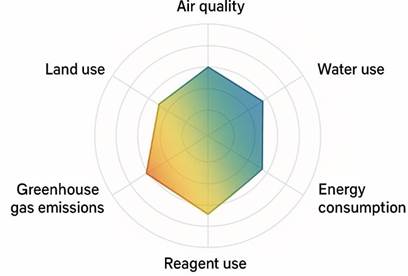
Figure 6. Environmental impact radar chart for major refractory-gold pretreatment and leaching routes. Adapted from Adams (2016); Komnitsas et al. (2020); Nazari et al. (2023).
The radar visualization shows that pressure oxidation and roasting mainly concentrate their environmental impacts on energy use, reagent consumption, and gaseous emissions. In contrast, biological oxidation spreads impact more evenly but needs larger reactor footprints and careful water management. Ultrafine grinding and mild-oxidation hybrids have relatively moderate environmental profiles, though they still require significant reagent use and slurry handling. Non-cyanide lixiviants (such as thiosulfate, halides, and glycine) offer potential benefits for air quality but often introduce secondary challenges like managing ammonia, halides, or organic ligands. Overall, visualization emphasizes that environmental performance depends heavily on the flowsheet, and improving sustainability requires integrated process design rather than isolated treatment steps.
The following section combines these technical, economic, and environmental insights into a decision-making framework that can identify appropriate processing methods for various refractory gold ore types.
10. Critical synthesis and decision matrix
Choosing the proper processing method for refractory gold ores involves considering mineralogy, carbon content, sulfur distribution, operational limits, and environmental regulations. Different ore types have unique mixes of sulfides, organic carbon, silicate gangue, and micro-scale gold enclaves, and no single technology suits all cases (Adams, 2016; Iglesias & Carranza, 1994). Pressure oxidation is most effective when arsenopyrite and pyrite are predominant and the operation can manage the high costs and downstream neutralization needs of autoclave systems (Espinoza-Martínez et al., 2025). Biological oxidation has lower capital costs and a slower oxidation rate, making it suitable when energy costs and environmental concerns outweigh processing speed (de Carvalho et al., 2019; Mubarok et al., 2017; Muravyov, 2019). Roasting remains a dependable method but demands stronger gas-cleaning systems and arsenic/sulfur stabilization, so it’s only feasible where proper off-gas handling and regulatory approval are in place (Thomas & Cole, 2005). Ultrafine grinding combined with mild oxidation offers a middle ground, providing better exposure of encapsulated gold without the high costs of autoclaves, while still enabling effective downstream leaching (Adams, 2016).
A scenario-based framework enables the evaluation of refractory gold ores based on mineralogical attributes and operational and environmental constraints that significantly affect flowsheet design. The five scenarios outlined in Table 5 incorporate sulfide content, carbon levels, arsenic concentrations, energy resources, and regulatory requirements to identify consistent pretreatment–leaching options. This structured approach helps lower uncertainty during early-stage engineering and aids in selecting practical metallurgical strategies for various ore types.
Table 5. Decision matrix for selecting pretreatment and leaching routes for refractory. Adapted from: Adams (2016); Habashi (2017); Marsden & House (2006); Komnitsas et al. (2020); Dai et al. (2021); Li & Miller (2022); Nazari et al. (2023); Guo et al. (2017); Canales et al. (2002)
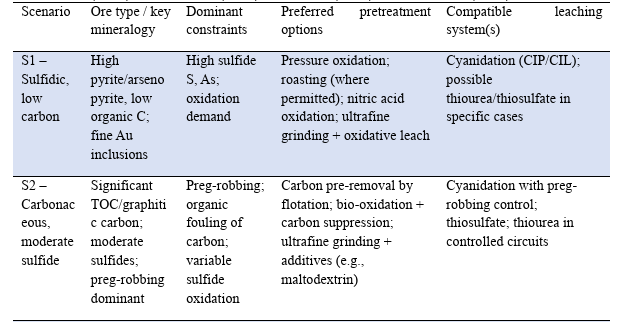
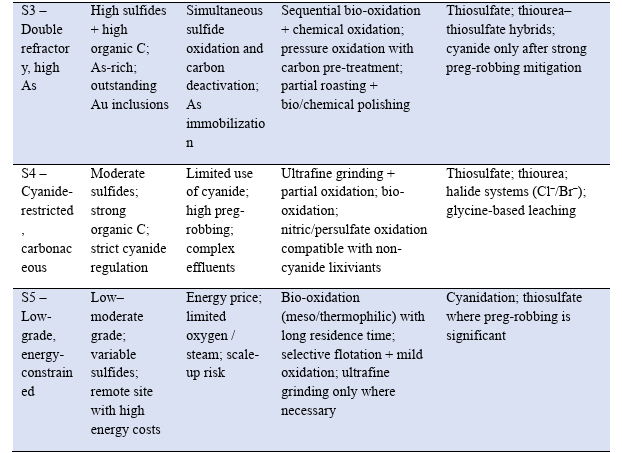
The scenario analysis emphasizes that no single pretreatment method can universally address the complexity of refractory and double refractory ores. Instead, selecting the most suitable processing route depends on the alignment of mineralogy, oxidation level, pregrobbing potential, and environmental requirements. Scenarios S1 and S3 mainly depend on oxidative pretreatments to handle sulfide and arsenic issues, while S2 and S4 focus on controlling preg-robbing and ensuring compatibility with non-cyanide lixiviants. Scenario S5 highlights the significance of energy supply and reagent logistics for remote or low-grade operations. Collectively, these scenarios offer a practical decision framework for matching ore properties with process capabilities, facilitating more coherent flowsheet development and techno-economic assessment.
Non-cyanide processes add further nuance, especially for ores with significant pregrobbing tendencies or where cyanide regulation limits traditional options. Thiosulfate systems provide pathways for carbonaceous or double refractory ores by preventing adsorption losses on organic matter (Guo et al., 2020; Ray et al., 2022). Halide-based methods, including chloride and bromide systems, facilitate selective gold dissolution under controlled redox conditions but need corrosion-resistant materials and strict control of volatiles (Wang et al., 2019). Glycine-based approaches support emerging sustainability goals, reduce lime consumption, and are compatible with partial oxidation (Cheng et al., 2013). The success of each process depends heavily on mineralogical characteristics, water chemistry, impurity profiles, and local access to reagents and energy. Consequently, processing decisions go beyond metallurgical recovery to include economic factors, safety considerations, and regional regulatory frameworks (Akcil, 2010; IFC, 2007; Responsible Jewellery Council, 2012).
Decision-making benefits from structured comparison tools that evaluate mineralogical complexity, oxidation levels, reagent use, environmental risks, and infrastructure readiness. A clear matrix can reduce options by connecting ore features with process abilities (Adams, 2016). Operations with high sulfide content but low carbon typically adopt oxidative pretreatments (Thomas & Cole, 2005), whereas double refractory ores require combined oxidation–carbon-suppression techniques to prevent preg-robbing losses (Afenya, 1991; Miller et al., 2005). Sites with limited energy supply but favorable environmental conditions might find biological or ultrafine-grinding hybrids effective (Mubarok et al., 2017). Conversely, locations with strict environmental regulations often focus on processes that produce stable residues and minimal gaseous emissions, even if capital costs are higher (Global Industry Standard on Tailings Management, 2020; Schoderer et al., 2020).
Viewed collectively, these considerations highlight the importance of aligning processing routes with both metallurgical objectives and long-term site stewardship. As technologies evolve, hybrid flowsheets and partial-oxidation strategies offer promising bridges between cost efficiency, regulatory compatibility, and improved gold liberation. Understanding these trade-offs creates a structured foundation for transitioning from conceptual evaluation to detailed engineering.
Figure 7 presents an integrated decision tree for selecting processing routes for refractory and double refractory gold ores. It consolidates mineralogical constraints, oxidation requirements, carbon behavior, water chemistry, and environmental considerations into a structured sequence of decision points. This framework helps narrow viable pretreatment and leaching options by linking ore characteristics to process capabilities and operational boundaries.
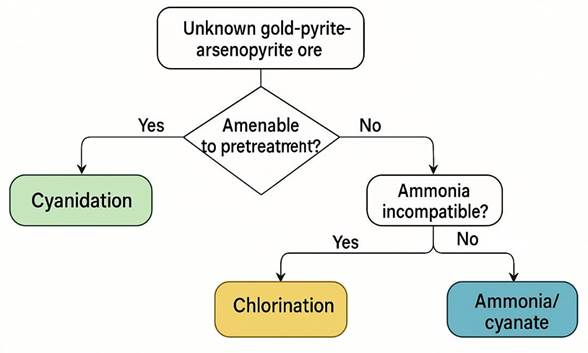
Figure 7. Hierarchical decision-tree illustrating how mineralogical constraints. Adapted from: Aftiainen et al. (2021); Barbouchi et al. (2024, 2025); Cole & Doll (1991); Iglesias & Carranza (1994); La Brooy et al. (1994); Marsden & House (2006); Adams (2016); Miller et al. (2005); Karthikeyan et al. (2015); Konadu et al. (2019, 2020); Hao et al. (2010); Wang et al. (2016); Rees & Van Deventer (2000); Ofori-Sarpong & Osseo-Asare (2013); Sasaki et al. (2024); Soto-Uribe et al. (2023).
A critical examination of current decision frameworks reveals a recurring limitation: most comparative analyses prioritize metallurgical performance but underweight environmental and socio-regulatory constraints that increasingly define project feasibility. Many published studies evaluate technologies in isolation without capturing how water chemistry, arsenic stabilization, energy pricing or reagent logistics reshape the feasibility envelope. Economic assessments often rely on simplified assumptions that obscure the sensitivity of capital and operating costs to site-specific variables such as altitude, water scarcity, and regional emission limits. Furthermore, the industry still lacks standardized metrics for comparing non-cyanide routes, which complicates cross-study evaluation and contributes to inconsistent reporting of reagent regeneration, effluent profiles, and long-term residue stability. A more rigorous, holistic approach is needed to align technological promise with the constraints and expectations of 2025 and beyond.
The synthesis developed here sets the stage for the conclusions that integrate technological advances, operational challenges and future research needs, offering a consolidated perspective on refractory gold processing.
11. Conclusions
Refractory gold processing has significantly advanced from 2020 to 2025, driven by deeper mineralogical understanding, stricter environmental standards, and the development of new lixiviants and pretreatment methods. Current knowledge indicates that gold liberation depends not only on breaking sulfide structures but also on reducing interactions with carbonaceous materials and controlling the chemistry of oxidation products, which influence leaching rates. Modern diagnostic tools now offer high-resolution analysis of mineral associations and gold occurrence, enabling more accurate flowsheet design and decreasing uncertainty during scale-up.
Technological progress has expanded the processing options beyond the long-standing dominance of pressure oxidation and roasting. Combined methods that include partial oxidation, advanced biological systems, ultrafine grinding with controlled activation, and increasingly effective non-cyanide lixiviants enable operations to balance better metallurgical performance, energy consumption, and environmental concerns. Meanwhile, issues such as residue stability, water management, and arsenic immobilization have become central to the viability of flowsheets rather than afterthoughts.
Future developments will rely on strengthening the links between mineralogy, reaction chemistry, energy efficiency, and environmental governance. Better predictive models that connect mineralogical features to pretreatment kinetics, along with reliable datasets for technoeconomic comparison across different ore types, will help turn laboratory innovations into industrial applications. Progress in instrumentation and process control will also be crucial for managing heat release in biological systems, preventing passivation during pressure oxidation, and maintaining reagent speciation in alternative lixiviant circuits.
Despite progress, the field still faces a fragmented knowledge base: inconsistent reporting of operating parameters, limited long-term assessments of residue stability, and a lack of transparent industrial case studies for emerging technologies. Non-cyanide routes, although promising, continue to encounter challenges related to reagent regeneration, selectivity, and effluent treatment—factors often underrepresented in academic studies. Techno-economic assessments also tend to overlook indirect costs, such as water scarcity, carbon pricing, and regulatory compliance, which significantly affect project feasibility. Addressing these gaps will require standardized testing protocols, more comprehensive reporting, and integrated environmental–economic evaluation frameworks.
References
Adams, M. D. (2016). Gold ore processing: Project development and operations (2nd ed.). Elsevier. https://www.sciencedirect.com/book/9780444636584/gold–ore–processing
Afenya, P. M. (1991). Treatment of carbonaceous refractory gold ores. Minerals Engineering, 4(7–11), 1043–1055. https://doi.org/10.1016/0892-6875(91)90216-T
Ahtiainen, R., Liipo, J., & Lundström, M. (2021). Simultaneous sulfide oxidation and gold dissolution by cyanide-free leaching from refractory and double refractory gold concentrates. Minerals Engineering, 175, 107042. https://doi.org/10.1016/j.mineng.2021.107042
Akcil, A. (2010). A review of the International Cyanide Management Code and its effect on cyanide use in the gold mining industry. Mineral Processing and Extractive Metallurgy Review, 31(3), 135–149. https://doi.org/10.1080/08827501003727022
Amanya, F., Ofori-Sarpong, G., Anni, V., & Amankwah, R. K. (2017). Preg-robbing of gold by carbonaceous materials encountered in gold processing. Ghana Mining Journal, 17(2), 50– 57.
Azizitorghabeh, A., et al. (2021). Thiocyanate leaching of gold from a refractory carbonaceous ore. Journal of Mining and Environment, 12(3), 643–656. https://doi.org/10.22044/jme.2020.10129.1903
Barbouchi, A., Louarrat, M., Mikali, M., & Benzakour, J. (2024). Advancements in improving gold recovery from refractory gold ores/concentrates: A review. Canadian
Metallurgical Quarterly, 63(4), 2370–2387. https://doi.org/10.1080/00084433.2024.2441548
Barbouchi, A., Louarrat, A., Hissane, A., et al. (2025). Highly efficient pretreatment for refractory gold ores using persulfate under acidic conditions: Kinetics and mechanism. Hydrometallurgy, 235, 106488. https://doi.org/10.1016/j.hydromet.2025.106488
Breed, A. P. (2000). Bacterial leaching of refractory gold ores (Doctoral thesis). University of Cape Town. https://open.uct.ac.za/
Cai, J., Wang, H., & Li, Q. (2009). Kinetics of high-sulphur and high-arsenic refractory gold concentrate oxidation by dilute nitric acid. Minerals Engineering, 22(2), 111–115. https://doi.org/10.1016/j.mineng.2008.05.001
Canales, C., et al. (2002). Continuous bio-oxidation of a refractory gold concentrate in a multistage stirred reactor system. Process Biochemistry, 37(9), 937–944.
Carson, C., et al. (2021). Significance of acid washing after bio-oxidation of sulfides in double refractory gold ores. Minerals, 11(12), 1316. https://doi.org/10.3390/min11121316 Cheng, Y., et al. (2013). Fast and effective gold leaching from a desulfurized gold concentrate using glycine. Industrial & Engineering Chemistry Research, 52(51), 18231–18238. https://doi.org/10.1021/ie4026852
Cole, A. P., & Doll, A. A. (1991). Processing of refractory gold ores. Minerals Engineering, 4(7–11), 1029–1041. https://doi.org/10.1016/0892-6875(91)90081-6
Costa, F. R., et al. (2020). Effective density concentration in refractory gold ore for process optimization. REM – International Engineering Journal, 73(3). https://doi.org/10.1080/25726641.2019.1658915
CyPlus GmbH. (n.d.). International Cyanide Management Code (ICMC). https://www.cyplus.com/content/Responsible-Care/ICMC.phpde Carvalho, L. C., da Silva, S. R., Giardini, R. M. N., de Souza, L. F. C., & Leão, V. A. (2019). Bio-oxidation of refractory gold ores containing stibnite and gudmundite.
Environmental Technology & Innovation, 15, 100390. https://doi.org/10.1016/j.eti.2019.100390
Environmental Law Alliance Worldwide. (2010). Guidebook for evaluating mining project EIAs. https://elaw.org/
Espinoza-Martínez, A. M., et al. (2025). Gold and silver recovery from a refractory pyritic concentrate by roasting and alkaline pressure oxidation. Minerals, 15(12), 1260. https://doi.org/10.3390/min15121260
Fraser, K. S., Cole, A. P., & Doll, A. A. (1991). Processing of refractory gold ores. Minerals Engineering, 4, 1029–1041. https://doi.org/10.1016/0892-6875(91)90081-6
Global Industry Standard on Tailings Management (GISTM). (2020). Global Tailings Review. https://globaltailingsreview.org/
Guo, X., et al. (2020). Stepwise extraction of gold from refractory concentrate by thiourea. Hydrometallurgy, 194, 105311. https://doi.org/10.1016/j.hydromet.2020.105311
Guo, Y., et al. (2017). Novel bio-oxidation and two-step thiourea leaching applied to refractory concentrate. Hydrometallurgy, 171, 1–7. https://doi.org/10.1016/j.hydromet.2017.05.023
Hao, Z., et al. (2010). Characterization of acidophilic bacterial consortia for bio-oxidation of refractory arsenopyritic gold ore. Hydrometallurgy, 104(2), 210–218. https://doi.org/10.1016/j.hydromet.2010.06.006
IFC. (2007). Environmental, Health and Safety Guidelines for Mining. World Bank Group. https://openknowledge.worldbank.org/
Iglesias, N., & Carranza, F. (1994). Refractory gold-bearing ores: Review of treatment methods. Hydrometallurgy, 34, 1–15. https://doi.org/10.1016/0304-386X(94)90074-4
International Cyanide Management Institute (ICMI). (2002). International Cyanide Management Code. https://cyanidecode.org/
International Finance Corporation. (2007). General Environmental, Health, and Safety Guidelines. https://www.ifc.org/
International Institute for Sustainable Development. (2023). IGF Mining Policy Framework – Guidance for Governments. https://www.iisd.org/
Jin, J., He, F., Han, Y., & Sun, Y. (2022). Strengthening gold extraction from carbonaceous ore by two-stage fluidized oxidation roasting. Minerals, 12(12), 1620. https://doi.org/10.3390/min12121620
Karthikeyan, O. P., Rajasekar, A., & Balasubramanian, R. (2015). Bio-oxidation and biocyanidation of refractory mineral ores for gold extraction: A review. Critical Reviews in Environmental Science and Technology, 45(15), 1611–1643. https://doi.org/10.1080/10643389.2014.966423
Konadu, K. T. (2019). Sequential pretreatment of double refractory gold ore with thermophilic iron-oxidizing archaeon and fungal enzymes (Doctoral thesis). Kyushu University. https://doi.org/10.15017/2534420
Konadu, K. T., et al. (2019). Sequential pretreatment of double refractory gold ore with archaeal and fungal biocatalysts. Minerals Engineering, 138, 86–94. https://doi.org/10.1016/j.mineng.2019.04.043
Konadu, K. T., et al. (2020). Biological pretreatment of carbonaceous matter in double refractory gold ores. Hydrometallurgy, 196, 105434. https://doi.org/10.1016/j.hydromet.2020.105434
La Brooy, S. R., Linge, H. G., & Walker, G. S. (1994). Review of gold extraction from ores. Minerals Engineering, 7(10), 1213–1241. https://doi.org/10.1016/0892-6875(94)90114-7
Lee, S., Gibson, C. E., & Ghahreman, A. (2021). Flotation of carbonaceous matter from double refractory ore. Minerals, 11(9), 1021. https://doi.org/10.3390/min11091021
Lee, S., Gibson, C. E., & Ghahreman, A. (2021). Separation of carbonaceous matter via multistage flotation. Minerals, 11(12), 1430. https://doi.org/10.3390/min11121430
Lemos, J., et al. (2025). Pressurized oxidation of a Brazilian refractory gold ore. REM – International Engineering Journal. (Acesso SciELO)
Li, D., et al. (2023). Ultrasound-enhanced thiocyanate leaching of refractory gold. Minerals, 13(4), 513. https://doi.org/10.3390/min13040513
Li, H., et al. (2022). Pore evolution in refractory gold ore formed by oxidation. ACS Omega, 7, 4472–4485. https://doi.org/10.1021/acsomega.1c06248
Li, K., et al. (2023). Improved thiourea leaching of gold using additives. Hydrometallurgy, 223, 106204. https://doi.org/10.1016/j.hydromet.2023.106204
Lin, Y., et al. (2023). Synergistic thiourea–thiosulfate leaching of gold. Separation and Purification Technology, 327, 124928. https://doi.org/10.1016/j.seppur.2023.124928
Liu, Q., Yang, H., Tong, L., Jin, Z., & Sand, W. (2016). Fungal degradation of carbon in carbonaceous gold ore. Hydrometallurgy, 160, 90–97. https://doi.org/10.1016/j.hydromet.2015.12.013
Marsden, J., & House, C. I. (2006). The chemistry of gold extraction (2nd ed.). SME.
Mendoza, D. M., Ichinose, H., Konadu, K. T., & Sasaki, K. (2021). Degradation of powdered activated carbon to improve gold recovery. Journal of Environmental Chemical Engineering, 9(2), 106375. https://doi.org/10.1016/j.jece.2020.106375
Miller, J. D., Wan, R. Y., & Díaz, X. (2005). Preg-robbing gold ores. In M. D. Adams (Ed.), Advances in gold ore processing (pp. 937–972). Elsevier.
Mizouho Bank. (2013). Environmental & social checklist: Mining. https://www.banktrack.org
Mubarok, M. Z., Winarko, R., Chaerun, S. K., Rizki, I. N., & Ichlas, Z. T. (2017). Improving bio-oxidation of refractory ores. Hydrometallurgy, 168, 69–75. https://doi.org/10.1016/j.hydromet.2016.10.018
Muravyov, M. (2019). Two-step processing of refractory sulfidic concentrates via biooxidation. Chemical Papers, 73(1), 173–183. https://doi.org/10.1007/s11696-018-0562-z Newmont Corporation. (2023). Cyanide management. https://s204.q4cdn.com/
Ofori-Sarpong, G., & Osseo-Asare, K. (2013). Preg-robbing from cyanide and non-cyanide complexes. International Journal of Mineral Processing, 119, 27–33. https://doi.org/10.1016/j.minpro.2012.12.007
Ospina-Correa, J. D., Nava, F., Castillo, J., & Lapidus, G. (2018). Process mineralogy of multi-to-refractory gold in thiosulfate leaching. Hydrometallurgy, 182, 104–117.
Pereira, A. C., Gomes, M. R. S., & Manfridini, A. P. A. (2025). Exploratory tests for leaching gold associated with limonitic ore. In D. C. Catapan (Ed.), Environmental science fundamentals (pp. 112–126). Brazilian Journals Editora. https://doi.org/10.35587/brj.ed.97865-6016-096-5_6
Pereira, A. C., & Barbosa, V. D. S. B. (2017). Effectiveness acidic pre-cleaning for coppergold ore. REM-International Engineering Journal, 70(4), 445-450.
Pereira, A. C., dos Santos Gomes, M. R., & de Andrade Manfridini, A. P. (2019). Ensaios exploratórios de lixiviação para ouro associado a minérios limoníticos. Brazilian Applied Science Review, 3(2), 1010-1022.
Pereira, A. C., Heck, N. B., & Gomes, M. R. dos S. (2016). Leaching diagnostic application in support research of mineral copper transition ore. Tecnologia em metalurgia, materiais e mineracao, 13(3), p. 242–247.
Qin, H., et al. (2021). Effect of pyrite on thiourea stability in gold leaching. International Journal of Minerals, Metallurgy and Materials, 28(10), 1685–1697. https://doi.org/10.1007/s12613-020-2142-9
Ray, D. A., et al. (2022). Thiourea leaching from refractory sources. Journal of Sustainable Metallurgy, 8, 597–612. https://doi.org/10.1007/s40831-022-00544-0
Rees, K. L., & Van Deventer, J. S. J. (2000). Preg-robbing phenomena in cyanidation. Hydrometallurgy, 58, 61–80. https://doi.org/10.1016/S0304-386X(00)00131-6
Responsible Jewellery Council (RJC). (2012). Standard Guidance—Cyanide (COP 38). https://www.responsiblejewellery.com/
Sasaki, K., Suyama, I., Takimoto, R., & Konadu, K. T. (2024). Gold recovery from double refractory ores by thiourea after bio-oxidation. In Proceedings of COM 2024 (pp. 1005– 1007). https://doi.org/10.1007/978-3-031-67398-6_166
Schoderer, M., et al. (2020). Water policy and mining governance. Environmental Science & Policy, 112, 154–163. https://doi.org/10.1016/j.envsci.2020.06.017
Soto-Uribe, I. C., et al. (2023). Optimization of flotation and pre-oxidation for complex refractory ore. Minerals, 13(1), 116. https://doi.org/10.3390/min13010116
Soltani, F., Darabi, H., Badri, R., & Piroz, Z. (2014). Improved recovery of low-grade refractory gold via flotation–preoxidation–cyanidation. International Journal of Mining Science and Technology, 24(4), 537–542. https://doi.org/10.1016/j.ijmst.2014.05.018 Takimoto, R., et al. (2025). Bio-oxidation of double refractory gold ores by mixed cultures. Journal of Sustainable Metallurgy. https://doi.org/10.1007/s40831-025-01170-8
Thomas, K. G., & Cole, A. P. (2005). Roasting developments for refractory ores. In M. D. Adams (Ed.), Advances in gold ore processing (pp. 403–432). Elsevier.
Urquizo Valdívia, V. A. (2003). Lixiviação bacteriana de minérios de ouro refratário (Doctoral thesis). Universidade de São Paulo. https://doi.org/10.11606/T.3.2003.tde27062024-095436
Valdivieso-Bermeo, P., et al. (2020). Treatment of carbonaceous gold ores using maltodextrin. REM – International Engineering Journal, 73(4). https://www.redalyc.org/
Wang, G., et al. (2016). Two-step oxidation of refractory gold with microbial communities. Journal of Microbiology and Biotechnology, 26(11), 1871–1880. https://doi.org/10.4014/jmb.1511.11031
Wang, Q., Hu, X., Zi, F., Qin, X., Nie, Y., & Zhang, Y. (2019). Bromate–FeCl₃ extraction of gold from refractory ore. Minerals Engineering, 136, 89–98. https://doi.org/10.1016/j.mineng.2019.02.037
Wang, S., et al. (2025). Pretreatment and extraction from refractory ore in acidic conditions. Minerals, 15(4), 340. https://doi.org/10.3390/min15040340
Wu, C., et al. (2018). Bio-oxidation and simultaneous gold extraction from low-grade refractory ore. Biochemical Engineering Journal, 133, 89–97.
Zhao, H., Xu, B., Li, X., Jiang, T., & Yang, Y. (2020). Bio-oxidation–thiosulfate leaching of refractory concentrate. International Journal of Minerals, Metallurgy and Materials, 27(4), 461–471. https://doi.org/10.1007/s12613-020-1962-0
1Ph.D. in Chemical Engineering, Federal University of Ouro Preto (UFOP) – Department of
Graduate Program in Materials Engineering, Ouro Preto, MG, Brazil
E-mail: claretipereira@gmail.com
ORCID: https://orcid.org/0000-0001-8115-4279