
REGISTRO DOI: 10.69849/revistaft/dt10202511181833
Karina Ferreira Vicente Costa
Abstract
The development of healthy school environments increasingly relies on empathetic and collaborative leadership, with pedagogical coordinators playing a central role in fostering emotional well-being, trust, and inclusion among all school actors. This study discusses humanized pedagogical leadership as a transformative approach that integrates emotional intelligence, empathy, and mediation skills into school management. Drawing on recent literature, it emphasizes how coordinators who engage in reflective dialogue, nonviolent communication, and collaborative decision-making contribute to effective conflict resolution, teacher motivation, and a stronger sense of belonging. Furthermore, empathetic coordination enhances the psychosocial climate, reduces burnout, and supports professional growth across educational contexts. By highlighting the coordinator’s function as a relational leader capable of building trust and collective purpose, the paper underscores the importance of humanized leadership as a foundation for sustained educational well-being and institutional resilience.
Keywords: Humanized leadership; pedagogical coordination; empathy; emotional intelligence; collaborative school climate; well-being.
The quest to develop healthy school environments increasingly depends on a form of leadership rooted in empathy and collaboration, where pedagogical coordinators play a pivotal role in mediating relationships and fostering well-being among teachers, students, and families. Contemporary educational leadership models argue that beyond technical skills, successful coordinators must possess the ability to create bonds, understand the emotional dynamics of their teams, and guide them toward collective objectives built on trust and inclusion.
Pedagogical coordination transcends administrative management; it is an active, ongoing process of relationship-building and mediation. Empathetic leadership allows coordinators to recognize individual and group needs, acting not only as supervisors but as facilitators of dialogue and emotional health. Research by Franco and Warde (2019) highlights that coordinators who prioritize empathy and collaborative practices tend to engender a participative climate and enhance teacher engagement, which, in turn, benefits student motivation and achievement. This approach acknowledges the school as a complex social ecosystem, where emotional intelligence and communication skills are as critical as curricular planning.
Empathy-driven coordination significantly improves conflict mediation, a recurring challenge in multidisciplinary teams. The literature shows that leaders with strong human relations competencies are more adept at reconciling divergent viewpoints, transforming tensions into opportunities for growth rather than sources of alienation. Lima (2021) discusses how constructive mediation promotes a sense of belonging and safety, encouraging teachers and students to actively participate in school life. In practical terms, empathetic coordinators regularly organize reflective spaces, employ nonviolent communication techniques, and support continuous professional development, emphasizing collective rather than authoritative decision-making.
Collaboration is another cornerstone of humanized leadership. Coordinators facilitate partnerships among teachers, students, and families, removing barriers to participation and fostering transparent, inclusive exchanges. Studies by Bolivar and Domingo (2016) found that schools with collaborative climates report higher levels of satisfaction, lower turnover among educators, and improved academic and psychosocial outcomes for students. Teamwork is promoted through shared goals, peer mentoring, and structured dialogue that values diverse voices and backgrounds.
The school climate reflects the coordinators’ ability to nurture trust and respect throughout the institution. Empirical research affirms that environments marked by psychological safety are less susceptible to chronic stress and burnout, problems that undermine motivation and learning. A healthy climate motivates all actors to contribute their strengths, engage in innovation, and respond resiliently to challenges. As Adair and Oliveira (2022) point out, the coordinator’s empathetic presence acts as a stabilizing force during periods of change or crisis, giving coherence and direction to the collective efforts of multidisciplinary teams.
The flowchart illustrates the process of humanized pedagogical leadership in creating healthy school environments. It begins with recognizing the need for emotional and social well-being in schools, followed by core principles of empathy and collaboration. The pedagogical coordinator plays a crucial role beyond administrative tasks, facilitating dialogue and emotional support. Key activities include organizing reflective spaces, using nonviolent communication, mediating conflicts, and promoting inclusiveness. These efforts lead to outcomes such as increased teacher motivation, improved school climate, conflict reduction, and better student achievement. Ultimately, this leadership fosters positive values, emotional well-being, and resilient, inclusive school communities, resulting in sustainable educational progress.
Figure 1. Flowchart of Humanized Pedagogical Leadership in Building Healthy School Environments.
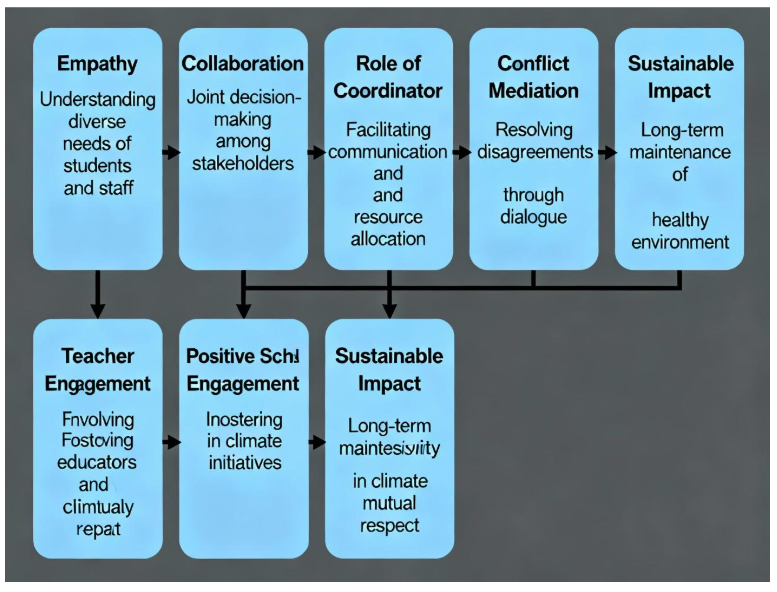
Ultimately, pedagogical leadership that centers on empathy and collaboration not only improves immediate relationships in the school setting but also contributes to the long-term development of positive values, emotional well-being, and social capital. The coordinator, as a humanized leader, embodies the guiding principles needed for schools to thrive as inclusive, healthy communities. By prioritizing well-being and motivation among teachers, students, and families, humanized pedagogical leadership lays the foundation for meaningful and sustainable educational progress.
References
Franco, M. A. F., & Warde, M. J. (2019). “Empathy in the context of pedagogical coordination: Practices and experiences in healthy school leadership.” Revista Brasileira de Educação, 24.
Lima, L. C. (2021). “Conflict mediation and emotional health in schools: the role of the pedagogical coordinator.” Educação em Debate, 13(2), 103-120.
Bolivar, A., & Domingo, J. (2016). “Collaborative climates in educational leadership: Impact on teacher satisfaction and student outcomes.” School Leadership & Management, 36(2), 147-163.
Adair, J. & Oliveira, P. L. (2022). “Humanized pedagogical leadership: challenges and possibilities for school teams.” Educação & Sociedade, 43(1), 1-17.
SANTOS,Hugo;PESSOA,EliomarGotardi.Impactsofdigitalizationontheefficiencyandqualityofpublicservices:Acomprehensiveanalysis.LUMENETVIRTUS,[S.l.],v.15,n.40,p.44094414,2024.DOI:10.56238/levv15n40024.Disponívelem:https://periodicos.newsciencepubl.com/LEV/article/view/452.Acessoem:25jan.2025.
Freitas,G.B.,Rabelo,E.M.,&Pessoa,E.G.(2023).Projetomodularcomreaproveitamentodecontainermaritimo.BrazilianJournalofDevelopment,9(10),28303–28339.https://doi.org/10.34117/bjdv9n10057
Freitas,G.B.,Rabelo,E.M.,&Pessoa,E.G.(2023).Projetomodularcomreaproveitamentodecontainermaritimo.BrazilianJournalofDevelopment,9(10),28303–28339.https://doi.org/10.34117/bjdv9n10057
Pessoa,E.G.,Feitosa,L.M.,ePadua,V.P.,&Pereira,A.G.(2023).EstudodosrecalquesprimáriosemumaterroexecutadosobreaargilamoledoSarapuí.BrazilianJournalofDevelopment,9(10),28352–28375.https://doi.org/10.34117/bjdv9n10059
PESSOA,E.G.;FEITOSA,L.M.;PEREIRA,A.G.;EPADUA,V.P.Efeitosdeespéciesdealnaeficiênciadecoagulação,Alresidualepropriedadedosflocosnotratamentodeáguassuperficiais.BrazilianJournalofHealthReview,[S.l.],v.6,n.5,p.2481424826,2023.DOI:10.34119/bjhrv6n5523.Disponívelem:https://ojs.brazilianjournals.com.br/ojs/index.php/BJHR/article/view/63890.Acessoem:25jan.2025.
SANTOS,Hugo;PESSOA,EliomarGotardi.Impactsofdigitalizationontheefficiencyandqualityofpublicservices:Acomprehensiveanalysis.LUMENETVIRTUS,[S.l.],v.15,n.40,p.44094414,2024.DOI:10.56238/levv15n40024.Disponívelem:https://periodicos.newsciencepubl.com/LEV/article/view/452.Acessoem:25jan.2025.
Filho, W. L. R. (2025). The Role of Zero Trust Architecture in Modern Cybersecurity: Integration with IAM and Emerging Technologies. Brazilian Journal of Development, 11(1), e76836. https://doi.org/10.34117/bjdv11n1-060
Oliveira, C. E. C. de. (2025). Gentrification, urban revitalization, and social equity: challenges and solutions. Brazilian Journal of Development, 11(2), e77293. https://doi.org/10.34117/bjdv11n2-010
Pessoa, E. G. (2024). Pavimentos permeáveis uma solução sustentável. Revista Sistemática, 14(3), 594–599. https://doi.org/10.56238/rcsv14n3-012
Filho, W. L. R. (2025). THE ROLE OF AI IN ENHANCING IDENTITY AND ACCESS MANAGEMENT SYSTEMS. International Seven Journal of Multidisciplinary, 1(2). https://doi.org/10.56238/isevmjv1n2-011
Antonio, S. L. (2025). Technological innovations and geomechanical challenges in Midland Basin Drilling. Brazilian Journal of Development, 11(3), e78097. https://doi.org/10.34117/bjdv11n3-005
Pessoa, E. G. (2024). Pavimentos permeáveis uma solução sustentável. Revista Sistemática, 14(3), 594–599. https://doi.org/10.56238/rcsv14n3-012
Pessoa, E. G. (2024). Pavimentos permeáveis uma solução sustentável. Revista Sistemática, 14(3), 594–599. https://doi.org/10.56238/rcsv14n3-012
Eliomar Gotardi Pessoa, & Coautora: Glaucia Brandão Freitas. (2022). ANÁLISE DE CUSTO DE PAVIMENTOS PERMEÁVEIS EM BLOCO DE CONCRETO UTILIZANDO BIM (BUILDING INFORMATION MODELING). Revistaft, 26(111), 86. https://doi.org/10.5281/zenodo.10022486
Eliomar Gotardi Pessoa, Gabriel Seixas Pinto Azevedo Benittez, Nathalia Pizzol de Oliveira, & Vitor Borges Ferreira Leite. (2022). ANÁLISE COMPARATIVA ENTRE RESULTADOS EXPERIMENTAIS E TEÓRICOS DE UMA ESTACA COM CARGA HORIZONTAL APLICADA NO TOPO. Revistaft, 27(119), 67. https://doi.org/10.5281/zenodo.7626667
Eliomar Gotardi Pessoa, & Coautora: Glaucia Brandão Freitas. (2022). ANÁLISE COMPARATIVA ENTRE RESULTADOS TEÓRICOS DA DEFLEXÃO DE UMA LAJE PLANA COM CARGA DISTRIBUÍDA PELO MÉTODO DE EQUAÇÃO DE DIFERENCIAL DE LAGRANGE POR SÉRIE DE FOURIER DUPLA E MODELAGEM NUMÉRICA PELO SOFTWARE SAP2000. Revistaft, 26(111), 43. https://doi.org/10.5281/zenodo.10019943
Pessoa, E. G. (2025). Optimizing helical pile foundations: a comprehensive study on displaced soil volume and group behavior. Brazilian Journal of Development, 11(4), e79278. https://doi.org/10.34117/bjdv11n4-047
Pessoa, E. G. (2025). Utilizing recycled construction and demolition waste in permeable pavements for sustainable urban infrastructure. Brazilian Journal of Development, 11(4), e79277. https://doi.org/10.34117/bjdv11n4-046
Testoni, F. O. (2025). Niche accounting firms and the brazilian immigrant community in the U.S.: a study of cultural specialization and inclusive growth. Brazilian Journal of Development, 11(5), e79627. https://doi.org/10.34117/bjdv11n5-034
Silva, J. F. (2025). Desafios e barreiras jurídicas para o acesso à inclusão de crianças autistas em ambientes educacionais e comerciais. Brazilian Journal of Development, 11(5), e79489. https://doi.org/10.34117/bjdv11n5-011
Silva, E. N. da. (2025). Urban circular microfactories: local micro-plants for regenerative urban economies. Brazilian Journal of Development, 11(9), e82335. https://doi.org/10.34117/bjdv11n9-059
DA SILVA, Eduardo Nunes. GREEN NANOTECHNOLOGY APPLIED TO CIRCULAR MANUFACTURING. LUMEN ET VIRTUS, [S. l.], v. 14, n. 32, 2024. DOI: 10.56238/levv14n32-029. Disponível em: https://periodicos.newsciencepubl.com/LEV/article/view/AEW09. Acesso em: 4 nov. 2025.
Recycling of Rare Earth Elements Using Ionic Liquids for Regenerative Manufacturing. (2023). International Seven Journal of Multidisciplinary, 2(5). https://doi.org/10.56238/isevmjv2n5-037