
REGISTRO DOI: 10.69849/revistaft/ar10202508251142
Camilla Ventura
Abstract
The COVID-19 pandemic has spurred an unprecedented scientific effort resulting in the rapid development of effective vaccines. Central to this achievement is the crucial role of chemistry in every stage of vaccine creation, from the synthesis of antigens and adjuvants to formulation, delivery, and quality control. Advances in synthetic chemistry, molecular design, and chemical engineering enabled the development of mRNA vaccines, lipid nanoparticle delivery systems, traditional inactivated and subunit vaccines, as well as novel adjuvants. Furthermore, analytical chemistry ensured vaccine purity and consistency, while polymer chemistry offers promising future delivery platforms. The continuous adaptation of vaccines to emerging viral variants also relies heavily on chemical biology and structure-guided design. This article highlights how chemistry has been indispensable to the swift and effective response to COVID-19, underscoring the need for ongoing chemical research to address current and future public health challenges.
Keywords: COVID-19 vaccines, chemistry, mRNA vaccines, lipid nanoparticles, vaccine adjuvants.
The COVID-19 pandemic has prompted an unprecedented global scientific effort, culminating in the rapid development of vaccines that have saved millions of lives. At the heart of this achievement lies the foundational role of chemistry, which has proven indispensable in every stage of vaccine development—from the synthesis of antigens and adjuvants to the formulation and stabilization of final vaccine products. Chemistry has enabled scientists to design and deliver highly specific and effective immunological tools against SARS-CoV-2, the virus responsible for COVID-19, by harnessing advances in molecular design, synthetic chemistry, bioconjugation, and materials science.
A key breakthrough in COVID-19 vaccine technology was the development of mRNA vaccines, such as those produced by Pfizer-BioNTech (BNT162b2) and Moderna (mRNA-1273). These vaccines rely on chemically synthesized strands of messenger RNA encoding the viral spike protein, which is crucial for virus entry into human cells. The mRNA itself is unstable and highly susceptible to enzymatic degradation, requiring chemical modifications to enhance stability and translation efficiency. Notably, nucleoside modifications such as the replacement of uridine with N1-methyl-pseudouridine were essential for reducing innate immune responses and enhancing protein production in host cells (Karikó et al., 2005). This innovation highlights the application of organic and bioorganic chemistry to optimize the molecular properties of vaccine components.
In addition to the mRNA, the lipid nanoparticles (LNPs) that encapsulate and deliver these molecules represent another triumph of chemical engineering. These LNPs are composed of precisely formulated mixtures of ionizable lipids, phospholipids, cholesterol, and polyethylene glycol-conjugated lipids. Each component plays a specific role in stabilizing the mRNA, facilitating cellular uptake, and promoting endosomal escape into the cytosol, where translation into the spike protein occurs. The design and synthesis of these lipids, particularly the ionizable lipids that change charge based on pH, required sophisticated chemical knowledge and structure-activity relationship (SAR) studies to achieve optimal delivery efficacy and biocompatibility (Schoenmaker et al., 2021).
Traditional vaccine platforms, including protein subunit and inactivated virus vaccines, also depended heavily on chemistry. The production of recombinant spike proteins or inactivated viral particles involved the use of chemical reagents for inactivation, purification, and stabilization. For example, in the case of CoronaVac, developed by Sinovac, the virus is inactivated using β-propiolactone, a chemical that modifies viral nucleic acids without denaturing immunogenic proteins. Stabilizing these proteins during production and storage required the addition of chemical excipients and preservatives, all of which were selected based on principles of physical chemistry and pharmaceutical formulation.
Adjuvants, substances used to enhance the immune response to an antigen, are another critical component whose design is grounded in chemical science. Aluminum salts (alum) have long been used as adjuvants, but the urgency of the COVID-19 crisis spurred interest in novel adjuvants such as Matrix-M, a saponin-based adjuvant used in the Novavax vaccine. The chemical structure of saponins allows them to form complexes with cholesterol and phospholipids, enhancing antigen presentation and immune activation (Tavares et al., 2020). These properties depend directly on the molecular configuration and functional groups of the adjuvant molecules, illustrating the necessity of chemical insight in adjuvant development.
Moreover, the role of analytical chemistry in ensuring vaccine safety and efficacy cannot be overstated. Techniques such as mass spectrometry, high-performance liquid chromatography (HPLC), and nuclear magnetic resonance (NMR) spectroscopy were vital in characterizing vaccine components, verifying purity, and detecting contaminants. These tools allowed researchers to monitor batch consistency, a crucial requirement in large-scale manufacturing and regulatory approval.
Another significant area where chemistry has proven vital is in the development of viral vector vaccines, such as Oxford-AstraZeneca’s ChAdOx1 nCoV-19 and Johnson & Johnson’s Ad26.COV2.S. These vaccines utilize non-replicating adenoviruses engineered to carry the gene encoding the SARS-CoV-2 spike protein. The production of these viral vectors involves complex biochemical and chemical processes, including gene insertion, viral inactivation (where applicable), and purification. The purification process often employs chromatographic techniques—such as ion-exchange or size-exclusion chromatography—where the interactions between molecules and surfaces are governed by chemical properties like charge, polarity, and molecular size. Ensuring the stability of the viral vectors during storage and distribution also requires a finely tuned buffer system and stabilizing agents, often based on empirical data obtained through chemical analysis and accelerated stability studies (Le et al., 2022).
Furthermore, polymer chemistry has played a prominent role in the formulation of novel vaccine delivery systems. Researchers have explored the use of polymeric nanoparticles, hydrogels, and microneedle patches to improve vaccine stability and administration efficiency. For example, poly(lactic-co-glycolic acid) (PLGA), a biodegradable polymer approved by the FDA, has been investigated as a potential carrier for COVID-19 antigens and adjuvants. These systems allow for sustained release and targeted delivery of immunogens, which could enhance immunogenicity while reducing the need for multiple doses. The synthesis, degradation, and physicochemical characterization of these polymers rely on advanced knowledge of chemical kinetics, thermodynamics, and surface chemistry (Makadia & Siegel, 2011). Although these technologies were not widely deployed in the first wave of COVID-19 vaccines, they are under active investigation for future use in booster doses or pan-coronavirus vaccines.
In addition, the ongoing efforts to adapt vaccines to emerging variants of concern, such as Delta and Omicron, demonstrate the dynamic interplay between virology and chemistry. Variant-adapted vaccines often involve redesigning the mRNA or protein sequences to reflect mutations in the viral spike protein. The synthesis of these updated sequences must meet strict chemical criteria, ensuring correct folding, post-translational modifications, and antigenic fidelity. Chemical biology techniques are employed to model the three-dimensional structures of mutated spike proteins and to predict their binding affinity to the human ACE2 receptor or neutralizing antibodies. Structure-guided design, supported by computational chemistry and crystallography, allows researchers to rationally engineer vaccine components for maximal immune recognition (Yin et al., 2021). This continuous feedback loop between viral evolution and chemical design reinforces the essential role of chemistry in pandemic response strategies.
The flowchart titled “Chemistry’s Role in COVID-19 Vaccine Development” illustrates how various branches of chemistry contributed to the rapid creation of effective vaccines. It highlights key areas such as mRNA vaccine design through nucleoside modifications and synthetic mRNA production, as well as the development of lipid nanoparticle (LNP) systems for delivery. Traditional vaccines benefited from chemical inactivation methods and adjuvant development, notably Matrix-M. Analytical chemistry ensured safety and purity using techniques like HPLC and NMR, while chemical engineering supported viral vector vaccines through purification and gene insertion processes. Finally, computational and structural chemistry enabled the adaptation of vaccines to emerging variants, underscoring the central role of chemistry in every stage of the process.
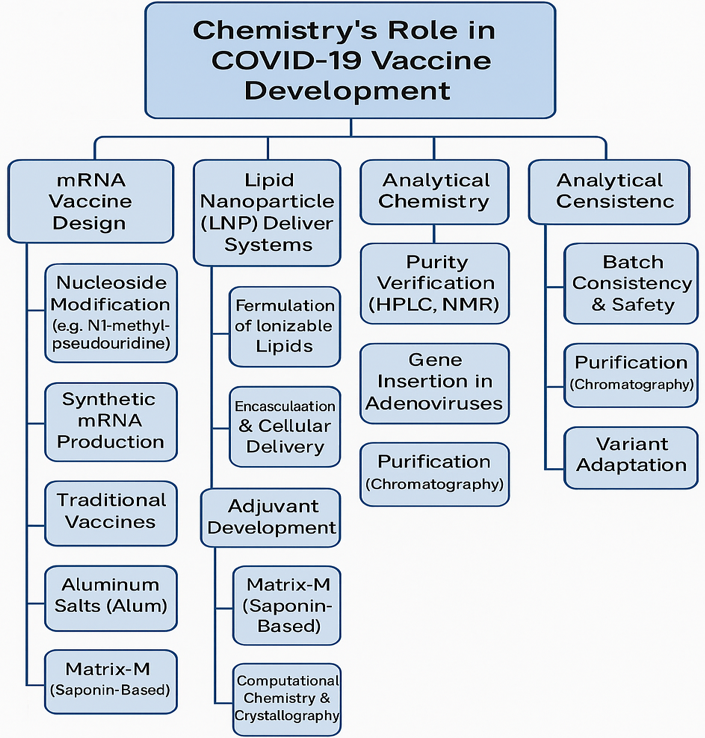
Source: Created by author.
In conclusion, chemistry played a central role in the rapid and effective response to the COVID-19 pandemic through vaccine development. From molecular design and synthesis to delivery systems and quality control, chemical sciences underpinned every aspect of creating safe and effective immunizations. This contribution underscores the necessity of sustained investment in chemical research and interdisciplinary collaboration for future public health preparedness.
References
Karikó, K., Buckstein, M., Ni, H., & Weissman, D. (2005). Suppression of RNA recognition by Toll-like receptors: the impact of nucleoside modification and the evolutionary origin of RNA. Immunity, 23(2), 165–175.
Schoenmaker, L., Witzigmann, D., Kulkarni, J. A., Verbeke, R., Kersten, G., Jiskoot, W., & Crommelin, D. J. A. (2021). mRNA-lipid nanoparticle COVID-19 vaccines: Structure and stability. International Journal of Pharmaceutics, 601, 120586.
Tavares, J. F., da Silva, M. S., de Souza, M. F. V., & Barreto, A. S. (2020). Recent applications of saponins as adjuvants in vaccine development. Revista Brasileira de Farmacognosia, 30(3), 281–292.
Le, T. T., Andreadakis, Z., Kumar, A., Gómez Román, R., Tollefsen, S., Saville, M., & Mayhew, S. (2022). The COVID-19 vaccine development landscape. Nature Reviews Drug Discovery, 19(5), 305–306.
Makadia, H. K., & Siegel, S. J. (2011). Poly Lactic-co-Glycolic Acid (PLGA) as biodegradable controlled drug delivery carrier. Polymers, 3(3), 1377–1397.
Yin, W., Xu, Y., Xu, P., Cao, X., Wu, C., Gu, C., … & Xu, H. E. (2021). Structures of the Omicron spike trimer with ACE2 and an anti-Omicron antibody. Science, 375(6584), 1048–1053.
Freitas, G. B., Rabelo, E. M., & Pessoa, E. G. (2023). Projeto modular com reaproveitamento de container maritimo. Brazilian Journal of Development, 9(10), 28303–28339. https://doi.org/10.34117/bjdv9n10-057
Gotardi Pessoa, E. (2025). Analysis of the performance of helical piles under various load and geometry conditions. ITEGAM-JETIA, 11(53), 135-140. https://doi.org/10.5935/jetia.v11i53.1887
Gotardi Pessoa, E. (2025). Sustainable solutions for urban infrastructure: The environmental and economic benefits of using recycled construction and demolition waste in permeable pavements. ITEGAM-JETIA, 11(53), 131-134. https://doi.org/10.5935/jetia.v11i53.1886