
REGISTRO DOI: 10.69849/revistaft/ma10202601131429
Silton Luiz Pereira Proença
Abstract
Urban logistics has become increasingly complex due to rapid urbanization, spatial constraints, and growing environmental concerns. Within this context, diffuse logistics emerges as a critical challenge, characterized by fragmented demand, dispersed origins and destinations, and irregular operational patterns. One of the most representative examples of diffuse logistics in urban areas is the removal of construction debris and bulky waste, which differs significantly from standardized freight distribution and scheduled municipal waste collection. This article examines the main challenges associated with diffuse logistics in urban environments, with particular emphasis on debris removal. Issues related to traffic congestion, spatial and temporal unpredictability, environmental regulation, technological limitations, and fragmented governance are discussed based on existing academic literature. The analysis highlights that although smart technologies and sustainability-oriented policies offer potential improvements, effective solutions require integrated planning, reliable data, and coordinated stakeholder engagement. The study concludes that debris removal should be understood as an integral component of urban logistics systems and a key factor in achieving sustainable urban development.
Keywords: Urban logistics; Diffuse logistics; Construction debris; Waste management; Sustainable cities.
Urban logistics has become an increasingly complex field as cities expand, densify, and diversify their economic and social activities. Within this context, diffuse logistics refers to logistics operations characterized by dispersed origins and destinations, irregular demand patterns, and heterogeneous cargo types. One of the most critical manifestations of diffuse logistics in urban areas is the removal of construction debris and bulky waste, which poses significant operational, environmental, and governance challenges. Unlike conventional freight distribution or scheduled household waste collection, debris removal is highly fragmented, spatially unpredictable, and often weakly regulated, making it a representative case for understanding the broader difficulties of diffuse urban logistics.
The primary challenge faced by diffuse logistics in urban environments is congestion and limited accessibility. Urban road networks are shared by passenger vehicles, public transport, cyclists, pedestrians, and service vehicles, leading to competition for space and time. Studies on urban freight transport show that congestion significantly increases travel times, fuel consumption, and operational costs, while also reducing the reliability of logistics services (Dablanc et al., 2017). For debris removal operations, which frequently rely on small trucks operating in residential or mixed-use neighborhoods, congestion complicates routing decisions and increases the likelihood of illegal parking or unsafe loading practices, further exacerbating traffic disruptions and public dissatisfaction.
Another critical challenge is the spatial dispersion and temporal irregularity of debris generation. Construction and demolition waste often originates from small-scale renovations or informal building activities that are difficult to monitor and predict. Unlike industrial waste streams, which tend to be centralized and relatively stable, urban debris generation is scattered across the city and varies according to economic cycles, real estate dynamics, and regulatory enforcement. According to Wilson et al. (2015), the lack of reliable data on waste generation at the neighborhood level undermines planning efforts and limits the effectiveness of logistics optimization models. This uncertainty forces service providers to adopt reactive rather than proactive strategies, reducing overall system efficiency.
Environmental and regulatory constraints further intensify the complexity of diffuse logistics. Many cities have introduced low-emission zones, time-window restrictions, and vehicle access regulations to mitigate air pollution and noise. While these measures contribute to sustainability goals, they also impose additional constraints on debris removal logistics, often requiring specialized vehicles or off-peak operations that increase costs (Russo and Comi, 2011). Inadequate alignment between environmental policy and operational realities can unintentionally encourage illegal dumping, as small generators seek to avoid the financial and administrative burden associated with compliant disposal.
Technological innovation has been widely proposed as a means of addressing these challenges, particularly through the integration of information systems, real-time monitoring, and data-driven decision-making. Smart waste management systems, including sensor-equipped containers and computer vision tools, have demonstrated potential to improve collection planning and reduce unnecessary trips (Silva et al., 2025). However, research also indicates that technological solutions alone are insufficient when institutional coordination and user engagement are weak. The adoption of smart logistics systems often faces resistance from stakeholders who perceive increased surveillance or do not experience immediate benefits, limiting the effectiveness of these interventions (Perboli et al., 2018).
Governance fragmentation represents another structural obstacle to effective diffuse logistics management. Debris removal typically involves multiple actors, including municipal authorities, private contractors, construction firms, and individual households. The absence of clearly defined responsibilities and coordinated policies often leads to gaps in service provision and enforcement. According to Lindholm and Behrends (2012), successful urban logistics systems require collaborative governance frameworks that integrate logistics planning with land use regulation and environmental management. Without such integration, diffuse logistics activities remain inefficient and environmentally harmful.
The flowchart, titled “Diffuse Logistics Challenges in Construction Debris Removal,” illustrates the core challenges of managing diffuse logistics in urban areas, using construction debris removal as a key example from the article. It begins with “Diffuse Logistics in Urban Areas” branching into five main rectangular process nodes: Traffic Congestion and Limited Accessibility (causing increased travel times, fuel use, and illegal parking); Spatial Dispersion and Temporal Irregularity (from scattered small-scale renovations with unpredictable demand); Environmental and Regulatory Constraints (like low-emission zones and time restrictions risking illegal dumping); Technological Limitations (needing smart sensors but facing adoption barriers); and Governance Fragmentation (involving uncoordinated multiple stakeholders). These converge into a diamond decision node “Integrated Solutions?” with two outcome paths: “Yes” leading to Smart Tech + Coordinated Planning + Stakeholder Engagement for Sustainable Urban Development, or “No” resulting in Continued Inefficiency and Environmental Harm.
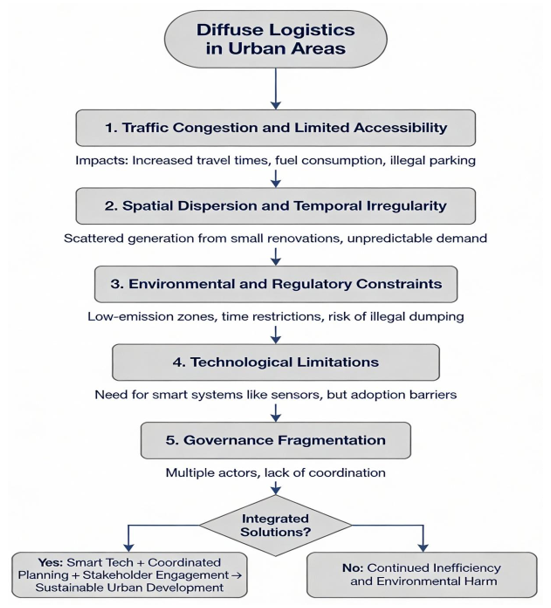
Figure 1. Diffuse Logistics Challenges in Construction Debris Removal.
Source: Created by author.
In conclusion, the case of debris removal highlights the broader challenges faced by diffuse logistics in urban areas. Congestion, spatial dispersion, regulatory complexity, technological limitations, and fragmented governance interact to create a highly challenging operational environment. While advances in smart technologies and sustainability-oriented policies offer promising pathways, their success depends on coordinated planning, reliable data, and stakeholder participation. Addressing diffuse logistics challenges requires a holistic approach that recognizes debris removal not as an isolated waste management issue, but as an integral component of urban logistics and sustainable city development.
References
Dablanc, L., Giuliano, G., Holliday, K., and O’Brien, T. (2017). Best practices in urban freight management: Lessons from an international survey. Transportation Research Record, 2647(1), 29–38.
Lindholm, M., and Behrends, S. (2012). Challenges in urban freight transport planning: A review in the Baltic Sea Region. Journal of Transport Geography, 22, 129–136.
Perboli, G., Rosano, M., Saint-Guillain, M., and Rizzo, P. (2018). Simulation-optimization framework for city logistics: An application on multimodal last-mile delivery. Transportation Research Part E, 117, 48–68.
Russo, F., and Comi, A. (2011). Measures for sustainable freight transportation at urban scale: Expected goals and tested results in Europe. Journal of Urban Planning and Development, 137(2), 142–152.
Silva, A., Costa, L., and Pereira, R. (2025). Smart waste management in urban environments: Data-driven approaches for logistics optimization. LOGI Scientific Journal, 16(1), 1–15.
Wilson, D. C., Rodic, L., Scheinberg, A., Velis, C. A., and Alabaster, G. (2015). Comparative analysis of solid waste management in 20 cities. Waste Management & Research, 33(9), 757–769.
SANTOS,Hugo;PESSOA,EliomarGotardi.Impactsofdigitalizationontheefficiencyandqualityofpublicservices:Acomprehensiveanalysis.LUMENETVIRTUS,[S.l.],v.15,n.40,p.44094414,2024.DOI:10.56238/levv15n40024.Disponívelem:https://periodicos.newsciencepubl.com/LEV/article/view/452.Acessoem:25jan.2025.
Filho, W. L. R. (2025). The Role of Zero Trust Architecture in Modern Cybersecurity: Integration with IAM and Emerging Technologies. Brazilian Journal of Development, 11(1), e76836. https://doi.org/10.34117/bjdv11n1-060
Oliveira, C. E. C. de. (2025). Gentrification, urban revitalization, and social equity: challenges and solutions. Brazilian Journal of Development, 11(2), e77293. https://doi.org/10.34117/bjdv11n2-010
Pessoa, E. G. (2024). Pavimentos permeáveis uma solução sustentável. Revista Sistemática, 14(3), 594–599. https://doi.org/10.56238/rcsv14n3-012
Filho, W. L. R. (2025). THE ROLE OF AI IN ENHANCING IDENTITY AND ACCESS MANAGEMENT SYSTEMS. International Seven Journal of Multidisciplinary, 1(2). https://doi.org/10.56238/isevmjv1n2-011
Antonio, S. L. (2025). Technological innovations and geomechanical challenges in Midland Basin Drilling. Brazilian Journal of Development, 11(3), e78097. https://doi.org/10.34117/bjdv11n3-005
Pessoa, E. G. (2024). Pavimentos permeáveis uma solução sustentável. Revista Sistemática, 14(3), 594–599. https://doi.org/10.56238/rcsv14n3-012
Pessoa, E. G. (2024). Pavimentos permeáveis uma solução sustentável. Revista Sistemática, 14(3), 594–599. https://doi.org/10.56238/rcsv14n3-012
Eliomar Gotardi Pessoa, & Coautora: Glaucia Brandão Freitas. (2022). ANÁLISE DE CUSTO DE PAVIMENTOS PERMEÁVEIS EM BLOCO DE CONCRETO UTILIZANDO BIM (BUILDING INFORMATION MODELING). Revistaft, 26(111), 86. https://doi.org/10.5281/zenodo.10022486
Eliomar Gotardi Pessoa, Gabriel Seixas Pinto Azevedo Benittez, Nathalia Pizzol de Oliveira, & Vitor Borges Ferreira Leite. (2022). ANÁLISE COMPARATIVA ENTRE RESULTADOS EXPERIMENTAIS E TEÓRICOS DE UMA ESTACA COM CARGA HORIZONTAL APLICADA NO TOPO. Revistaft, 27(119), 67. https://doi.org/10.5281/zenodo.7626667
Eliomar Gotardi Pessoa, & Coautora: Glaucia Brandão Freitas. (2022). ANÁLISE COMPARATIVA ENTRE RESULTADOS TEÓRICOS DA DEFLEXÃO DE UMA LAJE PLANA COM CARGA DISTRIBUÍDA PELO MÉTODO DE EQUAÇÃO DE DIFERENCIAL DE LAGRANGE POR SÉRIE DE FOURIER DUPLA E MODELAGEM NUMÉRICA PELO SOFTWARE SAP2000. Revistaft, 26(111), 43. https://doi.org/10.5281/zenodo.10019943
Pessoa, E. G. (2025). Optimizing helical pile foundations: a comprehensive study on displaced soil volume and group behavior. Brazilian Journal of Development, 11(4), e79278. https://doi.org/10.34117/bjdv11n4-047
Pessoa, E. G. (2025). Utilizing recycled construction and demolition waste in permeable pavements for sustainable urban infrastructure. Brazilian Journal of Development, 11(4), e79277. https://doi.org/10.34117/bjdv11n4-046
Testoni, F. O. (2025). Niche accounting firms and the brazilian immigrant community in the U.S.: a study of cultural specialization and inclusive growth. Brazilian Journal of Development, 11(5), e79627. https://doi.org/10.34117/bjdv11n5-034
Silva, J. F. (2025). Desafios e barreiras jurídicas para o acesso à inclusão de crianças autistas em ambientes educacionais e comerciais. Brazilian Journal of Development, 11(5), e79489. https://doi.org/10.34117/bjdv11n5-011
Silva, E. N. da. (2025). Urban circular microfactories: local micro-plants for regenerative urban economies. Brazilian Journal of Development, 11(9), e82335. https://doi.org/10.34117/bjdv11n9-059
DA SILVA, Eduardo Nunes. GREEN NANOTECHNOLOGY APPLIED TO CIRCULAR MANUFACTURING. LUMEN ET VIRTUS, [S. l.], v. 14, n. 32, 2024. DOI: 10.56238/levv14n32-029. Disponível em: https://periodicos.newsciencepubl.com/LEV/article/view/AEW09. Acesso em: 4 nov. 2025.
Recycling of Rare Earth Elements Using Ionic Liquids for Regenerative Manufacturing. (2023). International Seven Journal of Multidisciplinary, 2(5). https://doi.org/10.56238/isevmjv2n5-037
FURLAN, C. B.; DOS SANTOS, G. I. R. The Quality of Public Transport in Urban AverageCities: A Case Study in Palmas–Tocantins. arq.urb; No. 17 (2016): set. – dez.; 75-88. ISSN: 1984-5766. 2016.