
REGISTRO DOI: 10.69849/revistaft/ma10202601131349
Andrea Valim Magalhães
Abstract
Strategic communication plays a critical role in services marketing due to the inherent characteristics of services, including intangibility, heterogeneity, inseparability, and perishability. These characteristics increase consumer uncertainty and heighten the importance of well-planned, coherent, and customer-oriented communication strategies. This article examines the relevance of strategic communication in services marketing from both a theoretical and practical perspective. Drawing on established academic literature, the discussion highlights how strategic and integrated communication supports expectation management, customer education, value co-creation, and relationship building. In addition, the article incorporates professional experience to illustrate how strategic communication principles can be effectively applied in real service marketing contexts. The findings suggest that strategic communication is not merely a promotional tool but a core managerial function that enhances service quality perceptions, customer satisfaction, and long-term competitive advantage in service-based organizations.
Keywords: Strategic communication; Services marketing; Integrated marketing communication; Customer experience; Relationship marketing.
Strategic communication is a fundamental element of services marketing due to the intrinsic characteristics of services, such as intangibility, heterogeneity, inseparability, and perishability. These characteristics make services more difficult to evaluate prior to consumption, increasing customer uncertainty and perceived risk. As a result, communication in service contexts must go beyond traditional promotional functions and assume a strategic role in shaping expectations, clarifying value propositions, and fostering long-term relationships. According to Lovelock and Wirtz (2016), effective services marketing communication is essential for educating customers, facilitating their participation in the service process, and reinforcing trust in the service provider.
Academic research emphasizes that strategic communication in services marketing involves the deliberate alignment of messages, channels, and organizational objectives to ensure consistency and coherence across all customer touchpoints. Unlike product-based marketing, where physical attributes often speak for themselves, services rely heavily on symbolic cues and communicated promises. Zeithaml, Bitner, and Gremler (2020) argue that communication acts as a surrogate for tangible evidence, influencing customers’ perceptions of service quality even before the service encounter occurs. Therefore, strategic communication plays a decisive role in shaping perceived value, customer satisfaction, and loyalty.
The concept of integrated marketing communication further strengthens the importance of strategic communication in service environments. Integrated communication proposes that all communication efforts should be coordinated to deliver a unified message, reinforcing brand identity and reducing confusion among consumers. Empirical studies in service industries demonstrate that organizations adopting integrated communication strategies achieve stronger brand equity and superior performance outcomes (Luxton, Reid, and Mavondo, 2015). This integration is particularly relevant in services, where customers interact with multiple employees, platforms, and processes that collectively influence the service experience.
Strategic communication also serves an educational function in services marketing by guiding customers on how to engage effectively with the service. Since many services require active customer participation, clear and purposeful communication enhances service efficiency and outcome quality. Grönroos (2015) highlights that value in services is co-created through interaction, making communication a critical mechanism for aligning expectations between providers and customers. In this sense, strategic communication reduces misunderstandings, improves service encounters, and strengthens relational bonds.
From a professional perspective, the application of strategic communication principles has proven essential in service-oriented roles. In my professional experience, strategic communication was applied through the development of customer-centered messages that emphasized clarity, transparency, and consistency across digital and interpersonal channels. Educational communication was prioritized to explain service processes, expected outcomes, and customer responsibilities, contributing to reduced uncertainty and higher levels of engagement. This approach is consistent with academic findings that emphasize the importance of informative and relational messaging in services marketing (Zeithaml et al., 2020).
Additionally, integrated communication practices were implemented by aligning messaging across email campaigns, social media platforms, and direct client interactions. This strategic alignment reinforced service positioning and enhanced brand credibility, reflecting the principles outlined by Lovelock and Wirtz (2016). Feedback mechanisms were also incorporated to assess customer responses and continuously refine communication strategies, supporting a two-way communication model emphasized in strategic communication research (Hallahan et al., 2007).
The flowchart presented illustrates the central framework of the article on strategic communication in service marketing. It demonstrates how the inherent characteristics of services—intangibility, heterogeneity, inseparability, and perishability—create significant challenges in consumers’ perception of value. In response to these challenges, strategic communication emerges as the fundamental solution, functioning through three main mechanisms: expectation management, which aligns the organization’s promises with the reality of the service; customer education, which empowers consumers to participate effectively in the service process; and value co-creation, which recognizes the customer’s active role in generating value. Together, these three pillars of strategic communication converge on the desired end result: sustainable competitive advantage, achieved through improved perception of service quality and customer satisfaction. Thus, the flowchart synthesizes the article’s central proposition: that strategic communication is not merely a promotional tool, but a critical managerial function that integrates academic theory and professional practice to drive the success of service-oriented organizations.
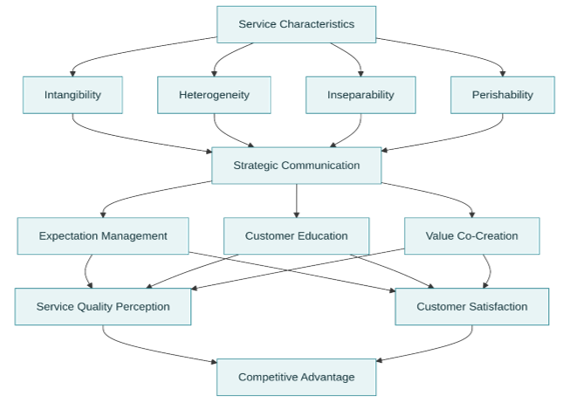
Figure 1. Strategic Communication Framework in Services Marketing: From Service Characteristics to Competitive Advantage
Source: Created by author.
In conclusion, strategic communication is a cornerstone of effective services marketing because it mitigates the challenges posed by service intangibility, enhances customer understanding, and supports value co-creation. The convergence of academic literature and professional practice demonstrates that well-planned, integrated, and customer-oriented communication strategies contribute significantly to service quality perceptions, customer satisfaction, and sustainable competitive advantage. As service economies continue to expand globally, the strategic management of communication will remain a decisive factor in organizational success.
References
Grönroos, C. (2015). Service Management and Marketing: Managing the Service Profit Logic. 4th ed. Chichester: Wiley.
Hallahan, K., Holtzhausen, D., van Ruler, B., Verčič, D., & Sriramesh, K. (2007). Defining strategic communication. International Journal of Strategic Communication, 1(1), 3–35.
Lovelock, C., & Wirtz, J. (2016). Services Marketing: People, Technology, Strategy. 8th ed. Boston: Pearson.
Luxton, S., Reid, M., & Mavondo, F. (2015). Integrated marketing communication capability and brand performance. Journal of Advertising, 44(1), 37–49.
Zeithaml, V. A., Bitner, M. J., & Gremler, D. D. (2020). Services Marketing: Integrating Customer Focus Across the Firm. 7th ed. New York: McGraw-Hill.
SANTOS,Hugo;PESSOA,EliomarGotardi.Impactsofdigitalizationontheefficiencyandqualityofpublicservices:Acomprehensiveanalysis.LUMENETVIRTUS,[S.l.],v.15,n.40,p.44094414,2024.DOI:10.56238/levv15n40024.Disponívelem:https://periodicos.newsciencepubl.com/LEV/article/view/452.Acessoem:25jan.2025.
Filho, W. L. R. (2025). The Role of Zero Trust Architecture in Modern Cybersecurity: Integration with IAM and Emerging Technologies. Brazilian Journal of Development, 11(1), e76836. https://doi.org/10.34117/bjdv11n1-060
Oliveira, C. E. C. de. (2025). Gentrification, urban revitalization, and social equity: challenges and solutions. Brazilian Journal of Development, 11(2), e77293. https://doi.org/10.34117/bjdv11n2-010
Pessoa, E. G. (2024). Pavimentos permeáveis uma solução sustentável. Revista Sistemática, 14(3), 594–599. https://doi.org/10.56238/rcsv14n3-012
Filho, W. L. R. (2025). THE ROLE OF AI IN ENHANCING IDENTITY AND ACCESS MANAGEMENT SYSTEMS. International Seven Journal of Multidisciplinary, 1(2). https://doi.org/10.56238/isevmjv1n2-011
Antonio, S. L. (2025). Technological innovations and geomechanical challenges in Midland Basin Drilling. Brazilian Journal of Development, 11(3), e78097. https://doi.org/10.34117/bjdv11n3-005
Pessoa, E. G. (2024). Pavimentos permeáveis uma solução sustentável. Revista Sistemática, 14(3), 594–599. https://doi.org/10.56238/rcsv14n3-012
Pessoa, E. G. (2024). Pavimentos permeáveis uma solução sustentável. Revista Sistemática, 14(3), 594–599. https://doi.org/10.56238/rcsv14n3-012
Eliomar Gotardi Pessoa, & Coautora: Glaucia Brandão Freitas. (2022). ANÁLISE DE CUSTO DE PAVIMENTOS PERMEÁVEIS EM BLOCO DE CONCRETO UTILIZANDO BIM (BUILDING INFORMATION MODELING). Revistaft, 26(111), 86. https://doi.org/10.5281/zenodo.10022486
Eliomar Gotardi Pessoa, Gabriel Seixas Pinto Azevedo Benittez, Nathalia Pizzol de Oliveira, & Vitor Borges Ferreira Leite. (2022). ANÁLISE COMPARATIVA ENTRE RESULTADOS EXPERIMENTAIS E TEÓRICOS DE UMA ESTACA COM CARGA HORIZONTAL APLICADA NO TOPO. Revistaft, 27(119), 67. https://doi.org/10.5281/zenodo.7626667
Eliomar Gotardi Pessoa, & Coautora: Glaucia Brandão Freitas. (2022). ANÁLISE COMPARATIVA ENTRE RESULTADOS TEÓRICOS DA DEFLEXÃO DE UMA LAJE PLANA COM CARGA DISTRIBUÍDA PELO MÉTODO DE EQUAÇÃO DE DIFERENCIAL DE LAGRANGE POR SÉRIE DE FOURIER DUPLA E MODELAGEM NUMÉRICA PELO SOFTWARE SAP2000. Revistaft, 26(111), 43. https://doi.org/10.5281/zenodo.10019943
Pessoa, E. G. (2025). Optimizing helical pile foundations: a comprehensive study on displaced soil volume and group behavior. Brazilian Journal of Development, 11(4), e79278. https://doi.org/10.34117/bjdv11n4-047
Pessoa, E. G. (2025). Utilizing recycled construction and demolition waste in permeable pavements for sustainable urban infrastructure. Brazilian Journal of Development, 11(4), e79277. https://doi.org/10.34117/bjdv11n4-046
Testoni, F. O. (2025). Niche accounting firms and the brazilian immigrant community in the U.S.: a study of cultural specialization and inclusive growth. Brazilian Journal of Development, 11(5), e79627. https://doi.org/10.34117/bjdv11n5-034
Silva, J. F. (2025). Desafios e barreiras jurídicas para o acesso à inclusão de crianças autistas em ambientes educacionais e comerciais. Brazilian Journal of Development, 11(5), e79489. https://doi.org/10.34117/bjdv11n5-011
Silva, E. N. da. (2025). Urban circular microfactories: local micro-plants for regenerative urban economies. Brazilian Journal of Development, 11(9), e82335. https://doi.org/10.34117/bjdv11n9-059
DA SILVA, Eduardo Nunes. GREEN NANOTECHNOLOGY APPLIED TO CIRCULAR MANUFACTURING. LUMEN ET VIRTUS, [S. l.], v. 14, n. 32, 2024. DOI: 10.56238/levv14n32-029. Disponível em: https://periodicos.newsciencepubl.com/LEV/article/view/AEW09. Acesso em: 4 nov. 2025.
Recycling of Rare Earth Elements Using Ionic Liquids for Regenerative Manufacturing. (2023). International Seven Journal of Multidisciplinary, 2(5). https://doi.org/10.56238/isevmjv2n5-037
FURLAN, C. B.; DOS SANTOS, G. I. R. The Quality of Public Transport in Urban AverageCities: A Case Study in Palmas–Tocantins. arq.urb; No. 17 (2016): set. – dez.; 75-88. ISSN: 1984-5766. 2016