
REGISTRO DOI: 10.69849/revistaft/ma10202507310802
Luiz Augusto de Oliveira1
Joashllenny Alves de Oliveira2
Glaucia Costa Pinheiro3
Ana Eliza Silva Campos3
Gleice Kelle Silva Marques Vilela4
Abstract: The Northeastern horse is one of the few naturalized equine breeds in Brazil, resulting from historical crossbreeding with Iberian horses introduced during the colonial period. Adapted to the harsh conditions of the semi-arid region, this animal exhibits remarkable traits of hardiness, physiological resilience, metabolic efficiency, and cultural value for rural communities in the Northeast. Despite its zootechnical and historical relevance, the breed is still not officially recognized by the competent authorities, which compromises its conservation and hinders the implementation of genetic improvement and sustainable management programs. This study presents a systematic literature review on the origin, morphology, functionality, and genetic-molecular aspects of the breed, highlighting the use of microsatellite markers as a key tool for its characterization and preservation. A lack of scientific data on allelic variability, population structure, and genetic parameters is evident, limiting the formulation of effective conservation strategies. In light of this scenario, the need for public policies, institutional actions, and coordinated efforts among researchers, breeders, and government agencies is emphasized to prevent the silent extinction of this important Brazilian animal genetic resource.
Keywords: Genetic conservation; Brazilian equines; Molecular markers
1. Introduction
The Brazilian naturalized breeds represent a valuable genetic and cultural heritage, resulting from centuries of adaptation to regional ecological and socioeconomic conditions (FAO, 2007; GROENEVELD et al., 2010). The Northeastern horse, also known as the “PéDuro,” is one of the few equine populations in Brazil whose origins are directly linked to the crossbreeding of Iberian horses introduced during the colonial period (COSTA, 2008). Adapted to the semi-arid environment, this horse stands out for its hardiness, physiological resilience, efficient locomotion, and strong cultural connection to rural and identity-related practices of the Brazilian Northeast (MOURA et al., 2015; RIBEIRO et al., 2023).
Despite its zootechnical, historical, and sociocultural importance, the breed still lacks formal recognition by official institutions and is undergoing a silent process of genetic erosion, driven by indiscriminate crossbreeding, inefficient management, and the absence of targeted public policies (PIRES, 2012; CARDOSO et al., 2020). The recent application of biotechnological tools – particularly microsatellite molecular markers – has paved the way for a robust genetic-population characterization, which is essential to support effective conservation and valorization strategies (SILVA et al., 2012; HORECKY et al., 2018).
This manuscript aims to compile and critically analyze the state of the art regarding the origin, morphology, functionality, genetic aspects, and conservation perspectives of the Northeastern horse, with emphasis on its molecular characterization and its relevance as a zootechnical resource adapted to the conditions of the Brazilian semi-arid region.
2. Methodology
This literature review was built upon a systematized bibliographic survey conducted across the databases Scopus, SciELO, Web of Science, Google Scholar, and institutional repositories of Brazilian universities. The following descriptors were used: Northeastern horse,’ ‘naturalized horse breeds,’ ‘genetic diversity in horses,’ ‘microsatellites in horses,’ and ‘local breed conservation.’ The selection prioritized studies published between 2007 and 2024, in Portuguese, English, and Spanish. Technical guides, breed identification manuals, and documents from FAO and INSA were also included, due to the limited availability of formal literature on the subject.
2.1 Strategic importance of local breed conservation
The conservation of local or creole breeds, such as the Northeastern horse, has become an increasingly prominent topic in the context of food security, sustainability, and climate change adaptation. The Food and Agriculture Organization of the United Nations (FAO, 2007) emphasizes that the disappearance of native breeds represents an irreversible loss of genetic and cultural heritage. In Brazil, the Northeastern horse is among the few equine breeds adapted to arid environments, with zootechnical, cultural, and socioeconomic value – particularly for small-scale farmers.
In addition to its historical importance in shaping the cultures of the semi-arid region, the Northeastern horse serves as a strategic alternative for equine production adapted to resource scarcity and is considered by some researchers to be a local breed undergoing recovery (MOURA et al., 2015; LOPES et al., 2020). However, the lack of scientific data regarding its genetics, management, and economic contribution limits the development of effective public conservation policies.
The origin of the Northeastern horsee is linked to the crossbreeding of equines brought to Brazil by European settlers during the colonial period, between the 16th and 17th centuries (SOARES, 2022). It is a small-sized horse, weighing between 150 and 250 kg, and, as its name suggests, the majority of its population is found in Brazil’s Northeast region. Its coat colors are predominantly bay (DIÁRIO DO AGRO, 2025) and dark shades; however, .for the purposes of official breed standards, all colors are accepted except pinto and gray with pink skin (gázeo) (MELO et al., 2013).
2.2 Influence of iberian breeds and historical admixture
The Northeastern horse originates from the introduction of Iberian equines to Brazil, particularly breeds such as the Andalusian and Garrano, brought by Portuguese colonizers during the 16th and 17th centuries (COSTA, 2008). As these animals adapted to the harsh conditions of the northeastern semi-arid region, they underwent a natural selection process based on resilience, metabolic efficiency, and hardiness.
Over the following centuries, spontaneous crossbreeding and geographic isolation contributed to the development of an equine type with unique characteristics. This history parallels the emergence of other Brazilian regional breeds, such as the Baixadeiro in Maranhão and the Crioulo in the South – both also derived from Iberian roots (PAIVA et al., 2021). However, unlike the Crioulo, the Northeastern horse lacks formal recognition and organized breeding programs, placing it at risk.
Due to its hardiness and high adaptability to the environmental conditions of the northeast – acquired over time – the Northeastern horse has become highly representative of local equine production. These traits contributed to the development of resistance mechanisms to the Brazilian semi-arid climate, giving the breed significant value in local socioeconomic development (MARTINS, 2023). In this context, observations in the state of Paraíba show that these animals are generally raised under extensive systems, where nutritional management is absent, and reproductive and sanitary management are inadequate. Additionally, few breeders perform zootechnical registration (RIBEIRO et al., 2024).
The conservation of this breed is strongly linked to regional history and local customs, as the animals are used in daily labor and leisure activities such as horseback riding. Therefore, it is crucial to promote studies aimed at identifying the phenotypic, genotypic, and demographic characteristics of this breed, to inform action plans for its valorization. These should include appropriate management practices for breeders and the implementation of public policies that support the recovery and preservation of the genetic heritage of this and other native horse breeds (RIBEIRO; MEDEIROS; SANTOS JUNIOR, 2023).
Culturally, the Northeastern horse is associated with the figure of the vaqueiro (cowboy), traditionally used in cattle herding (vaquejada) and religious festivals, where it often serves as a central attraction. As the only equine breed native to the northeast, its importance to breeders depends largely on activities that enhance its genetic potential in the semi-arid region (MARTINS, 2023).
Due to its unique traits and immense genetic value, the Northeastern horse has proven capable of surviving under harsh conditions, such as high solar radiation, low forage availability, and scarce water resources. These characteristics allow it to reproduce and perform work-related tasks without burdening the breeder (CARDOSO, 2020). The Northeastern horse is especially suited for working with cattle in the caatinga biome and for vaquejada competitions – making its cultural relevance as important as its functional utility in the region. Its naturally hard hooves eliminate the need for horseshoes, which grants it excellent mobility on dry soils. It can travel up to 70 kilometers per day, which is a valuable trait for extensive systems (MOURA, 2022).
Due to the general lack of knowledge about the traits of native equine populations in Brazil, the Northeastern horse is often mistaken for “common horses.” In response to this, a breed identification manual was developed. Initiatives like this can significantly impact the understanding of the breed’s traits and its economic, historical, and cultural importance to northeastern communities that depend on it for both daily tasks and leisure. In this publication,
Ribeiro; Medeiros; Santos Junior (2023) demonstrate that breed identification follows phenotypic traits according to the standardization criteria established by the Brazilian Association of Breeders of the Northeastern Horse (ABCCN).
2.3 Functional comparisons with commercial breeds
The Northeastern horse has a morphology compatible with the demands of work in arid regions, revealing characteristics resulting from a long adaptation to the Brazilian semi-arid; in general, it presents medium stature, lean body conformation, a proportional head with a straight to slightly convex profile, medium-sized and well-directed ears, as well as hard and wellformed hooves, dispensing the use of horseshoes (MELO; PIRES; RIBEIRO, 2013; MOURA, 2022).
Morphometric studies conducted by Cardoso (2020) with remnants of the breed demonstrated that the body pattern of the Northeastern horse favors its thermal resistance, as it presents a good body surface-to-volume ratio, aiding in heat dissipation. Furthermore, its natural gait, often the ‘marcha batida’ or ‘marcha picada,’ (a natural gait typical of certain Brazilian breeds) ensures comfort during long journeys, making it useful for extensive travel, rural practices, and cultural activities such as vaquejada and traditional horseback riding (RIBEIRO et al., 2023).
In Table 1, comparisons with other breeds show that, unlike the Quarter Horse, which exhibits greater robustness and muscular development aimed at explosive speed, the Northeastern horse prioritizes endurance and economy of movement, being more similar to the Mangalarga Marchador in terms of locomotion and temperament. Hardiness and docility are two qualities highly emphasized by breeders and researchers, reinforcing its potential for selection programs aimed at small-scale producers (SILVA et al., 2024).
Table 1. Morphological comparisons between the Northeastern horse and related breeds (Mangalarga Marchador and Quarter Horse)
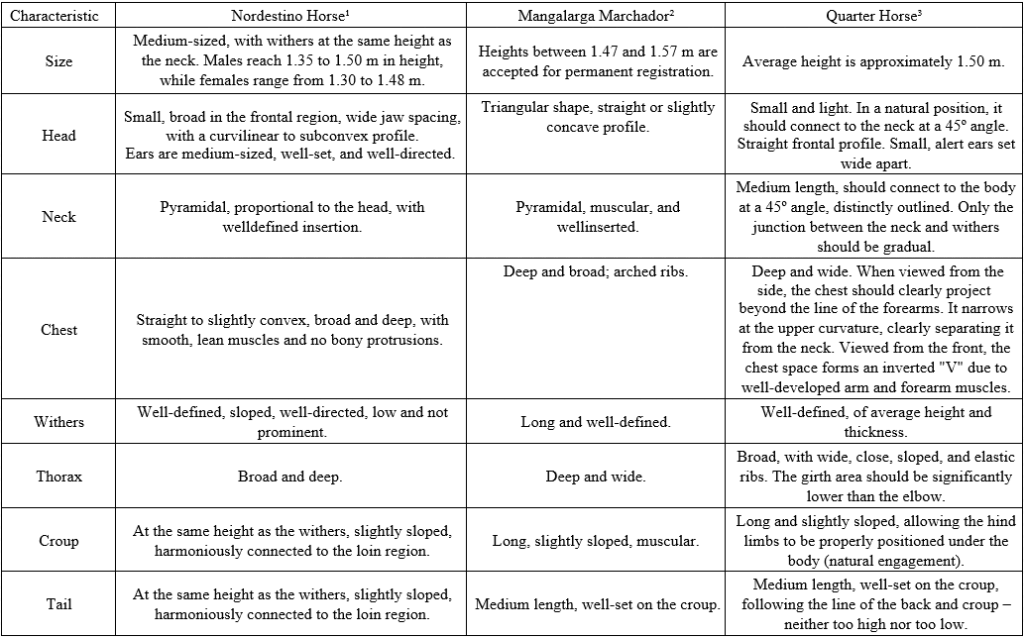
1ABCCN: Brazilian Association of Northeastern Horse Breeders; 2ABCCMM: Brazilian Association of Mangalarga Marchador Horse Breeders; 3ABQM: Brazilian Association of Quarter Horse Breeders. Sources: Melo; Pires; Ribeiro (2013); Moura (2022); Ribeiro et al. (2023).
From a functional perspective, physiological studies also demonstrate tolerance to long journeys under heat without compromising homeostatic parameters (MARIZ et al., 2014). This physiological capacity reinforces its suitability as a light draft and riding animal, even with lowquality feed typical of extensive systems in the sertão.
According to Ribeiro et al. (2023), other advantages are also observed in raising the Northeastern horse, such as its docility, intelligence, and ease of training, as well as exhibiting the “passada” (a natural gait typical of certain Brazilian breeds) gait, which provides the rider with comfort during horseback riding, and they are widely used for transporting goods.
Initiatives promoted by the National Institute of the Semi-Arid, linked to the MCTI – Ministry of Science, Technology and Innovation (INSA/MCTI), through data collection programs aimed at developing booklets about the breed, population surveys, genetic material collection, and germplasm banks creation, are important for its valorization and conservation.
Furthermore, the presence of institutions in the northeast such as the Brazilian Association of Northeastern Horse Breeders (ABCCN), the Northeastern horse Preservation and Selection Center (NPSCN), and the Equestrian and Northeastern horsee Preservation Association (AEPCN) play a significant role in providing information on preserving the breed’s original characteristics to breeders and enthusiasts (DIÁRIO DO AGRO, 2025).
2.4 Current status of the breed and conservation
The Northeastern horse, also known as “Pé-Duro,” represents one of the few naturalized equine populations in Brazil, adapted to the semi-arid climate, with remarkable physiological resilience, hardiness, and sociocultural value. Despite this significance, the breed still lacks formal recognition by the Ministry of Agriculture and Livestock (MAPA), which implies the absence of an official studbook, hindering population control and the development of systematic breeding and conservation programs (RIBEIRO et al., 2023).
The lack of knowledge regarding the actual population size, its geographic distribution, and the degree of genetic variability among breeding centers contributes to the vulnerable status of the breed (FAO, 2015). The predominance of extensive systems with poor sanitary and nutritional management, along with the recurring practice of castrating males with good conformation and the absence of structured selection programs, result in a gradual process of genetic erosion (CARDOSO et al., 2020; MARTINS, 2023).
Despite these challenges, important initiatives are underway. The National Institute of the Semi-Arid (INSA), in collaboration with northeastern universities such as UFRPE and UFPB, has promoted phenotypic surveys, awareness actions with breeders, and the preparation of technical manuals for breed identification. Notably, the booklet “How to Identify the Northeastern horse” (INSA, 2023) presents standardized morphological criteria according to the proposal of the Brazilian Association of Northeastern Horse Breeders (ABCCN).
The establishment of the Equestrian and Northeastern Horse Preservation Association (AEPCN) has also significantly contributed to the coordination among breeders, researchers, and public institutions, promoting participatory conservation strategies. These actions include encouraging informal registration of animals, the creation of preservation centers in the states of Piauí, Pernambuco, and Paraíba, and the establishment of germplasm banks in partnership with research centers (MELO, 2011; LOPES et al., 2020).
However, the sustainability of these efforts still depends on the implementation of specific public policies to support the breeding and preservation of local breeds. The literature on animal genetic conservation indicates that the lack of institutional support and integrated policies is one of the main factors associated with the silent extinction of Criollo populations (FAO, 2007; GROENEVELD et al., 2010). In this context, the northeastern breed remains an emblematic example of the urgency to coordinate technical, political, and sociocultural actions for the maintenance of Brazil’s animal biodiversity.
2.5 Genetic aspects of the northeastern breed
The genetic characterization of locally adapted breeds has proven fundamental to guide conservation strategies, sustainable management, and the valorization of national zootechnical heritage. In the case of the Northeastern horse, systematic molecular studies are still scarce, although some isolated works have demonstrated the breed’s potential in terms of genetic and functional variability.
Santos et al. (2015) were pioneers in evaluating the semen quality of northeastern stallions, analyzing parameters such as motility, vigor, sperm concentration, and viability after thawing. The results revealed satisfactory fertility rates even after cryopreservation, suggesting the breed’s viability for use in assisted reproduction programs and germplasm bank formation. The natural hardiness, combined with reproductive functionality, makes the Northeastern horse suitable for ex situ in vitro conservation programs with reasonable technical efficiency.
From a molecular standpoint, the specialized literature highlights microsatellites (SSRs) as the most widely used markers for characterizing genetic diversity in equines (Silva et al.,2012). Although most Brazilian studies still focus on breeds such as Mangalarga Marchador, Lavradeiro, and Criollo, the methodological principles and statistical tools used in these studies are fully applicable to the Northeastern horse. The high polymorphism rate, codominant inheritance, and wide genomic distribution of microsatellites make them ideal for evaluating population parameters such as heterozygosity, FIS, FST, Hardy-Weinberg equilibrium, and genetic structure among geographic nuclei.
Recent studies suggest that the Northeastern horse represents a valuable reservoir of adaptive alleles, shaped by centuries of natural selection in hostile environments characterized by water scarcity, intense heat, and limited food supply (RIBEIRO et al., 2023). Advantageous genetic traits such as resistant hooves, efficient metabolism, and resistance to parasitic diseases are often cited as evidence of adaptive selection.
These characteristics give the Northeastern horse a strategic profile, both for developing composite breeds suited to arid regions and for maintaining genetic variability in conservation programs. As highlighted by Lobo (2022), the use of molecular markers to monitor alleles of adaptive interest is essential to prevent genetic erosion in populations traditionally excluded from conventional breeding programs.
Additionally, comparative analysis with commercial breeds such as the Quarter Horse and Mangalarga Marchador reveals important differences in the genetic-functional profile.
While these breeds were selected for sports performance and morphological aesthetics, the Northeastern horse has maintained traits of functionality and hardiness, preserving natural diversity often lost in intensive selection programs (PAIVA et al., 2021).
The absence of targeted selection and management in extensive systems, although challenging in terms of productivity, contributed to maintaining a broader and less inbred genetic base in certain population nuclei. However, this advantage may rapidly disappear with the increasing practice of random crossbreeding with exotic breeds, reinforcing the urgent need for specific population genetic studies of the northeastern breed (CARDOSO et al., 2020; PIRES, 2012).
Therefore, generating reliable molecular data through standardized microsatellite panels will be an essential tool to support official breed recognition, the creation of conservation nuclei, and the definition of priority lineages for assisted reproduction and cryopreservation.
2.6 Molecular markers and genetic studies in equines
Advances in biotechnologies applied to animal genetics have enabled a qualitative leap in breed characterization, especially for locally adapted breeds historically neglected in conventional breeding programs. Among the available tools, microsatellites (or SSRs: Simple
Sequence Repeats) continue to be widely used in characterizing the genetic diversity of equine populations due to their high polymorphism rate, codominant inheritance, and broad genomic distribution (HORECKY et al., 2018; SILVA et al., 2012).
Microsatellites consist of short repetitions of nucleotide sequences (usually 2 to 6 base pairs) distributed throughout the genome. Their allelic variability is especially useful for assessing heterozygosity, inbreeding, population structure, and differentiation between groups (FIS, FST, and AMOVA), being widely used for parentage verification as well as for constructing dendrograms and genetic maps (OCHOA; STOREY, 2021).
In equines, these markers have been successfully employed for parentage studies, breed organization, conservation of genetic diversity, and introgression analyses. Horecky et al. (2018) demonstrated the efficiency of panels containing 11 to 15 microsatellite loci in analyzing the genomic diversity of domestic horses and the subspecies Equus ferus przewalskii. In Brazil, Silva et al. (2012) applied a set of 11 loci to assess five local breeds (Campeira, Lavradeira, Pantaneira, Mangalarga Marchador, and Baixadeiro), detecting average heterozygosity above 0.6 and high levels of polymorphic information content (PIC), although with concerning signs of inbreeding and genetic imbalances in some groups.
Moreover, microsatellites have been effective in identifying gene flow between breeds, revealing uncontrolled crossbreeding processes, as observed in the Lavradeira and Pantaneira populations, with genetic influences from exotic breeds such as Arabian and Thoroughbred (SILVA et al., 2012). These findings highlight the tool’s potential to monitor the genetic integrity of naturalized breeds.
More recent applications of SSRs also include the analysis of genomic regions associated with immunity, such as the Major Histocompatibility Complex (MHC) and the Natural Killer Complex (NKC), both fundamental for resistance to infectious diseases (HORECKY et al., 2018). These approaches are particularly promising for breeds like the Northeastern horse, historically exposed to adverse sanitary conditions.
Despite these advances, much of the genetic research in Brazilian equines still focuses on commercial breeds. Literature on the Northeastern horse, in turn, lacks robust and systematic molecular investigations. Preliminary data obtained by Cardoso et al. (2020) through wholegenome sequencing suggest that the breed exhibits relevant genetic variability and signs of genomic adaptation to water and heat stress, reinforcing its potential as a strategic genetic resource.
Analyzing the population structure of naturalized breeds requires special attention to the methodology employed. Traditional FST estimates, for example, assume idealized and isolated populations, which can lead to inaccurate interpretations in contexts with genetic overlap and recent gene flow. To overcome these limitations, Ochoa; Storey (2021) proposed a more robust statistical model to estimate FST and relatedness among individuals, even in populations with complex or fragmented structure, such as those found in Criollo or naturalized ecotypes.
Therefore, the use of standardized microsatellite panels represents a viable and validated approach for studies of genetic diversity, parentage, population structure, and conservation of the Northeastern horse.
This strategy will allow precise quantification of the level of diversity within the population, identification of potential genetic subgroups, assessment of crossbreeding with commercial breeds, and support decisions on germplasm bank formation, breeder selection, and official breed recognition.
2.7 Potential advances with molecular genetics
Despite recent progress in phenotypic description and informal recognition of the Northeastern horse breed, significant scientific gaps persist. Most studies focus on morphological aspects and cultural uses, while genetic, sanitary, and productive research remain incipient or nonexistent.
In the field of molecular genetics, the scarcity of information on allelic variability, observed and expected heterozygosity levels (Ho and He, respectively), as well as inbreeding coefficients (FIS), hinders the formulation of genetic management and conservation strategies. Additionally, the population structure of the breed (FST among population nuclei) is unknown, preventing the detection of possible subpopulations or adapted genetic lines (CARDOSO et al., 2020; PIRES, 2012).
Compared to breeds such as Criollo and Mangalarga Marchador, which have extensive genetic databases and organized breeding programs, the Northeastern horse remains at an early stage of study, dependent on isolated actions by researchers and local associations (LOPES et al., 2020; FAO, 2015). This is concerning because, according to FAO studies, the loss of genetic variability in local breeds often occurs silently until it becomes irreversible.
From a sanitary and productive standpoint, the lack of data on disease prevalence, parasite resistance, and physiological responses to heat stress represents another critical gap. In terms of public policy, financial incentives for breeders maintaining pure breed lines are still scarce.
Furthermore, other management problems identified by Ribeiro et al. (2024) in the breeding of the Northeastern horse in the state of Paraíba – such as improper castration of males with better conformation, lack of adoption of selection systems, and low implementation of technological and sanitary practices – highlight the need for institutional support for the conservation of these equines. According to the authors, horses in the region generally exhibit an undefined breed pattern and are characterized by crossbreeding with other breeds such as Quarter Horse, Mangalarga, and Thoroughbred, which interferes with the breed’s genetic preservation.
Advances in molecular biology tools, especially the use of microsatellite panels, can significantly contribute to the genetic characterization of the breed, revealing its diversity and degree of genetic isolation relative to other national and international breeds. Only from this characterization will it be possible to identify priority lineages for conservation, support official breed recognition, and propose sustainable participatory genetic management programs. The use of population structure analyses – such as those performed with software like STRUCTURE or GENETIX – combined with the construction of genetic affinity dendrograms, can also reveal undesirable gene flow between the Northeastern horse and exotic commercial breeds (EXCOFFIER; LISCHER, 2010).
Indeed, the implementation of actions for the preservation of the Baixadeiro horse – such as developing partnerships between research institutions, public and private companies, and organized breeders – has proven viable for conserving the Northeastern horse (HONORATO, 2024).
Under these conditions, Ribeiro et al. (2024) emphasize that, with proper management, it will be possible to direct projects toward sustainable breeding, as well as facilitate rural financing proposals aimed at breeder training. Such measures directly contribute to the valorization and strengthening of local breeds, recognizing them as national genetic heritage.
3. Conclusion
The Northeastern horse represents one of the most emblematic naturalized breeds of Brazil, combining attributes of hardiness, functionality, and cultural value. Its adaptation to the semi-arid region, associated with physiological resilience and favorable morphological conformation, makes it a strategic resource for low-demand production systems.
However, its institutional invisibility, lack of official recognition, and limited genetic knowledge hinder the formulation of effective conservation policies. The use of molecular tools, especially microsatellites, should be encouraged as a foundation for breed recognition, the definition of priority lineages, and participatory genetic management actions.
Strengthening the connections between science, breeders, and public policies is essential to avoid the irreversible loss of the genetic heritage represented by the Northeastern horse – a breed that, beyond its historical value, can play a decisive functional role in equine culture adapted to climate change and the extensive systems of Brazil’s northeast.
Declaration of Conflicts of Interest
The authors declare that there is no conflict of interest. The sponsors had no role in the study design; in the collection, analysis, or interpretation of data; in the writing of the manuscript; or in the decision to publish the results.
Author Contributions
All authors contributed equally to the conception and writing of the manuscript. All authors critically reviewed the manuscript and approved the final version.
4. References
ABCCMM – Associação Brasileira dos Criadores do Cavalo Mangalarga Marchador. Padrão da raça Mangalarga Marchador. ABCCMM, 2025. http://leia.abccmm.org.br/portal/regulamentos/padraodaraca.pdf.
ABQM – Associação Brasileira de Criadores de Cavalo Quarto de Milha. Padrão racial do cavalo Quarto de Milha. ABQM, 2025. https://antigo.abqm.com.br/pt/conteudos/quarto-demilha/padrao-racial.
CARDOSO, D.C. Sequenciamento de genoma completo do cavalo Nordestino para identificação de variantes genômicas (SNVs e INDELs) e validação em populações remanescentes. 2020. 123 f. Tese (Doutorado em Zootecnia) – Escola de Veterinária, Universidade Federal de Minas Gerais, Belo Horizonte, 2020. https://x.gd/kyras.
CARDOSO, D.C. et al. Whole-genome sequencing of a Brazilian naturalized horse breed resistant to arid climate for identifying single nucleotide variants and insertions/deletions.
Research Square, v.1, p1-20, 2020. https://doi.org/10.21203/rs.3.rs-21956/v1.
COSTA, M.R.T.R. A História dos equinos na Amazônia: ênfase ao cavalo marajoara. In: ENCONTRO INTERNACIONAL DA PECUÁRIA DA AMAZÔNIA, 1., 2008, Anais…,Belém, PA. Meio ambiente e pecuária: [anais]. Belém, PA: FAEPA; Instituto Frutal; SEBRAE-PA, 2008. https://www.alice.cnptia.embrapa.br/alice/handle/doc/409962.
DIÁRIO DO AGRO. Conheça o cavalo nordestino, um dos mais resistentes do Brasil. Diário do Agro, 2025. https://diariodoagro.com/conheca-o-cavalo-nordestino-um-dos-mais-resistentes-do-brasil/
EXCOFFIER, L.; LISCHER, H.E.L. Arlequin suite ver 3.5: a new series of programs to perform population genetics analyses under Linux and Windows. Molecular Ecology Resources, v.10, n.3, p.564-567, 2010. https://doi.org/10.1111/j.1755-0998.2010.02847.x.
FAO – Food and Agriculture Organization of the United Nations. Second report on the state of the world’s animal genetic resources for food and agriculture. Rome: FAO, 2015. 606p. https://x.gd/F2yQ9.
FAO – FOOD AND AGRICULTURE ORGANIZATION OF THE UNITED NATIONS. The state of the world’s animal genetic resources for food and agriculture. Rome: FAO, 2007. 524p. https://x.gd/2YJs2.
GROENEVELD, E. et al. Genetic diversity in farm animals: a review. Animal Genetics, v.41, p.6-31, 2010.
HONORATO, J. Características de cavalos (Equus Caballus) da baixada maranhense e contribuição para a sua conservação genética. Revista Multidisciplinar de Educação e Meio Ambiente, v.5, p1-2, 2024. http://dx.doi.org/10.51189/coneamb2024/39734.
HORECKY, C. et al. Microsatellite markers for evaluating the diversity of the natural killer complex and major histocompatibility complex genomic regions in domestic horses. HLA, v.91, n.4, p.271-279, 2018. https://doi.org/10.1111/tan.13211.
LOPES, F.B. et al. Conservação de recursos genéticos animais no semiárido brasileiro. Revista Brasileira de Agropecuária Sustentável, v.10, n.2, p.145-157, 2020.
MARIZ, T.M.A. et al. Variáveis fisiológicas de equinos remanescentes do Cavalo Nordestino durante a pega de boi. Journal of Animal Behaviour and Biometeorology, v.2, n.4, p.139141, 2014. http://dx.doi.org/10.14269/2318-1265/jabb.v2n4p139-141.
MARTINS, V.L.G.A. O cavalo nordestino: Integração, produção e conservação de recursos genéticos.2023. 32 f. Trabalho de Conclusão de Curso (Graduação em Medicina Veterinária) – Instituto Federal da Paraíba, Sousa. https://repositorio.ifpb.edu.br/handle/177683/2067.
MELO, J. B.; PIRES, D. A. F.; RIBEIRO, M. N. Perfil fenotípico do remanescente do cavalo nordestino no nordeste do Brasil. Archivos de Zootecnia, v.62, n.238, p.171-180, 2013. http://dx.doi.org/10.21071/az.v62i238.659.
MOURA, E.A.F. Pelagem dos equinos: principais categorias e tipos nas raças e ecótipos localmente adaptados no Brasil. 2022. 53 f. Trabalho de Conclusão de Curso (Graduação em Agronomia) – Universidade Estadual do Maranhão, Centro de Ciências Agrárias, São Luís. https://x.gd/qlLwG.
MOURA, J.M. et al. Raças naturais de equinos no Brasil: conservação e potencial zootécnico.
Archivos de Zootecnia, v.64, n.245, p.15-26, 2015.
PIRES, D.A.F. Caracterização genética de remanescentes da raça equina nordestina em mesorregiões dos estados da Bahia, Pernambuco e Piauí através de marcadores microssatélites. 2012. 100 f. Dissertação (Mestrado em Zootecnia) – Universidade Federal Rural de Pernambuco, Recife, 2012. http://www.tede2.ufrpe.br:8080/tede2/handle/tede2/6728.
RIBEIRO, N.L. et al. Phenotypic characterisation and production system of the Nordestino horse from a multivariate perspective. Scientific Reports, v.14, n.1173, p.1-12, 2024. https://doi.org/10.1038/s41598-023-51018-y.
RIBEIRO, N.L. et al. Cavalos & jumentos do Brasil: raças e ecótipos. 1ed. . Série Equídeos do Brasil. Campina Grande: INSA, 2023.598p. https://socio.abraveq.com.br/wpcontent/uploads/2024/01/Cavalos-e-Jumentos-do-Brasil-2023.pdf.
RIBEIRO, N.L.; MEDEIROS, G.R.; SANTOS JUNIOR, E.C. Como identificar o cavalo Nordestino. [S.l.]: ABCCN – Associação Brasileira de Criadores do Cavalo Nordestino, 2023. 4p. https://www.gov.br/insa/pt-br/centrais-de-conteudo/publicacoes-do-insa/sistemas-deproducao-animal/como-identificar-o-cavalo-nordestino.pdf.
SILVA, B.O.V. et al. História e morfologia da raça Quarto de Milha: uma revisão de literatura. RevistaFT, v.28, n138, p.1-22, 2024. https://doi.org/10.69849/revistaft/ni10202409202144.
SILVA, R.M. et al. Equídeos do Brasil: panorama histórico e genético das raças nacionais.
Revista Brasileira de Zootecnia, v.50, e20210034, 2021. https://doi.org/10.37496/rbz5020210034.
PAIVA, S.R. et al. Genetic variability in local Brazilian horse lines using microsatellite markers. Genetics and Molecular Research, v.11, n.2, p.881-890, 2012. http://dx.doi.org/10.4238/2012.April.10.4.
SOARES, A.S.B.S. Equinos: origem no mundo, criação no Brasil e particularidades do Nordeste: uma breve revisão. 2022. 38 f. Trabalho de Conclusão de Curso (Graduação em Zootecnia) – Universidade Federal de Alagoas, Arapiraca. https://x.gd/m1oM9.
1Associate Professor – UFPI, Teresina, Piauí, Brazil; ORCID: 0000-0003-0380-8753
2Ph.D. in Animal Science – UFV, Viçosa, Minas Gerais, Brazil; ORCID: 0000-0001-7249-5047
3Specialist in Animal Production – UEMASUL, Maranhão, Brazil; ORCID: 0009-0002-2437-2442
3Veterinary Medicine Student – UFPI, Teresina, Piauí, Brazil; ORCID: 0009-0009-8500-4070
4Doctoral student in Tropical Animal Science – UFPI, Teresina, Piauí, Brazil; ORCID: 0000-0003-3505-6285