
REGISTRO DOI: 10.69849/revistaft/ma10202602130910
Caio César Souza Andrade
Abstract
The growing complexity of construction projects has revealed significant limitations in traditional planning and scheduling methods with regard to predictability, cost control, and productivity. Four-dimensional Building Information Modeling (4D BIM), which integrates time-related information into three-dimensional digital models, has emerged as an effective approach to overcome these limitations. This study examines the impacts of 4D BIM integration on construction management, with emphasis on schedule reliability, decision-making processes, and productivity enhancement. Based on a critical review of academic literature, the analysis demonstrates that 4D BIM improves visualization of construction sequences, enables scenario-based planning, strengthens coordination among project stakeholders, and supports proactive control of time- and cost-related risks. Despite existing implementation challenges, the findings indicate that 4D BIM constitutes a strategic tool for improving overall project performance and supporting the digital transformation of the construction industry.
Keywords: 4D BIM; construction planning; schedule control; project management; productivity; cost management.
The increasing complexity of construction projects has exposed the limitations of traditional planning and scheduling methods in ensuring reliable timelines, cost control, and productive workflows. Four-dimensional Building Information Modeling (4D BIM), which integrates time-related data into three-dimensional digital models, has emerged as a promising approach to address these challenges. This article examines the role of 4D BIM in enhancing predictability, decision-making, and schedule control within construction management. Based on a synthesis of academic literature, the discussion highlights how 4D BIM improves visualization of construction sequences, supports scenario-based planning, strengthens coordination among stakeholders, and contributes to improved cost performance and productivity. Despite existing implementation challenges, the findings indicate that 4D BIM constitutes a critical tool for improving project performance in contemporary construction environments.
The integration of four-dimensional Building Information Modeling (4D BIM) into construction management represents a significant advancement in planning and control practices, particularly with respect to schedule reliability, cost management, and productivity improvement. Traditional construction planning methods, commonly based on two-dimensional drawings and Critical Path Method (CPM) schedules, often fail to capture the dynamic, spatial, and temporal complexity of construction processes. This limitation contributes to low predictability, coordination failures, schedule overruns, and budget escalation, especially in complex projects (Eastman et al., 2011; Hartmann et al., 2008). In response to these challenges, 4D BIM extends conventional three-dimensional modeling by integrating time-related information, allowing construction activities to be simulated and analyzed throughout the project lifecycle.
By embedding scheduling data directly into the digital building model, 4D BIM enables stakeholders to visualize construction sequences in a clear and intuitive manner. This enhanced visualization improves understanding of task interdependencies, spatial constraints, and workflow logic, which are often difficult to interpret using traditional bar charts or network schedules. Empirical studies demonstrate that 4D BIM significantly enhances schedule predictability by enabling early identification of sequencing conflicts, workspace clashes, and constructability issues before they materialize on site (Hartmann et al., 2008; Candelario-Garrido et al., 2022). Consequently, project teams can proactively adjust schedules, mitigate risks, and maintain greater control over project timelines.
Beyond predictability, 4D BIM functions as an effective decision-support tool by enabling simulation-based planning and scenario analysis. Construction managers can assess alternative sequencing strategies, evaluate phasing options, and examine the impacts of resource reallocations or scope changes. This capability improves the quality of decision-making by making the consequences of planning choices explicit and visually accessible, reducing uncertainty and reliance on fragmented information (Silva et al., 2019). The use of 4D BIM within collaborative planning environments further enhances communication among project stakeholders, promoting shared understanding and reducing conflicts related to scheduling responsibilities and expectations.
Although cost management is more directly associated with five-dimensional BIM, the integration of time data through 4D BIM plays a crucial role in financial performance. Schedule deviations are closely linked to cost overruns, and the ability to visualize construction progress over time enables more accurate forecasting of expenditures and cash flows. When schedule changes occur, their potential cost impacts can be identified at early stages, supporting timely corrective actions and more effective budget control (Eastman et al., 2011; Khoshkonesh et al., 2025). Research indicates that projects adopting integrated 4D and 5D BIM frameworks achieve greater accuracy in cost estimation and improved alignment between planned and actual expenditures.
Productivity improvement constitutes another major benefit of 4D BIM adoption. Visualization of construction sequences enhances coordination between trades and improves alignment between design intent and execution strategies, thereby reducing rework and inefficiencies (Silva et al., 2019). Furthermore, 4D BIM supports optimized resource and logistics planning by linking labor, equipment, and material deliveries to specific activities and timeframes. This contributes to smoother workflows, reduced idle time, and improved site organization, aligning closely with lean construction principles focused on waste reduction and process optimization (Hartmann et al., 2008).
Despite these advantages, several challenges continue to limit widespread adoption of 4D BIM. Interoperability issues between BIM platforms and scheduling software, the need for high-quality and well-structured data, and limited automation of model-to-schedule linkages remain significant barriers (Candelario-Garrido et al., 2022). Additionally, organizational resistance to change and insufficient technical expertise can hinder effective implementation, particularly in firms with lower levels of digital maturity. Nevertheless, the academic literature suggests that these challenges can be mitigated through standardized workflows, targeted training programs, and incremental integration of BIM-based planning into established project management practices.
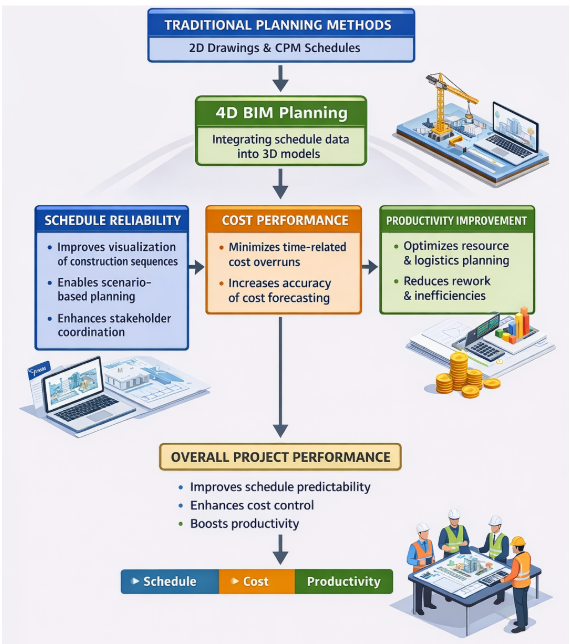
This flowchart illustrates the integration of 4D BIM planning into construction management and its impacts on schedule, cost, and productivity. It shows how traditional planning methods based on 2D drawings and CPM schedules evolve into 4D BIM by incorporating time-related data into 3D models. Through this integration, project teams gain improved visualization of construction sequences, enabling more reliable scheduling, scenario-based planning, and stronger coordination among stakeholders. The diagram also highlights how enhanced schedule control contributes to better cost performance by reducing time-related overruns and improving forecasting accuracy, while simultaneously increasing productivity through optimized resource and logistics planning and reduced rework. Overall, the image emphasizes that 4D BIM acts as a strategic tool that links time, cost, and productivity to improve overall project performance.
Figure 1. Integration of 4D BIM Planning into Construction Management and Its Impacts on Schedule, Cost, and Productivity.
Source: Created by author.
In conclusion, the integration of 4D BIM into construction planning and management substantially enhances predictability, decision-making quality, and control over schedules, costs, and productivity. By linking temporal information to digital building models, 4D BIM enables simulation-based analysis of construction processes that surpasses the capabilities of traditional planning tools. Although implementation challenges persist, empirical evidence increasingly supports 4D BIM as a critical enabler of improved project performance. As digital transformation continues to reshape the construction industry, 4D BIM is expected to play an essential role in delivering more efficient, transparent, and resilient construction projects.
References
Eastman, C., Teicholz, P., Sacks, R., & Liston, K. (2011). BIM Handbook: A Guide to Building Information Modeling for Owners, Managers, Designers, Engineers and Contractors (2nd ed.). Wiley.
Hartmann, T., Gao, J., & Fischer, M. (2008). Areas of application for 3D and 4D models on construction projects. Journal of Construction Engineering and Management, 134(10), 776–785.
Candelario-Garrido, A., García-Sanz-Calcedo, J., & López-Caballero, R. (2022). The creation of construction schedules using 4D BIM. Buildings, 12(8), 1145.
Silva, P., Crippa, J., & Scheer, S. (2019). BIM 4D in construction scheduling: Benefits and implementation difficulties. PARC – Pesquisa em Arquitetura e Construção, 10, e019007.
Khoshkonesh, A., Mohammadagha, M., & Ebrahimi, N. (2025). Simulation-based validation of an integrated 4D/5D digital-twin framework for construction planning. arXiv preprint arXiv:2511.03684.