
REGISTRO DOI: 10.69849/revistaft/ni10202511091553
Murillo Pedreiro1
Adriano Machado dos Santos2
Abstract
With declining birth rates and an aging population, efficient and strategic management of Medical and Hospital Equipment (MHE) has become indispensable in healthcare institutions. Prioritizing maintenance activities ensures equipment availability, particularly in critical scenarios. This study proposes a global prioritization model for MHE maintenance integrating the VED and ABC classifications. The research considers the criticality of the equipment and their respective failure rates, relying on data from 46 countries and their regulatory agencies and health authorities, obtained from the database compiled by 250 journalists from the International Consortium of Investigative Journalists (ICIJ). It proposes a preventive maintenance plan, ensuring continuous patient safety and equipment availability. Furthermore, the preventive approach supports process optimization, cost reduction, and operational sustainability in healthcare facilities.
Keywords: Maintenance prioritization; Medical and hospital equipment; VED classification; ABC classification; Clinical engineering.
1 INTRODUCTION
In recent decades, many regions worldwide have experienced a significant increase in the occurrence of epidemics, natural disasters, and armed conflicts—factors that directly contribute to rising mortality rates. Simultaneously, socioeconomic crises observed in different countries have led to declining birth rates, resulting in substantial changes to the global demographic structure. In this context, it is essential for healthcare institutions to adopt effective and innovative solutions capable of ensuring that no life is lost due to failures in Medical and Hospital Equipment (MHE).
To ensure safe, high-quality, and sustainable care, MHE plays a central role in performing accurate diagnoses, delivering advanced treatments, and continuously monitoring patients. However, proper management of these technologies represents a constant challenge for clinical engineering and hospital administration, requiring careful planning, control, and prioritization of maintenance activities.
Prioritizing repair orders and maintenance routines for MHE aims to ensure immediate equipment availability, reduce downtime, and optimize the human and material resources of healthcare institutions. According to World Health Organization (WHO) guidelines, the definition of these priorities should consider a combination of critical factors related to function, risk, maintenance, and failure frequency—parameters used in the VED classification (Vital, Essential, and Desirable). Complementarily, the ABC classification, based on the Pareto Principle, is used to identify and rank equipment according to the number of recorded failures or maintenance recalls.
In this context, the present study proposes a healthcare technology management plan based on data from the International Consortium of Investigative Journalists (ICIJ), which compiles information from 46 countries and their regulatory agencies and health authorities. The aim is to support clinical engineering teams in transforming hospitals into more efficient and patient-centered environments, strengthening both operational reliability and the culture of safety.
This integration of technology and healthcare, grounded in the principles of engineering and innovation, constitutes the foundation for the continuous improvement of hospital care and the achievement of excellence in the management of medical and hospital equipment.
2 METHODOLOGY
A total of 24 medical and hospital equipment items were analyzed, distributed across 10 groups corresponding to different medical specialties. The VED classification, in the document Medical Equipment Maintenance Programme Overview (WHO, 2011a), was obtained from the sum of points assigned to four criteria as defined by the World Health Organization: Equipment function, physical risk, maintenance requirements, and history of frequency failure. The result of this sum constitutes the Equipment Management Number (EM#), calculated using the formula:
EM# = Function + Risk + Requirements + History.
The VED classification is determined based on the EM# value, as follows: devices with a score of 18 points or higher are considered Vital (V); those with scores between 12 and 17 points are classified as Essential (E); and equipment with scores below 12 points are defined as Desirable (D).
Table 1. Equipment function

Source: WHO, 2011a.
Table 2. Physical risk associated with clinical application

Table 3. Maintenance requirements

Table 4. Equipment incident history

The ABC classification helps identify which equipment fails most often, assigning it a higher maintenance priority. Thus, items are classified as follows:
– Class A: Corresponds to a small number of items (approximately 20%) that represent much of the total impact (around 80%). Indicates high priority, with up to 80% of accumulated failures.
– Class B: Includes intermediate items (about 30%) that have a moderate impact (around 15%). Indicates medium priority, between 80% and 95% of accumulated failures.
– Class C: Comprises most items (approximately 50%) with a reduced impact (around 5%). Indicates low priority, above 95% of accumulated failures.
A quantitative analysis of notifications—including recalls, safety alerts, and field safety notices—was conducted with the aim of applying the ABC classification using data from the International Consortium of Investigative Journalists. This database compiles information from 46 countries (Table 5) and their regulatory agencies and health authorities (Table 6), obtained through an investigation conducted by more than 250 journalists, initiated in November 2018, related to techno vigilance activities.
Each piece of equipment was classified as A, B, or C, not based solely on the number of recalls, as this would categorize only the most common equipment as A. Instead, the classification considered the ratio between the number of recalls and the total amount of equipment produced by each company.
Table 5. Names of the 46 countries.

Table 6. Names of the 46 regulatory agencies and health authorities.


To integrate both classifications, each category was assigned a numerical score, as shown in Table 7. By scoring these categories, the VED and ABC classifications can be proportionally aligned and combined for prioritization.
Table 7. Scoring for VED and ABC
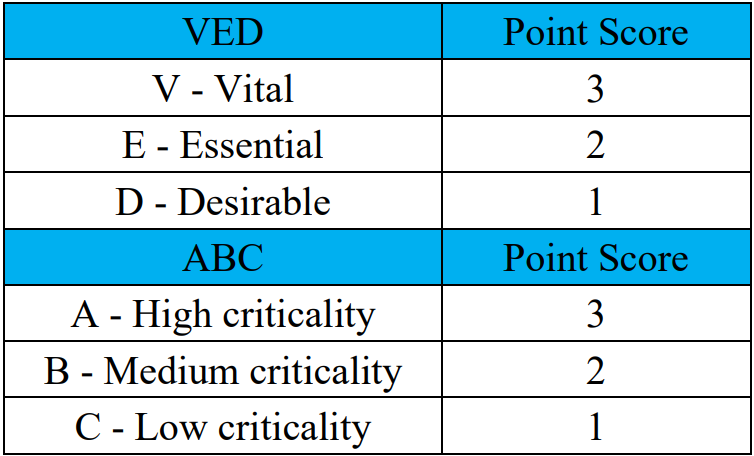
Table 8. VED–ABC Combination for Equipment Prioritization

Source: PINTO, Matheus Fernandes; ICHINOSE, Roberto Macoto. Priorização de Plano de Manutenção de Equipamentos Médicos Hospitalares Utilizando as Classificações ABC e VED. In: Encontro Nacional de Engenharia.
3 RESULTS AND DISCUSSION
This section demonstrates how the integration of the VED and ABC classifications can be used to objectively prioritize the preventive maintenance of medical and hospital equipment. By combining the functional criticality of each device with its operational impact, it was possible to develop a structured model that guides maintenance scheduling according to risk and reliability levels. This model was guided by objective criteria (WHO) and supported by international data (ICIJ).
The analysis revealed that equipment classified as Vital and belonging to Class A represents the highest priority group, requiring weekly maintenance. This category includes devices such as Defibrillators and Monitors, whose failure can directly endanger patient life.
Equipment classified as Vital in Class B, or Essential in Class A, received high priority with a biweekly maintenance schedule. Examples include Anesthesia Machines and Hypothermia/Hyperthermia Equipment.
Essential equipment in Class B or Desirable equipment in Class A showed medium operational criticality, requiring monthly maintenance, as it still significantly impacts hospital service efficiency — for example, Heated Humidifiers and Portable Surgical Lights.
Finally, devices classified as Essential in Class C, or Desirable in Class B, such as fiber- optic light sources and medical video cameras, were assigned low priority with bimonthly maintenance, due to their lower clinical impact and lower frequency of failures.
The analysis provided measurable criteria to support planning decisions, linking maintenance frequency directly to risk levels and equipment reliability. This quantitative approach enhances transparency in defining work orders and promotes a more efficient allocation of human and financial resources within clinical engineering.
Table 9. VED + ABC Classification result

Source: Elaborated by the author (2025).
4 CONCLUSION
Prioritizing the maintenance of medical and hospital equipment (MHE) based on the VED and ABC classifications on a global level has proven to be an effective strategy for optimizing technological management in healthcare institutions. The integration of both classifications provides objective and standardized criteria for defining priority and maintenance frequency, adapting preventive maintenance plans to the specific risk profile of each piece of equipment. The model reduces downtime, optimizes resources, and strengthens patient safety and system reliability, and standardizing clinical engineering practices according to global quality standards.
It is therefore concluded that this model is a highly useful tool for strategic hospital maintenance planning and can be adopted in both public and private institutions. Furthermore, the study highlights the importance of international databases, such as the ICIJ, in supporting technical decisions with field evidence and enhancing the reliability of the prioritization process.
Although the priority column was well established and consistent with the two proposed classifications, future work should focus on the practical validation of the model in hospital environments, particularly to assess the applicability of the periodicity column in real maintenance routines. The proposed model can serve as a reference for improving maintenance management and optimizing hospital technology planning worldwide.
REFERENCES
1. ICIJ. The Implant Files. International Medical Devices Database. Available at: https://medicaldevices.icij.org/. Accessed on: October 24, 2025.
2. WHO. Medical Equipment Maintenance Programme Overview. World Health Organization, Geneva, p. 92, 2011a. (ISBN 978 92 4 150153 8).
3. PINTO, Matheus Fernandes; ICHINOSE, Roberto Macoto. Prioritization of the Maintenance Plan for Hospital Medical Equipment Using ABC and VED Classifications. In: National Production Engineering Meeting (ENEGEP), 41st, 2021, Foz do Iguaçu.
4. UDROIU, George. Optimization of Medical Equipment Maintenance Programs. Bulletin of “Carol I” National Defence University, 2021.
5. LIU, Yaojun; TANG, Yuhua; WANG, Ping; SONG, Xiaolin; WEN, Meilin. Reliability-Centered Preventive Maintenance Optimization for a Single-Component Mechanical Equipment, 2023.
6. WEBBER, Christina M.; MARTÍNEZ-GÁLVEZ, Gabriel; LOPERA HIGUITA, Manuela. Developing Strategies for Sustainable Medical Equipment Maintenance in Under-Resourced Settings, 2020.
7. ARAB-ZOZANI, M.; IMANI, A.; DOSHMANGIR, L. et al. Assessment of Medical Equipment Maintenance Management: Proposed Checklist Using Iranian Experience, 2021.
8. LIN, Zhensheng; KANG, Jian; ZOU, Benan. Maintenance Management Strategies for Medical Equipment in Healthcare Institutions: A Review, 2024.
9. CORCIOVĂ, Călin; ANDRIŢOI, Doru; LUCA, Cătălina. A Modern Approach for Maintenance Prioritization of Medical Equipment, 2020.
10. MARKETSANDMARKETS. Optimizing Medical Equipment Maintenance: A Strategic Framework for Reliable Healthcare Operations, 2025.
1Undergraduate student of the Electrical Engineering Program at Universidade Evangélica de Goiás – UniEVANGÉLICA, Anápolis Campus. E-mail: murillopedreiro85@icloud.com
2Faculty member of the Electrical Engineering Program at Universidade Evangélica de Goiás – UniEVANGÉLICA, Anápolis Campus. Master’s degree in electrical engineering (UFG). E-mail: adriano.santos@unievangelica.edu.br