
REGISTRO DOI: 10.69849/revistaft/ar10202508251110
Alexandre Wagner Barbosa Neves Filho
Abstract
Service providers working with schools and educational institutions face unique challenges in managing receivables, given the sector’s dependence on budget cycles, procurement regulations, and its mission-driven priorities. This paper examines effective collection strategies tailored to the education context, drawing on insights from trade credit management, public procurement governance, relationship marketing, and behavioral economics. Findings suggest that acceptance-ready invoicing, early-payment incentives, dynamic discounting, and supply chain finance mechanisms are particularly effective when aligned with the procedural requirements of educational buyers. Furthermore, evidence indicates that structured communication, documentation completeness, and alignment with academic and fiscal calendars significantly reduce payment delays while preserving long-term trust. Ethical compliance and careful contract architecture also play critical roles in ensuring financial sustainability for service providers without compromising educational service continuity. The study contributes to both managerial practice and academic literature by integrating cross-disciplinary perspectives to propose a coherent framework for receivables management in education-related services.
Keywords: Receivables management; Collection strategies; Service firms; Educational institutions; Public procurement; Trade credit; Financial sustainability; Relationship marketing.
Service providers that work with schools and other educational institutions face a distinctive receivables landscape shaped by public procurement rules, budget cycles, enrollment-driven seasonality, and a mission-oriented culture that prioritizes continuity of learning over commercial urgency. This article analyzes which collection strategies are most effective for firms delivering cleaning and facilities services, student transport, IT support, tutoring, meals, and maintenance to schools. It integrates insights from trade credit and receivables research, public procurement and education finance, relationship marketing, and behavioral science to propose an evidence-based playbook that improves cash conversion while preserving long-term partnerships central to the education sector.
A starting point is designing credit terms that reflect service risk and the governance of the buyer. Classic trade-credit research shows that payment terms are not merely a financing tool but also a device to manage quality verification and bargaining (Ng, Smith, & Smith, 1999). In the school context, verification hinges on service-level acceptance—e.g., cleanliness audits, route completion logs, help-desk closure reports—which suggests structuring milestones and partial acceptances so invoices can be approved in smaller, lower-friction batches. Where buyers are public entities, documented acceptance linked to performance-based service level agreements (SLAs) and sign-offs by designated officials reduces disputes and shortens approval time, an approach consistent with public procurement governance emphasizing clarity of deliverables and accountability (Thai, 2001; Domberger & Jensen, 1997). For multi-school contracts, master service agreements with school-level purchase orders—each with distinct acceptance evidence—limit the risk that one site’s dispute holds up portfolio-wide payment.
Pre-contract screening remains essential but should be adapted to public and quasi-public buyers. Private credit scoring is less informative for a school district than understanding its appropriation timing, prompt-payment policies, and historical days-to-pay. Procurement literature notes that public entities often pay reliably but on rigid schedules tied to budget calendars (Arrowsmith, 2010). Providers should therefore price and staff to the cash cycle they will actually face. Two practical structures reduce working-capital strain without eroding relationships: early-payment discounts and dynamic discounting on approved invoices. Empirical work on trade credit indicates that price-discount incentives can align interests when quality is verifiable and administrative capacity exists (Summers & Wilson, 2000). In education, discounts offered post-approval—rather than at the PO stage—are more ethical and effective because they avoid pressuring public officials during competitive tendering and are applied only after services meet standards. Where districts cannot accept discounts due to policy, supply chain finance (SCF) or receivables purchase programs can be arranged with a financing partner that advances funds at modest spreads once invoices reach “approved” status; the SCF literature documents how such arrangements lower suppliers’ financing costs by leveraging the buyer’s credit quality (Gelsomino, Mangiaracina, Perego, & Tumino, 2016).
Collections communication should sequence “soft” measures first, blending rigor with the trust that underpins repeat contracts in education. Relationship marketing research underscores that credible, responsive communication and procedural fairness drive long-term buyer–seller ties (Dwyer, Schurr, & Oh, 1987; Grönroos, 1994; Zeithaml, Parasuraman, & Berry, 1988). For schools, front-line administrators juggle multiple priorities; disputes often stem from missing documentation rather than opportunistic delay. A high-yield tactic is “acceptance-ready” invoicing: attach objective evidence (SLA dashboard, ticket closures, route manifests, supervisor sign-off, and a plain-language variance note). When invoices arrive complete and easy to audit, buyers approve faster. Many districts also require vendor registration portals; aligning invoice metadata with purchase order fields (fund codes, location codes, service period) prevents rejections and restarts that prolong days sales outstanding (DSO).
Behavioral insights offer further gains at minimal cost. Randomized field evidence shows that simple reminders and salience cues can meaningfully reduce delinquency and improve timely actions (Karlan, McConnell, Mullainathan, & Zinman, 2016). Applied to education receivables, the cadence could be an automated pre-due reminder five business days before due date, a due-date reminder with a one-click link to the invoice packet, and a post-due nudge framed around shared goals (“ensures uninterrupted service for students”) while remaining compliant with public-sector tone norms. The message should specify next steps, name the approving official, and include a direct contact. Where permissible, statements can highlight the costs to the school of delayed payment (e.g., loss of early-payment discount) rather than threatening service interruption—preserving the prosocial framing that schools respond to and avoiding harm to learners.
For public buyers in jurisdictions with prompt payment regulations or late-payment penalties, the strategy is to reference the policy neutrally, supply the acceptance evidence, and request a specific payment run date. Legal and policy frameworks—such as prompt-payment statutes and, in the EU, measures inspired by the Late Payment Directive—seek to protect suppliers’ cash flow without adversarial escalation; aligning dunning letters with these rules increases legitimacy and resolution speed (European Commission, 2011; Arrowsmith, 2010). In low-capacity contexts, an escalation map that moves from accounts payable to the contract manager, then to the procurement officer, and finally to the finance director—each time adding missing documents and narrowing the ask—outperforms legalistic demand letters that can undermine future tenders.
Contract architecture strongly shapes collection effectiveness. Fixed fees with monthly tranches are simpler to approve than variable “time and materials”; when variability is unavoidable (e.g., incident-driven IT tickets), monthly not-to-exceed caps plus pre-agreed unit prices and a close-out meeting reduce disputes. Retention mechanisms common in facilities contracts should be modest and time-bound to avoid becoming de facto slow payment. Clear service credits for underperformance, applied contemporaneously, minimize end-of-year reconciliation that can stall approvals. From a governance standpoint, such clarity aligns with recommendations in public procurement scholarship to reduce ex-post renegotiation and improve measurable performance criteria (Thai, 2001; Domberger & Jensen, 1997).
Working-capital tools can be decisive for vendors serving many schools simultaneously. Factoring or invoice discounting—used judiciously—can smooth cash conversion when the underlying approval is reliable, as trade-credit studies show firms adopt receivables finance when facing long but low-risk terms (Summers & Wilson, 2000; Ng et al., 1999). For multi-year framework agreements, non-recourse programs priced on the school district’s credit standing can be cheaper than overdrafts. Providers should also employ portfolio analytics: segment receivables by buyer type (public district, charter, private), by documentation completeness, and by dispute reason. Targeted Kaizen on the top three dispute codes (e.g., mismatched PO line, missing acceptance, wrong period) often trims DSO more than across-the-board pressure campaigns.
Another differentiator is aligning service delivery with the academic and fiscal calendars. Education finance emphasizes the constraints created by budget adoptions, mid-year adjustments, and year-end close processes (Odden & Picus, 2014). Providers should time large invoices away from known blackout periods, front-load acceptance meetings before school breaks when approvers are present, and, where permitted, split invoices monthly rather than quarterly to fit routine payment runs. For student transportation and food services, where disruption is sensitive, pre-agreed contingency clauses enable continued service during disputes while financial adjustments are settled separately; this protects students and reduces the risk that payment conflict escalates.
Ethical and regulatory compliance is non-negotiable when collecting from schools. Data shared in invoicing and reminders must respect confidentiality rules, and communications should exclude student-identifiable information. While the specific statutes vary by jurisdiction, the principles mirror those in education privacy regimes and public ethics guidance, reinforcing that effective collections in this sector rely on procedural propriety as much as financial acumen (Arrowsmith, 2010). Internally, providers should separate account management from collections escalation to protect relationships, adopting a “service advocate” and a “cash advocate” who coordinate but communicate differently—one to resolve operational issues, the other to finalize payment logistics.
The flowchart illustrates the sequential process of effective collection strategies for service firms working with educational institutions. It begins with recognizing the unique challenges of the educational sector and moves to designing credit and contract strategies that align with procurement rules. Next, it highlights the role of incentives and financing mechanisms, such as early-payment discounts and supply chain finance, followed by the importance of structured communication and complete documentation to minimize delays. Behavioral insights, including reminders and positive framing, further support timely payments. When issues persist, escalation and compliance ensure resolution, while working capital tools help firms maintain financial stability. Finally, continuous monitoring and evaluation ensure sustainable cash flow and long-term trust with schools.
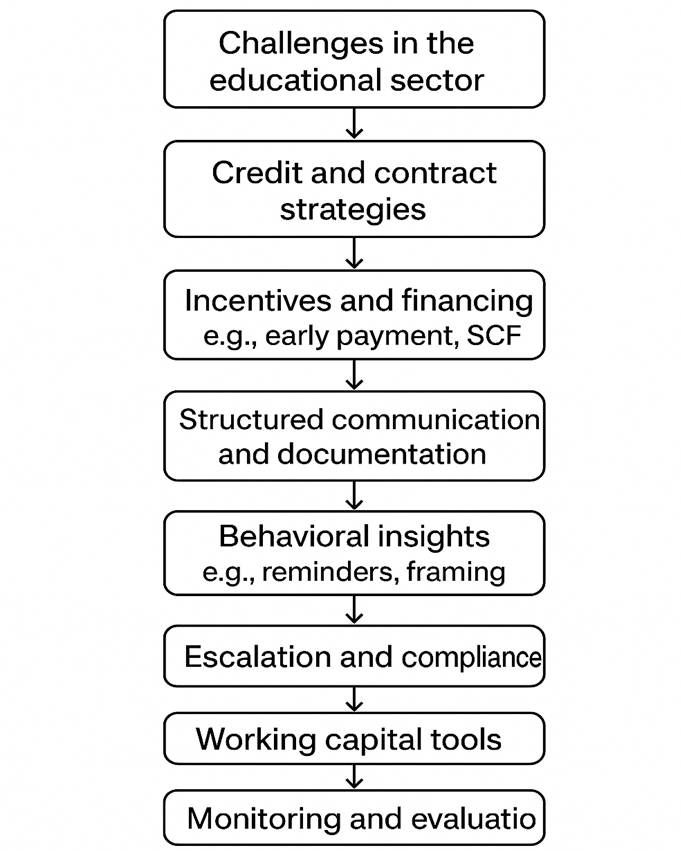
Source: Created by author.
Finally, the strategy must be evaluated empirically. Providers should track leading indicators—first-pass approval rate, median approval days by site, share of invoices with complete acceptance at submission—and run controlled pilots of specific tactics, such as acceptance checklists or reminder cadences. Over time, firms can benchmark buyers by actual days-to-pay and documentation friction, feeding this information back into bid pricing and staffing. The cumulative effect is a receivables system tuned to the realities of education: respectful, documentation-heavy, calendar-aware, and backed by selective financing that minimizes cost of capital. When executed with this balance, companies improve cash flow without compromising the trust that keeps them in classrooms, buses, cafeterias, and server rooms—where their services directly support student outcomes.
References
Arrowsmith, S. (2010). The Law of Public and Utilities Procurement (3rd ed.). Sweet & Maxwell.
Domberger, S., & Jensen, P. (1997). Contracting out by the public sector: theory, evidence, prospects. Oxford Review of Economic Policy, 13(4), 67–78.
Dwyer, F. R., Schurr, P. H., & Oh, S. (1987). Developing buyer–seller relationships. Journal of Marketing, 51(2), 11–27.
European Commission. (2011). Directive 2011/7/EU on combating late payment in commercial transactions.
Gelsomino, L. M., Mangiaracina, R., Perego, A., & Tumino, A. (2016). Supply chain finance: a literature review. International Journal of Physical Distribution & Logistics Management, 46(4), 348–366.
Grönroos, C. (1994). From marketing mix to relationship marketing: towards a paradigm shift in marketing. Management Decision, 32(2), 4–20.
Karlan, D., McConnell, M., Mullainathan, S., & Zinman, J. (2016). Getting to the top of mind: How reminders increase saving. Management Science, 62(12), 3393–3411.
Ng, C. K., Smith, J. K., & Smith, R. L. (1999). Evidence on the determinants of credit terms used in interfirm trade. The Journal of Finance, 54(3), 1109–1129.
Odden, A., & Picus, L. O. (2014). School Finance: A Policy Perspective (5th ed.). McGraw-Hill.
Summers, B., & Wilson, N. (2000). Trade credit management and the decision to use factoring: An empirical study. Managerial and Decision Economics, 21(1), 17–24.
Thai, K. V. (2001). Public procurement re-examined. Journal of Public Procurement, 1(1), 9–50.
Zeithaml, V. A., Parasuraman, A., & Berry, L. L. (1988). SERVQUAL: a multiple-item scale for measuring consumer perceptions of service quality. Journal of Retailing, 64(1), 12–40.
Freitas, G. B., Rabelo, E. M., & Pessoa, E. G. (2023). Projeto modular com reaproveitamento de container maritimo. Brazilian Journal of Development, 9(10), 28303–28339. https://doi.org/10.34117/bjdv9n10-057
Gotardi Pessoa, E. (2025). Analysis of the performance of helical piles under various load and geometry conditions. ITEGAM-JETIA, 11(53), 135-140. https://doi.org/10.5935/jetia.v11i53.1887
Gotardi Pessoa, E. (2025). Sustainable solutions for urban infrastructure: The environmental and economic benefits of using recycled construction and demolition waste in permeable pavements. ITEGAM-JETIA, 11(53), 131-134. https://doi.org/10.5935/jetia.v11i53.1886