
REGISTRO DOI: 10.69849/revistaft/ni10202512201619
Sergio Mario Lins Galdino
Jornandes Dias da Silva*
Abstract
Sugarcane bagasse was processed via aqueous acid hydrolysis to produce xylose and glucose solutions from hemicellulose and cellulose, respectively. These monosaccharides were then hydrogenated using a nickel catalyst to yield polyols. The hydrolysis resulted in yields of 21.67% (xylose) and 14.03% (glucose), based on the dry weight of lignin-free bagasse. The hydrogenation process produced xylitol (78.62% yield) and sorbitol (39.64% yield). Kinetic analysis revealed activation energies of 12.92 kJ/mol for hemicellulose hydrolysis, 29.88 kJ/mol for cellulose hydrolysis, 42.74 kJ/mol for xylose hydrogenation, and 49.08 kJ/mol for glucose hydrogenation.
Keywords: biomass, hydrolysis, catalytic, carbohydrates, hydrogenation, polyols
1. Introduction
Biomass conversion processes involving hemicellulose and lignin pretreatment, followed by acid hydrolysis of cellulose, enable the breakdown of these polymeric structures. The resulting saccharides possess a wide range of functional groups, allowing the formation of compounds with diverse chemical structures. Combined with their high availability from agricultural sources, these saccharides represent promising intermediate feedstocks for the production of value-added compounds.
The processing of rich raw materials in saccharides (sugarcane, starch, molasses, and bagasse) have been the subject of studies (Abreu et al., 1995; Baudel et al., 2005; Dussán et al., 2014; Oliveira et al., 2015) to yield products with potential to industrial application. Biomass conversions employ hydrolysis and pre-treatments of hemicellulose and lignin, and acid or enzymatic hydrolysis of cellulose to break the polymeric structures to their saccharides and lignin components to value added chemicals for subsequent processing (Aho et al., 2015; Kusserow et al., 2003, Yadav et al., 2012). Hemicellulose and cellulose can be depolymerized by acid hydrolysis to produce xylose and glucose, respectively (Guan-Yu Pan et al., 2016, Mushrifet al., 2015). In the presence of homogeneous or heterogeneous catalysts the oligomeric mixtures selected may be processed in order to produce valuable chemicals. Through catalytic hydrogenation these mixtures can be converted to polyols.
Catalysts based nickel, chromium and copper has been used to hydrogenate mono- and disaccharides into polyols (Turek et al., 1983). Recently, novel catalysts based on ruthenium has been formulated to improve this hydrogenation activity [Mushrif et al., 2015]. Hydrogenation of aqueous glucose solution was performed in batch and continuous reactors using supported nickel and ruthenium catalysts (Mikkola et al., 2000).
In this work, the sugar cane bagasse was processed by acidic hydrolysis in operating steps that provided the availability of xylose and glucose, from the hemicellulose and cellulose, respectively. Then, the solutions were processed by hydrogenation with nickel catalyst to promote the production of polyols. The kinetic evaluation methodology was adopted for quantitative evaluation of the hydrolyses and hydrogenations.
2. Material and Experimental Methods
The reaction operations, including alkaline delignification and acid hydrolysis were carried out in a slurry reactor (VR =1.5L) using solid-liquid ratios of 1:3 and 1:1. The delignification was conducted with the bagasse treated by pre-hydrolysis. The residual material was filtered (mbag) and the liquid phase analyzed in terms of total solids and lignin. The hemicellulose extraction was carried out with an aqueous solution of H2SO4 (1.0 wt.%) at 80°C, 90°C and 100°C during 2 hours. After the operation the material was quantified in terms of residual solid (cellulose) and saccharide content. The cellulosic fraction was hydrolyzed at 140°C, 160°C and 180°C, under inert atmosphere (Ar, 30 bar) for 3 hours with a HCl solution (20.0 wt.%) containing LiCl (8.0 wt.%). The hydrolysates from hemicellulose and cellulose were processed with Ca(OH)2 and Pb for sulfur and chlorine removal, respectively.
Then, the saccharide solutions were processed by catalytic hydrogenation. The catalyst used was prepared from nickel nitrate (Ni(NO3)2.6H2O, Sigma) and activated carbon (Sp = 890 m2g-1, dp= 91 μm, Carbomafra Co., Br) as support. The preparation method was the incipient wetness where the activated carbon was impregnated by the nickel nitrate solution. The solid was dried at 393 K for 12 h, and calcinated at 500 ºC in argon flow during 5h. To promote the activation, the material was reduced in hydrogen flow (1:1 v/v, 120 cm3.min-1, 3 h) at 700 ºC, during 2h. The catalyst was characterized by the methods including metal content determinations by atomic absorption spectrophotometry (A.A.S., Model-CGAA7BC), textural characterization (Sp, Vp) according to the BET method (BET, ASAP 2010), and solid phases by X-ray diffraction (XRD, Cu-K source, Siemens D5000).
The hydrogenation experiments were carried out with 0.50 L saccharide solutions in a batch reactor (Parr Inst., USA, 1.0 L). The initial concentrations of xylose and glucose were 98.86 g.L-1 and 102.32 g.L-1, respectively, and the catalyst was 5.0 g.L-1. The reaction was started when the reaction temperature was reached the operating temperature, under 30.0 bar, maintained constant, and measured with an accuracy of ± 1 K.
Analyses of saccharides and polyols in the liquid phases were performed via liquid chromatography (HPLC) with a column Aminex HPX-87 (BioRad, USA), using H2SO4-0,001N as mobile phase.
2.1. Model Calculations
The solutions of the mass balance equations were obtained by the 4th order Runge-Kutta method using the initial condition: t = 0; CPDn = CPDn0 and CMo =0. A numerical optimization procedure was associated with the solution method where the initialization values of the kinetic parameters were modified by comparing the solutions in terms of the component concentrations with the experimental ones. The optimized final values of the parameters were obtained by defining a quadratic objective function f0 (f0 = Σf0i; i = PDn, Mo), where f0i = Σ(CmiExp – CmiTh)2, m = 1,2,…,n,andCmiExp and CmiTh are the experimental and calculated concentrations of each component of the process.
3. Results and Discussion
The fractionation of the biomass by extraction of hemicellulose and cellulose (PDn, degree of polymerization) and subsequent depolymerization of oligosaccharides (PNDn-1) and monosaccharides (Mo) is formulated below,

Based on the reaction scheme and considering steady state approximation for the intermediate acidified oligomers (PDnH; n = 1, 2, 3 ….) the rate of production of monosaccharides (rMo) is expressed as follows:

Where kPDn e k’PDn are the rate constants of the steps of acidification and depolymerization, respectively. C0PDn,CMo and C0AcHare the initial concentrations of the components, polysaccharide, monosaccharide and acid.
3.1. Hydrolysis of Hemicellulose
The fractionation of biomass with extraction of hemicellulose (PDn = Hm) and consequent depolymerization was considered where the biomass pulp (free lignin) was subjected to an acid diluted hydrolysis (AcH = H2SO4), that promoted high decomposition and removal of hemicelluloses. Eq. 2, including the production rate of monosaccharide (Eq. 1), represents the mass balance in terms of concentrations for the operation (batch) of the hemicellulose conversion into xylose (Mo = XL).

The solution of the mass balance equation associated to the optimization procedure was performed with the data of each isothermal operation where the values of the kinetic parameters were estimated at the three temperatures. Then, Arrhenius law was applied and the activation energy (EatHm) value was obtained. The Fig. 1 shows the experimental and predicted concentrations of residual oligomers, and produced xylose.
Figure 1 – Concentration evolutions of hemicellulose oligomers and xylose. Conditions: 100ºC, mbag = 50.0 g, VL = 1.50 L, HCl (5.0% wt.).

The evolution of concentrations indicates that xylose extraction (64% yield, [xylose/hemicellulose] x100) was very pronounced, accounting for 16.0 % wt./biomass at 100°C after 3 hours using 5.0 % by weight of sulfuric acid solution. The arabinose content was approximately 1.2 % wt./biomass, while the degradation product (furfural), produced via dehydration, was obtained in low concentrations (1.0 % wt./biomass).
From the constant reaction rate values in the operating temperatures (k80ºC = 8.13×10⁻³ min-1,k90ºC = 9.87×10⁻³ min-1, k100ºC = 10.23×10⁻³ min-1) was estimated an order of magnitude of the activation energy for the hydrolytic conversion of hemicellulose, EatHm = 12.92 kJ / mol.
3.2. Hydrolysis of Cellulose
The cellulose pulp (PDn = Cel), processed by acid hydrolysis (AcH = HCl) in presence of LiCl, was converted into oligomers (PDn-1) and monosaccharide (Mo = GL). The mass balance, including the production rate of glucose rGL (Eq. 1), was formulated in Eq. 3 for the operation (batch) of cellulose conversion into glucose (GL).

A similar procedure that adopted for the hemicellulose-xylose process was employed to solve the mass balance equation of cellulose-glucose process. Figure 2 shows the evolution of experimental and predicted concentrations of residual oligomers and glucose produced.
Figure 2 – Concentration evolutions of cellulose oligomers and glucose. Conditions: 180ºC, mbag = 50.0 g, VL= 1.50 L, HCl (25.0 % wt.), CLiCl =10 g/L.
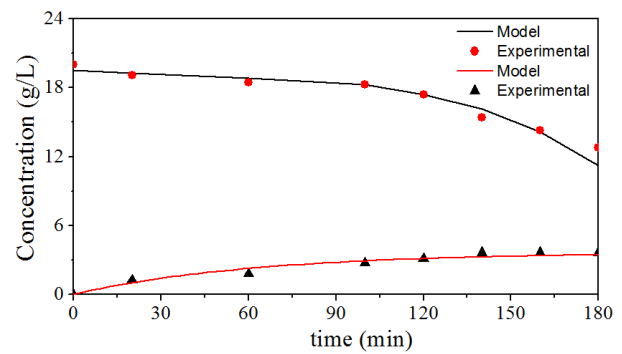
The cellulose conversion reached a level of 34 %, and lithium chloride was an effective promoter for the acid hydrolysis of cellulose. The evolution of concentrations indicates that glucose extraction (16.23 % yield, [glucose/cellulose]x100) accounting for 10.52 % wt./biomass at 100 °C after 180 minutes using 5.00 % by weight of sulfuric acid solution. The degradation product (hydroxylmethylfurfural), obtained via dehydration, was obtained in low concentrations (0.76 % wt./biomass).
The values of the kinetic parameters were estimated in three different temperatures (kCel1(40°C) =18.44 x 10⁻⁴ min-1, kCel1(60°C) = 22.31 x 10⁻⁴ min-1, kCel1(80°C) = 36.87 x 10⁻⁴ min-1). The activation energy value (Arrhenius’ law) was obtained, EatCel = 29.88 kJ/mol.
3.3. Hydrogenation of Carbohydrates
Soluble carbohydrates obtained from biomass were hydrogenated in presence of Ni (9.6% wt.)/AC catalyst at 160ºC under H2, 30.0 bar. The nickel content and its surface area, characterized by AAS and B.E.T.-N2, were 9.65 % by weight and 578 m2/g, respectively. The XRD analyses allowed identify the nickel oxide (2θ 37.7º, 63.7º) and nickel presences at 2θ 44.5º, 51.8º.
3.3.1. Modeling of hydrogenation operations
The hydrogenation of monosaccharides (No) originated from hemicellulose and cellulose, is represented by H2 (g) + Mo(L) ⎯Cat⎯→ Po(L), where Po are the polyols (xylitol, arabitol, sorbitol). The monosaccharide production rate (Eq. 3) is expressed by a model of Langmuir-Hinshelwood type, dehydrogenation-hydrogenation. The model assumes adsorption of hydrogen on basic sites (activated carbon support), adsorption of glucose on metallic sites (nickel), through the aldehyde function, interaction hydrogen-aldehyde, and desorption of the formed polyol.

The mass balance of the components (j = Mo, Po), which describe the evolution of the processes are represented by Eq. 4, referring to the operation in the slurry reactor. It is assumed that hydrogen is retained surplus in the liquid phase under pressure, where there is strong mechanical agitation, ensuring chemical kinetic regime conditions. At the operating conditions, to confirm the rate-controlling regime in the catalytic reaction the mass transfer limitations through the Weisz criterion, Ф҆i (Фi’ = riLc2/Dei Ci), and the external mass transfer resistance fraction fei (fei = riLc/kimCi) were quantified. The estimated values [Ф’i = (0.85-3.85) x 10-3;fei = (5.73-8.96) x 10-4] show that the process was rate-controlling, indicating that there was no mass transfer limitations. The mass balance equations are expressed as:

Where Mc is the catalyst mass, VL is the liquid volume and kMo = k KH2 KMo PH2 [HH2 (1+KH2CH2)]-1; KH2, PH2, HH2 are the hydrogen parameters (adsorption equilibrium constant, partial pressure, Henry’s constant). The initial condition is, t = 0 ; CMo = CMo,0 and CPo = 0.
From the experimental concentrations of monosaccharides and polyols the proposed models were well adjusted (objective functions, fo,XL-X = 6.25×10⁻², fo,GL-G = 3.08×10⁻²). In Figs. 3 and 4 are shown the concentration evolutions, experimental and predicted by the models.
Figure 3 – Hydrogenation of carbohydrates and conversion of xylose into xylitol. Conditions: cat. Ni (9.62% wt.)/AC, 160ºC, 30.0 bar.

Figure 4 – Hydrogenation of carbohydrates and conversion of glucose into sorbitol. Conditions: cat. Ni (9.6% wt.)/AC, 160ºC, 30.0 bar.
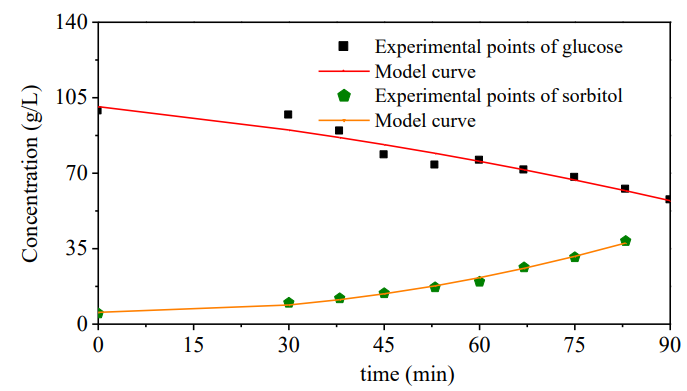
Based on the model adjustment, were estimated values of the reaction rate constants (kMo = kX, kG), and the adsorption constants (KMo = KX, KG; KPo = KXL, KS), ( see Tables 3, 4).
Table 3 – Parameters of hydrogenation of xylose into xylitol. Conditions: cat. Ni (9.62% wt.)/AC, 120 – 160ºC, 30.0 bar.

Table 4 Parameters of hydrogenation of glucose into sorbitol. Conditions: cat. Ni (9.62% wt.)/AC, 120 – 160ºC, 30.0 bar.

Kinetic assessments at three temperatures with Ni catalyst (9.6% wt.)/AC, led to estimates of the activation energy values (Arrhenius’law) for the hydrogenation of glucose and xylose to xylitol and sorbitol, respectively. For xylose hydrogenation, the value of EatXL = 42.74 kJ/mol was lower to that found by Mikkola et al. (2000) (53.00 kJ/mol), with Raney Ni at 130ºC and 70.0 bar. For the glucose hydrogenation, EatGL = 49.08 kJ/mol was of an order of magnitude somewhat higher than that obtained by Turek et al. (1983) (38.54 kJ/mol), with nickel catalyst supported on sílica.
The values of the adsorption constants of monosaccharides were higher than the polyols. The estimated heats of adsorption for xylitol (ΔHad = 6.75kJ/mol) and sorbitol (ΔHad = 97.05kJ/mol) (vant ‘Hoff equation) are consistent with the experimental evidences of their availability in the liquid phase due its weak adsorption suitable for your product conditions.
4. Conclusions
Hemicellulose and cellulose obtained from sugarcane bagasse were depolymerization by acid hydrolysis to produce xylose and glucose. The monosaccharides were produced with yields [(monosaccharide/polysaccharide) x 100] of 63.87% in xylose, and 21.05% in glucose. Based on mass of sugarcane bagasse, free of lignin, the saccharides were accounted for 21.67 % and 14.03 % wt./biomass.
The monosaccharide solutions (102.32 g xylose.L-1, 98.86 g glucose.L-1) were hydrogenated in the presence of nickel catalyst (Ni (9.6% wt.)/AC), with activities quantified by the activation energies of EatXL = 42.74 kJ/mol for xylose hydrogenation and EatGL = 49.08 kJ/mol for glucose hydrogenation.
The valuable polyols were produced with yields of 78.62% in xylitol, and 39.64% in sorbitol.
Nomenclature


References
Abreu, C. A. M., Lima Filho, N. M. and Zoulalian A., Biomass and Bioenergy, v. 9, pp. 487-492 (1995).
AhoA., RogganS.,EränenK., SalmiT. and MurzinD. Y., Continuous hydrogenation of glucose with ruthenium on carbon nanotube catalysts Catalysis Science and Technology, v.5, pp. 953-959 (2015).
Baudel, H. Zaror, M., C. and Abreu, C. A. M., Improving the value of sugarcane bagasse wastes via integrated chemical production systems: an environmentally friendly approach. Industrial Crops and Products, v. 21, pp. 309-315 (2005).
Dussan, K. J., Silva, D. D. V., Moraes, E. J. C., Arruda P. V. and Felipe M. G. A., Acid hydrolysis of cellulose to glucose from sugarcane bagasse. Chemical Engineering Transactions, v. 38, pp.433-438 (2014).
Guan-Yu Pan, Yu-Long Ma, Xiao-Xia Ma, Yong-Gang Sun, Jun-Min Lv, Jian-Li Zhang., Catalytic hydrogenation of corn stalk into polyol over Ni–W/MCM-41 catalyst. Chemical Engineering Journal, v. 299, pp. 386-392 (2016).
Kusserow, B., Schimpf, S. and Claus P., Hydrogenation of Glucose to Sorbitol over Nickel and Ruthenium. Catalysts Advanced Synthesis and Catalysis, v. 345, pp. 289-299 (2003).
Mikkola, Jyri-Pekka, Vainio, H., Salmi, T., Sjöholm R., Ollonqvist T. and Väyrynen J., Deactivation kinetics of Mo-supported Raney Ni catalyst in the hydrogenation of xylose to xylitol. Applied Catalysis A: General, v. 196, 143-155 (2000).
Mushrif, S. H., Vasudevan, V., Krishnamurthy, C. B., Venkatesh, B., Multiscale molecular modeling can be an effective tool to aid the development of biomass conversion technology: A perspective. Chemical Engineering Science, v. 121, pp. 217-235 (2015).
Oliveira, C. C. B., Silva, D. J., Araújo, A. D. F., RaphaelC. R. B., Abreu, C. A. M., Kinetic evaluation of carbohydrate biomass conversions. Chemical Engineering Transactions, v. 43, 949-954 (2015).
Turek, F., Chakrabarti, R. K., Lange, R., Geike, R. and Flock, W., Chemical Engineering Science, v.38, 275-281 (1983).Yadav, M., Mishra, D. K., Hwang, Jin-Soo., Catalytic hydrogenation of xylose to xylitol using ruthenium catalyst on NiO Modified TiO2 support. Applied Catalysis A: General, v. 425 – 426, PP. 110 – 116 (2012).
*Polytechnic School – UPE, Laboratory of Environmental and Energetic Technology
Corresponding author: e-mail address: jornandesdias@poli.br