
AVALIAÇÃO DA DIETA DE CROTALUS DURISSUS LINNAEUS, 1758 (SQUAMATA, VIPERIDAE), EM CATIVEIRO
REGISTRO DOI: 10.69849/revistaft/cl10202509101218
Marina Gonçalves Lima¹
Rodney Murillo Peixoto Couto²
Fernanda de Cássia Gonçalves Alves Riquelme³
Paula Helena Santa Rita³
Luiz Humberto Guimarães Riquelme Junior⁴
Rodrigo Gonçalves Mateus⁵
RESUMO
O maior propósito no manejo nutricional de animais selvagens é oferecer a quantidade ideal e os nutrientes necessários para a manutenção do organismo saudável. O estudo teve como objetivo avaliar o desenvolvimento de dois manejos alimentares de serpentes gênero Crotalus durissus (Cascavel) cativas no serpentário do Biotério da Universidade Católica Dom Bosco. Foram alimentadas dez cascaveis, aos quais cinco animais pertencentes ao Alimentação 1 (A1) com Mus musculus e 5 animais pertencentes ao Alimentação 2 (A2) com Rattus norvergicus. As alimentações e coletas de dados foram pré estabelecidas realizando oito alimentações com intervalos de trinta dias e três coletas de dados com intervalos de noventa dias. As avaliações químicas das dietas foram feitas utilizando quinze exemplares de Rattus norvergicus e quinze de Mus musculus. Para avaliar as amostras foram utilizadas fezes da primeira excreção pós alimentação das serpentes. O A1 obteve uma maior taxa de digestibilidade do alimento comparado ao A2, obtendo maior ganho de massa e aumento do escore. A obesidade para répteis de cativeiro é algo indesejável. Deve ser almejado o oferecimento de uma alimentação adequada para a espécie e idade do animal, proporcionando uma melhor qualidade de vida, visando atender necessidades sanitárias, nutricionais e fisiológicas das serpentes.
Palavras-chave: Cascavel; Cativeiro; Dieta; Nutrição; Selvagem.
ABSTRACT
The main purpose of nutritional management for wild animals is to provide the optimal quantity and nutrients necessary for maintaining a healthy body. This study aimed to evaluate the development of two feeding regimens for captive snakes of the genus Crotalus durissus (Rattlesnake) in the serpentarium of the Dom Bosco Catholic University Animal Facility. Ten rattlesnakes were fed: five animals in Feeding Group 1 (A1) with Mus musculus and five animals in Feeding Group 2 (A2) with Rattus norvergicus. Feeding and data collection were preconditional, with eight feedings performed at thirty-day intervals and three data collections at ninety-day intervals. Chemical analyses of the diets were conducted using fifteen Rattus norvergicus and fifteen Mus musculus specimens. Feces from the snakes’ first post-feeding excretion were used to evaluate the samples. A1 showed a higher food digestibility rate compared to A2, resulting in greater mass gain and an increased score. Obesity in captive reptiles is undesirable. Aim to provide a diet appropriate for the animal’s species and age, ensuring a better quality of life and meeting their health, nutritional, and physiological needs.
Keywords: Rattlesnake; Captivity; Diet; Nutrition; Wild.
INTRODUCTION
In Brazil, the genus Crotalus is represented by a single species, C. durissus, and five different subspecies that have a wide spatial distribution throughout the territory, being found in the Cerrado, arid and semi-arid regions of the Northeast, and fields and open areas of the South, Southeast, and North (Melgarejo, 2003). They are robust animals and can measure up to 180 cm. Their feeding preferences are rodents and marsupials, but they can also prey on lizards (Bernarde, 2014). The prey of this species consists predominantly of rodents (Cavia, Rattus, and Mus) and birds (Salomão et al., 1995). However, teiid lizards (Ameiva) can also be part of the rattlesnake’s diet. There is no genetic variation within the species, feeding primarily on mammals (Salomão et al., 1995, Bernarde, 2014). For wild animals, captivity is a limiting factor where there is space restriction, low prey diversity, and in some groups adaptation to captive life does not occur, developing a process known as “Maladaptation Syndrome”, where animals develop an anorexic stage that can result in death (Santos, 2005).
For animals that do not adapt to captivity, the prognosis is poor and treatment for anorexia is difficult, given their difficulty in feeding themselves. Tube feeding can be a risky procedure that, when not performed by an experienced professional, can cause future stomatitis or traumatic esophagitis, serving as a gateway for some pathogens (Bassetti and Verdade, 2014).
Reptiles experiencing intense acute stress are predisposed to emaciation, immune depression, and reproductive difficulties. Chronically stressed animals, on the other hand, can develop obesity and hepatic lipidosis (Silvestre, 2014). Another pathogen is the deposition of urate crystals in tissues and organs. The normal blood concentration of uric acid in snakes varies between 2 and 6 mg/dl, and values above 25 mg/dl may be indicative of uric gout, and may be influenced by diet due to its sporadic availability (Kolesnikovas et al., 2007).
In these cases, prophylactic management is the best way to control this unfavorable prognosis. As a preventative methodology, certain feeding management methods and environmental enrichment studies should be developed for captive animals, making captivity a more appropriate environment, specifically tailored to each species. Generally, well-nourished animals, not subjected to adverse situations, live in apparent harmony and health. These animals, when exposed to stressful conditions, such as captivity, can lose this delicate balance (Greco, 2000).
Properly designed feeding management seeks to approximate as closely as possible the diet these captive animals would receive in the wild. However, the nutritional requirements of each stage of the ontogenetic cycle and other situations that may arise when developing the diet must be considered (Leira, 2017). Inadequate nutrition can harm the animal’s health, such as diseases caused by malnutrition or excess nutrients, which generate physical consequences such as obesity or excessive weight loss, bone deformities, motor changes or even death (Leira, 2017).
The present work aimed to evaluate the efficiency of food management of captive snakes of the genus Crotalus durissus in the serpentarium of the Bioterium of the Universidade Católica Dom Bosco.
MATERIAL AND METHODS
The research was conducted in accordance with the Biodiversity Authorization and Information System (SISBIO) under registration number 47695-1, the Mato Grosso do Sul Environmental Institute (IMASUL), and the Animal Ethics and Use Committee (CEUA) of Dom Bosco Catholic University, under protocol number 010/2019. Ten snakes of the genus Crotalus durissus were used. They were subjected to treatments following a randomized block design and distributed into two treatments according to feeding management. The ten snakes used were divided into feeding groups based on sex (three males and two females), lengths ranging from 100cm to 125cm, and weights ranging from 500g to 700g. All animals had been held captive for more than two years and were pre-evaluated as healthy animals.
Feeding Group 1 (A1) – five snakes fed every thirty days with three 40g Swiss mice (Mus musculus) per snake;
Feeding Group 2 (A2) – five snakes fed at the same frequency as Group A1, using three 40g Wistar rats (Rattus norvergicus) per snake per feeding. Both strains were heterogeneous, with females and males meeting conventional health standards.
To monitor the animals’ development, the following zootechnical parameters were assessed: total length (cm), tail length (cm) using a tape measure, weight (g) on a Marte® LS 500 scale, and body condition score according to the table described by Alves (2019).
Clinical parameters were also assessed: heart rate auscultation; respiratory rate counting; integrity of dorsal and ventral scales; color of the cloacal and oral mucosa; body temperature; pupillary reflex; proprioception; venom extraction and volume of venom extracted.
Feeding was as suggested by Melgarejo (2003), offering 15% to 20% of the total for each animal, achieving an average monthly food weight of 120g for each snake. This was done over the eight-month experiment, on predetermined dates, always fifteen days after the zootechnical data assessments. The snakes were weighed one day before food was offered for weight recording and monitoring.
To maintain the snakes in captivity, inspections and maintenance were performed daily. The animals were handled only when it was necessary to remove soiled substrate, refill, and/or change the water bowl.
Zootechnical, clinical, and blood parameters were collected throughout the eight-month experimental period (October to June). Three collections were performed two months apart, thus obtaining average data for the three periods, including initial time (Ti), mean time (Tm), and final time (Tf). For the data and sample collection procedure, herpetological hooks and transparent PVC acrylic containment tubes were used.
Uric acid was analyzed using plasma extracted from a whole blood sample collected from the animals, via tail vein puncture (Campbell, 2006) using 1 mL syringes with a 13×0.45 mm-26G needle. Plasma was obtained by centrifuging the tube at 2,500 rpm for 10 minutes. Biochemical analysis was performed using Bioplus® flow cytometry, and the Analisa® reagent was used to determine the results.
For the chemical evaluation of the food, fifteen Swiss mice and fifteen Wistar rats were used. The animals were euthanized and divided into small pieces of approximately 2 cm. The samples were kept in a Marconi® incubator for 168 hours at a constant temperature of 65°C. For the first four days, the samples were rotated to ensure uniform drying. After drying, the carcasses were ground in a sieve with a mesh fitted with 1 mm sieves.
For excreta analysis, feces from the snakes’ first post-feeding excretion were used. Three fecal samples were collected from the snakes: at the initial time (Ti) in October, the middle time (Tm) in February, and the final time (Tf) in June. The feces were placed in aluminum containers and separated into 30 packages, with three samples from each snake. The material was dried for 72 hours in an oven at 65°C and then manually macerated using a mortar and pestle.
The food and feces were analyzed in the laboratory for dry matter (DM), crude protein (CP), and ether extract (EE) contents, respectively, using methods 930.15, 976.05, and 920.39 (AOAC, 2000).
To evaluate the chemical composition data, treatments A1 and A2 were compared to samples of A1 (Wistar) and A2 (Swiss). For statistical analysis, the percentage data (%) were transformed into arcsin-sqrt (Arcsine transformation of Warton and Hui, 2011) to obtain closer homogeneity of variance.
To test the hypothesis that treatment conditions can alter the physical and physiological conditions of venomous snakes according to the following variables: weight (g), tail length (TL), total length (TL), heart rate (HR), respiratory rate (r), body temperature (BT), venom volume (VN), and score for individuals in groups A1 and A2.
Before statistical analysis, the Shapiro-Wilk data normality test was performed using the “shapiro.test” function (Royston, 1995). The variables TL, VN, and score were non-normally distributed and were transformed to standardize the data using the statistical model (Box & Cox, 1964) using the “dados_boxcox” function in the “MASS” package.
The remaining variables were normally distributed and underwent two-way ANOVA (ref) variance test using the “aov” function. Tests that obtained significance of p≤0.05 were compared by a Tukey a posteriori test (ref) using the “HSD.test” function of the “agricolae” package. All analyses were performed using the R Studio program – R language (R Core Team 2018).
RESULTS AND DISCUSSION
Analyzing the clinical and zootechnical parameters, it was noted that only the snakes’ body weight showed a significant difference (P=0.002). Group A1, which included snakes fed Swiss mice, had the greatest weight gain compared to Group A2 (Wistar rats). Excessive weight gain is not desirable for captive animals. According to Melgarejo (2002), the feeding frequency of snakes varies only according to the animals’ weight and age.
The difference in weight gain can be observed in both groups A1 and A2 by evaluating two foods with different compositions and digestibility rates (Table 1). This takes into account only feeding frequency and not the 20% percentage for adult animals as suggested by Greco (2000).
Table 1 – Zootechnical and clinical parameters of snakes of the genus Crotalus durissus subjected to two feeding managements
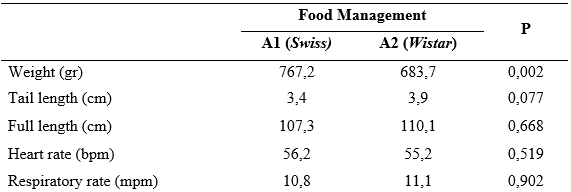

There were no significant differences in the results for tail length (3.65 cm), total length (108.7 cm), heart rate (55.7 bpm), respiratory rate (10.95 mpm), body temperature (28.6 °C), venom volume (36.55 μl), and body condition score (4.5 points). Corroborating these results, Santa-Rita (2018) describes that the results of the evaluation of zootechnical and clinical parameters are similar within the same species, and can have large variance when comparing snakes of different genera and species.
The low food selectivity of C. durissus contributed to this experiment, as these factors minimize food rejection and mortality in captivity. According to Marques et al. (2001), in free-living rattlesnakes, feeding is consistent with their geographic distribution, due to their high degree of adaptation to modified and anthropogenic environments.
The animals in this study received pathogen-free food to ensure good food quality and not compromise the health of the herd. The rodents were sourced from the Dom Bosco Catholic University vivarium.
The experimental feeding lasted eight months, beginning in spring and ending in fall. It was not possible to evaluate the influence of diet throughout the entire seasonal cycle. According to Salomão et al. (1995), the reproductive life of rattlesnakes naturally peaks in fall and winter, with offspring born in summer. However, the objective of this experiment was not to evaluate the potential impact of dietary management on the reproductive life of captive animals in intensive care. For both groups, statistics indicate no significant differences in development, even though both groups were of mixed genders.
Nutrition is crucial for sustaining an individual’s core physiological processes, and for snakes, it’s directly linked to their survival in captivity. During the eight-month experimental period, all snakes in both groups remained healthy and did not refuse food.
During the experimental period, weight gain in group A1 was greater than in group A2 (Figure 1).
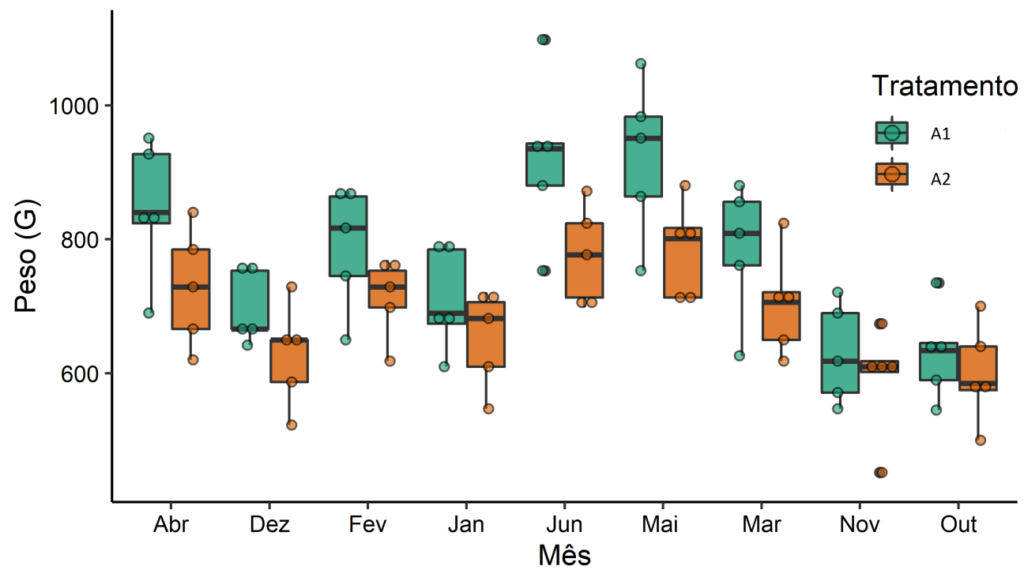
Figure 1 – Weight gain of snakes of the genus Crotalus durissus subjected to two feeding managements, during the eight experimental months.
When weight is assessed in conjunction with the Crotalus durissus body condition score chart (Table 1), it can be seen that the animals in group A1 gained excess weight when fed a diet with a higher digestive value. However, the chart shows that the animals in group A2 experienced less weight gain during the experimental period, and a small difference in the score.
For feeding, the animals are dependent on their keepers and the range of studies carried out to ensure their well-being. In captivity, it is common to observe cachectic or obese snakes. Although snakes have a high degree of adaptability, being kept in inadequate enclosures with inadequate feeding management develops obesity, creating a physiological overload for the animal. Reptiles that experience intense acute stress are predisposed to emaciation, immune depression, and reproductive difficulties. Conversely, chronically stressed animals can develop obesity and hepatic lipidosis (Silvestre, 2014).
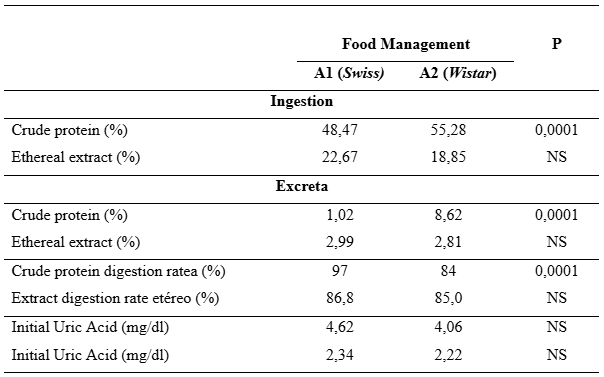
The chemical composition of food and excreta differed in terms of protein content (Table 2)
Table 2- Chemical composition of the diet and feces, apparent digestibility and plasma uric acid concentration of snakes of the genus Crotalus durissus subjected to two feeding managements.
Among the feeding management methods, the expected result due to the different species and ages of the rodents, a fact presented by Barbosa (2020), is not similar. The author mentions groups of the same species, but does not mention the gender and age of the animals. It is noteworthy that although in both studies the animals are rodents and were frozen for later sample analysis, the author discusses the nutritional and anti-nutritional importance of the age at slaughter, and also presents a comparative difference between the two species.
As a result of the fecal evaluation, A1 had a higher crude protein digestion rate, corresponding to 92%, and A2, 84% (Table 2). The animals in A1 had greater weight gain and increased body condition score compared to A2. The initial feeding of both groups was carried out as suggested by Melgarejo (2003), offering the adult animal 20% of its body weight once a month. Over the months, the animals gained mass, and during the eight-month experiment, to maintain a feeding pattern consistent with the rodent’s weight, there was no variation in the snakes’ diet or feeding frequency, maintaining a feeding schedule every thirty days with 120g of food for each animal. Therefore, it was observed that the percentages of food volume (g) decreased inversely proportional to the animal’s weight, which increased. It can be seen that the adequacy of feeding captive snakes is not simply related to the percentage of food relative to their weight, but rather to the feeding frequency and the quality of the food offered.
The digestion rate was calculated using the formula: (%) = [(ingested – excreted) / ingested] x 100. Feed digestibility in group A1 was higher than in group A2. This is explained by the chemical and bromatological values found in the protein and ether extract that make up the carcass of an approximately 50-day-old, 40g-old individual of the species Rattus norvegicus (Wistar), when compared to a Mus musculus (Swiss), approximately 120 days old, 40g, which has a higher percentage of protein and ether extracts. This corroborates the findings of Divers & Mader (2005), who reported a difference of 48% and 29% protein and 47% and 69% fat in the carcasses of adult Swiss and Wistar puppies, respectively.
The current study presents a difference in bromatological values (Table 2) between Swiss and Wistar rats. This corroborates Barbosa (2020), who mentions in his research on the centesimal composition of carcasses that, in general, slaughter age has a significant effect on moisture, protein, calcium, iron, and acidity levels. He also mentions that fat, protein, and iron levels increase with age, while meat moisture decreases inversely.
Keeping all experimental animals in the same room allowed for uniform pre-, trans-, and post-feeding temperatures to standardize the snakes’ digestion rate, which depends on several factors, including body temperature, hydration status, and prey size. One of the essential components of digestive mechanisms is pepsinogen, which digests protein particles. Its production is stimulated by factors such as the animal’s internal temperature and gastric pH. According to Cox & Secor (2008), digestion becomes more efficient when the animal maintains an optimal environmental temperature.
The use of extremes in feeding, such as overweight or cachectic prey, or only protein-rich food for healthy snakes in captivity, is not recommended. According to Oliveira (2003), feeding obese animals can trigger fatty liver syndrome (hepatic steatosis). Using cachectic prey lacks the fat and protein the animals need, leading to long-term metabolic pathologies. And excessively protein-rich food predisposes the animal to developing uric gout.
During the experiment, none of the individuals were referred to the outpatient clinic for treatment. All ten snakes shed without difficulty and ate at every meal. When assessing uric acid levels, no significant differences were found in the initial or final means (Table 2). According to Scott (1992), the main cause of uric acid gout is excess protein in the diet. This is an essential component of assessment for rattlesnakes, which are predisposed to developing uric acid gout, according to Mader (2014), especially when provided with an inadequate diet.
An average initial plasma value for A1 of 4.62 mg/dL and 4.06 mg/dL for A2 was obtained, values within the averages described in the literature, and it can be observed that the final uric acid concentration of all animals had a significant reduction, in both groups, in both sexes, resulting in an average value of 2.34 mg/dL for A1 and 2.22 mg/dL for A2. According to Silva et al. (2010), mean plasma uric acid values were found for Crotalus durissus of 2.08 ± 1.4 mg/dL. In a study by Rameh De-Albuquerque (2007), ranges were obtained from 2.64 to 3.42 mg/dL for Crotalus durissus collilineatus and from 4.28 to 11.97 mg/dL for Crotalus durissus terrificus. Troiano et al. (2001) found a mean value of 0.450 ± 0.143 mmol/L (7.57 mg/dL) for Crotalus durissus terrificus.
Obesity results from errors in feeding management in captivity, where the same dietary methodology is used for different captive species. Oliveira (2003) mentions the excess calorie consumption of reptiles in captivity, which generates rapid growth in young animals and obesity in adults, leading to the accumulation of a large amount of adipose tissue in the coelom, subcutaneously, intramuscularly, on the face and in parenchymal organs.
The nutritional values of each food provided to captive snakes were determined. The comparison of the two foods demonstrated that captive snakes need not only ingest a volume of food corresponding to their weight, but also a food with a nutritional potential consistent with their needs in captivity. Some factors, such as anorexia, malnutrition, reproduction, and growth, require a diet with a higher potential for digestion.
It is also necessary to monitor the temperature daily before, during, and after feeding, thus optimizing their digestion. Therefore, bromatological evaluation is of paramount importance in the feeding of captive animals, as they are dependent on their keepers and the range of studies developed for their well-being. For animals in the growth phase or weakened and cachectic animals, it is recommended to use a diet with the potential for weight gain until they reach the ideal weight and score, as represented in this study by diet A1. Furthermore, it is worth noting that prey of different weights/ages can offer more or less nutrients, thus allowing the snakes’ diet to be personalized according to demand (Couto, 2025).
CONCLUSION
Snakes fed Swiss mice demonstrated greater mass gain and increased body mass index due to the higher ether extract and protein content in the food, as well as improved digestibility. However, for healthy captive animals, when weight gain is not desirable and only a maintenance diet is desired, feeding with Wistar rats is recommended.
BIBLIOGRAPHICAL REFERENCE
ALTRAK, Georg et al. Nutrição e manejo de animais silvestres e exóticos em zoológico. 2012.
ALVES, F.C.G. Influência Do Jejum Na Modulação Da Microbiota Cloacal De Crotalus durissus De Diferentes Escore Corporais, 2019. UNIVERSIDADE CATÓLICA DOM BOSCO PROGRAMA DE PÓS-GRADUAÇÃO EM BIOTECNOLOGIA. Acessado em: https://site.ucdb.br/public/md-dissertacoes/1035174-dissertacao-fernanda-de-cassia-goncalves-alves.pdf
ARGAEZ, Maria Adelaida Hoyos. A cascavel neotropical Crotalus durissus: uma abordagem morfológica e da história natural em populações do Brasil. 2012. Tese de Doutorado. Universidade de São Paulo.
BARBOSA, V. N. et al. Serpentes de uma área de proteção urbana da Floresta Atlântica nordestina brasileira. Cuadernos de Herpetología, v. 34, 2020.
BASSETTI, L. A. B.; VERDADE, L. M. Crocodylia. In: CUBAS, Z. S.; SILVA, J. C. R.; CATÃO-DIAS, J. L. Tratado de animais selvagens: Medicina Veterinária. 2. ed. São Paulo: Roca, 2014. Cap. 13, p. 154-169.
BOX, G.E.P., COX, D.R. An analysis of transformations (with Discussion, 1964). Journal of the Royal Statistical Society, Series B26 (2), 211-252.
CAMPBELL TW. Clinical pathology of reptiles. In: Mader DR, editor. Reptile medicine and surgery.2nd ed. St. Louis: Elsevier; p. 460–5. 2006.
CEI – CAMBRIDGE E-LEARNING INSTITUTE. The welfare of captive wild animals: zoological parks. Animal Welfare Course, 2006.
COUTO, R. M. P. “Valores nutricionais de presas inteiras congeladas utilizadas na alimentação de animais de cativeiro.”. Dissertação de Mestrado, Unesp, Campus de Ilha Solteira. 2025
COX, C. L.; SECOR, S. M. Matched regulation of gastrointestinal performance for the Burmese python, Python molurus. Journal of Experimental Biology, v. 211, p. 1131-1140, 2008.
DIVERS, S. J., & MADER, D. R. (Eds.). (2005). Reptile Medicine and Surgery-E-Book. Elsevier Health Sciences.
FOWLER, M.E. Zoo and wild animal medicine. 2.ed. Philadelphia: W.B. Saunders Co., 1986.
GREGO, K. F. Patologia comparada das principais infecções parasitárias acometendo as serpentes da espécie Bothrops jararaca. (WIED, 1824). São Paulo, 86 2000. 97p. Dissertação (Mestrado em Patologia Experimental e Comparada) – Setor de Medicina Veterinária, Faculdade de Medicina Veterinária e Zootecnia, Universidade de São Paulo.
LEIRA, M. H. et al. Bem-estar dos animais nos zoológicos e a bioética ambiental. PUBVET, v. 11, p. 538-645, 2017.
MADER, D.R. How I treat metabolic bone diseases in reptiles. UNOPAR Científica, Ciências Biológicas e da Saúde, Londrina, v. 10, n.2, p. 29-38,out 2008.
MCPHEE, M. E. & CARLSTEAD, K. (2010). The importance of maintaining natural behaviors in captive mammals. In Kleiman, D. G., Thompson, K.V. & Baer, C.K. Wild mammals in captivity: principles and techniques for zoo management. Chicago: University of Chicago Press, 303-313.
MELGAREJO, A. R. Serpentes peçonhentas do Brasil. Animais peçonhentos no Brasil: biologia, clínica e terapêutica dos acidentes, p. 33-61, 2003.
OLIVEIRA, P. M. A. Animais silvestres e exóticos na clínica particular. São Paulo: Roca, 2003. 375p
PIZZATTO, L. 2006. Ecomorfologia e estratégias reprodutivas nos Boidae (Serpentes), com ênfase nas espécies Neotropicais. Tese de doutorado, Universidade Estadual de Campinas, Campinas.
RAMEH-DE-ALBUQUERQUE, L. C. Aspectos hematologicos, bioquímicos, morfológicos e citoquímicos de células sanguíneas em Viperideos neotropicais dos gêneros Bothrops e Crotalus mantidos em cativeiro. 2007. 177 f. 2007. Tese de Doutorado. Tese (Doutorado em Patologia Experimental e Comparada)–Universidade de São Paulo, São Paulo.
ROYSTON, P. Remark AS R94: A remark on Algorithm AS 181: The\(W\) test for normality (1995). Applied Statistics, 44, 547-551.10.2307/2986146.
SALOMÃO, M.G.; ALMEIDA-SANTOS, S,M.; PUORTO, G. Activity pattern of the rattlesnake Crotalus durissus (Viperidae: Crotalinae): Feeding, reproduction and snakebite. Studies on Neotropical Fauna Environment, v.30, p.101-106, 1995.
SANTOS, K. R. dos. Implicações do parasitismo por nematódeos do gênero Rhabdias (Nematoda, Rhabdiasidae) em Crotalus durissus terrificus (Serpentes, Viperidae): alterações pulmonares, microbiológicas e hematológicas. 2005.
SCOTT, P. W. Nutricional diseases. In: LAWTON, M. P. C.; COOPER, J. E. Manual of reptile. Britsh Small Animal Veterinary Association. Poole, Dorset: J. Looker Printers, 1992. 138 – 152p.
SILVA, W.B., Soares R.M., Machado C., Freire I.M.A., Silva L.C.C.P., Moreira S.B., Goldberg D.W. & Almosny N.R.P. 2010. Bioquímica plasmática de cascavéis (Caudisona durissa Linnaeus, 1758) em cativeiro. Ciência Rural 40:2510-2514.
SILVA, D. J.; QUEIROZ, A. C. Análise de alimentos: métodos químicos e biológicos. 3. ed. Viçosa: UFV, 2002. 235 p.
SILVESTRE, A.M.; Hematología y bioquímica en reptiles. EN PORTADA. Barcelona – Espanha. p. 32-35. 2014. Retirado em: http://www.amasquefa.com/uploads/87._Hematolog_a_y_bioqu_mica_en_reptiles699.pdf Acessado em: 16 de fevereiro de 2021.
TROIANO J.C., GOULD E.G., ALTHAUS R., MALINSKAS G., GOULD J.A., HEKER J., VIDAL J.C., AMANTINI E. & SIMONCINI C. 2001. Blood biochemical profile of the south american rattlesnakes (Crotalus durissus terrificus) in captivity. J. Venom. Anim. Toxins 7:183-189.
¹Departamento de Pós-graduação de Ciências Ambientais e Sustentabilidade Agropecuária, Universidade Católica Dom Bosco, Campo Grande, Mato Grosso do Sul, Brasil.
²Departamento de Biologia e Zootecnia, Universidade Estadual Paulista (UNESP), Ilha Solteira, São Paulo, Brasil.
²Departamento de Pesquisa, Biotério Pantanal LTDA, Ilha Solteira, São Paulo, Brasil.
³Departamento de Pró Reitoria de Pesquisa, Universidade Católica Dom Bosco, Campo Grande, Mato Grosso do Sul, Brasil.
⁴Departamento de Pós Graduação do Programa de Biotecnologia da Universidade Católica Dom Bosco, Campo Grande, Mato Grosso do Sul, Brazil.
⁵Consultoria e Assessoria Rural, GERENPEC, Aquidauana, Mato Grosso do Sul, Brazil.