
A INFLUÊNCIA DA VARIAÇÃO DO TEMPO DE EXPOSIÇÃO EM PROTÓTIPO IRRADIADOR UV-C NO CONTROLE DO CRESCIMENTO DE BACTÉRIAS NO AMBIENTE BRASILEIRO
REGISTRO DOI: 10.69849/revistaft/cl10202507071244
J. V. de S. Coutinho1, 2*
J. V. X de Oliveira2
S. D. Vervloet2
M. M. Miranda2
R. L. Melhorato4
O. de A. Azevedo2
Multidrug-resistant bacteria represent a major challenge worldwide, with control methods often promoting resistance. UV-C radiation has emerged as a cost-effective alternative to chemical treatments. This study evaluated the effectiveness of UV-C against multidrug-resistant bacteria common in Brazil, including Pseudomonas aeruginosa, Proteus vulgaris, Salmonella enteritidis and Escherichia coli. The bacteria were grown in Petri dishes, incubated and evaluated by CFU counting. A UV-C eradicator was used at a fixed distance of 50 cm with variable exposure times. The results showed an inverse relationship between bacterial growth and UV-C exposure, following an exponential decay pattern. However, the exposure times required exceeded the manufacturer’s recommendations, suggesting that the Brazilian strains may be more resistant. Although UV-C has proved effective, further studies on other microorganisms would increase its applicability in Brazil.
Keywords: Ultraviolet radiation, microbial control, multidrug-resistant organisms.
Bactérias multirresistentes representam um grande desafio em todo o mundo, com métodos de controle frequentemente promovendo resistência. A radiação UV-C surge como uma alternativa econômica aos tratamentos químicos. Este estudo avaliou a eficácia da UV-C contra bactérias multirresistentes comuns no Brasil, incluindo Pseudomonas aeruginosa, Proteus vulgaris, Salmonella enteritidis e Escherichia coli. As bactérias foram cultivadas em placas de Petri, incubadas e avaliadas pela contagem de UFC. Um erradicador UV-C foi usado a uma distância fixa de 50 cm com tempos de exposição variáveis. Os resultados mostraram uma relação inversa entre o crescimento bacteriano e a exposição à UV-C, seguindo um padrão de decaimento exponencial. No entanto, os tempos de exposição necessários excederam as recomendações do fabricante, sugerindo que as cepas brasileiras podem ter maior resistência. Embora a UV-C tenha se mostrado eficaz, estudos adicionais sobre outros microrganismos aumentariam sua aplicabilidade no Brasil.
Palavras-chave: Radiação ultravioleta, controle microbiano, organismos multirresistentes.
1. INTRODUCTION
One of the great impasses plaguing the contemporary world is the adaptive processes of microorganisms, especially bacteria, which culminate in resistance to conventional methods of controlling these beings [1, 2]. These processes consist of physiological and biochemical responses to means used for microbial control, sort of drugs such as penicillins, cephalosporins, glycopeptides, sulfonamides, tetracyclines, and many others [2, 3].
The above-mentioned problem was intensified during the SARS-CoV-2 pandemic, which spread the use of antimicrobials worldwide to treat co-infections resulting from a weakened immune system and prevent them and their consequences [2, 3, 4, 5]. Thus, one of the legacies of this period is precisely the growth of bacterial resistance profiles [6, 7].
The current scenario is worrying due to the limitation of therapeutic applications and points to a catastrophic future with the expansion of microbiological resistance mechanisms [8, 9, 10]. Given this, it is essential to investigate new methods for dealing with these scenarios so that microorganisms can be combated without obtaining new extrinsic or even intrinsic resistance tools [11, 12].
In this sense, ultraviolet radiation C (UV-C) is a viable alternative for mitigating microbial populations without stimulating possible mechanisms for generating resistance. It, therefore, opens the doors to more sustainable and effective alternatives for developing technological instrumentation [12, 13]. In this sense, this study aims to validate a device for emitting UV-C radiation with controlled and intelligent activation applied to four bacteria classes, e.g., Pseudomonas aeruginosa, Proteus vulgaris, Salmonella enteritidis, and Escherichia coli, in the Brazilian scenario.
2. METHODOLOGY
This is an experimental, quantitative, and qualitative study. It was based on a search for complete works indexed on the PUBMED and SciELO platforms, using the descriptors “Ultraviolet Rays” and “Drug Resistance, Microbial”, both standardized as descriptors in health sciences (MeSH). In addition, concerning the core of the experimental processes, engineering methods were established and applied to build the intelligent prototype and microbiological analysis methods as well, which will be explained below.
2.1 The UV-C Gadget
The UV-C gadget (Fig. 1) is a prototype that looks like a kart assembled on a wood structure. As part of it, there is a UV-C lamp with 25 W total power but emitting an 8 W peak on 256 nm wavelength. It was built to be controlled by the Arduino Uno platform on-site or remotely by Bluetooth (but the last one has not been implemented yet), which can turn on and off the UV-C light, set up the timer operation, and delay start.

Fig. 1: UV-C prototype. In this first design, it is easily moved through the wheels. Note that it is possible to adjust the lamp for five different heights and rotate it in two degrees of freedom (F). The arm that sustains the lamp can be decoupled from the structure and adapted to other purposes. A: Wood struture; B: Wheels; C: UV-C lamp; D: Arduino Uno controller; E: AC Source; F: Rotate points. (AUTHORS, 2025).
Its structure was first thought to be low-cost and easily transportable. It might be used in places shared daily that are prominent environments for the proliferation of microorganisms, such as toilets, sinks, and kitchens.
The code used in Arduino Uno allows the gadget to operate as automatically as possible, avoiding human interactions during irradiation. Because of this, it has included a twenty-second delay to start the operation in its code. Thus, the operator sets the irradiation time and departs from the device. At the end, the lamp is turned off, and a buzzy is activated for ten seconds, emitting an alert, allowing the operator to approach the device again.
2.2 Obtaining samples
The bacterial samples were obtained from the microbiology laboratory at Centro Universitário São Camilo and stored in a freezer under controlled thermal conditions. These microorganisms were isolated and properly characterized before being added to the bacterial bank at the aforementioned institution. After thawing at a temperature of approximately 278.15 K, they were cultivated. Initially, activation was carried out on nutrient agar medium and then a second propagation was carried out on the same medium to obtain suitable samples for sequential analysis. The species used in this study were Pseudomonas aeruginosa, Proteus vulgaris, Salmonella enteritidis e Escherichia coli
2.3 Experimental protocol
The duly activated samples were seeded in Petri dishes containing nutrient agar medium for the prototype validation analyses. After seeding, the plates were taken to a laminar flow hood, where the gadget UV-C was located, and the radiation was emitted from a distance of 50 cm at regular time intervals, e.g., 30, 60, 120, and 240 seconds. When the irradiation was completed, the Petri dishes were taken to the oven set up at 308.15 K temperature for 24 hours. Afterward, microbial growth was assessed using a manual colony counter, with the results expressed in CFU.
2.4 Statistical analysis
All the analyses were carried out in triplicate. After counting the CFUs, statistical work was done to obtain the arithmetic mean and standard deviation. All the results were tabulated and duly presented. If the number of CFUs exceeded 100, the analytical precision was disregarded, and it was only reported that the value obtained remained at levels above 100 CFUs.
2.5 Dose evaluating
The UV dose was evaluated in agreement with [28]:
| D=EtIR | (2.1) |
Where:
D – UV exposure dose or fluence (J/m²);
Et – exposure time (s);
IR – Irradiance (W/m²).
We have modeled the irradiance considering the radiation emission by one tube lamp [30]:
| IR=eA | (2.2) |
Thus, e corresponds to the total radiant flux that propagates in an isotropic way with spherical wavefronts; therefore, the parameter A in eq. 2.2, will be the sphere area, i.e., 4pir²:

Fig. 2: Spherical propagation of radiation beam due to an isotropic source [29].
The radiation beam reaches the Petri dishes at a perpendicular angle and a fixed distance r of 50 cm. As the samples were positioned at the center of the tube lamp and the dishes’ dimensions are small compared to the lamp length, equation 3.2 can be a good approximation to estimate the irradiance value. Although the lamp has 25 W power, we have considered only 8W peak power as the radiant flux. This value is related to the UV-C wavelength, which effectively kills microorganisms.
3. RESULTS AND DISCUSSION
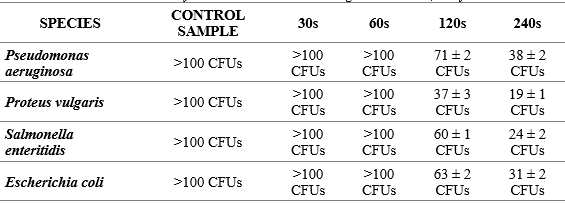
Fig. 3 and Table 1 show that the microorganisms were reduced when exposed to UV-C radiation. This finding reaffirms those described by Conner-Kerr and collaborators [14], who demonstrated the effectiveness of this kind of radiation in mitigating the microbial population. However, a fundamental issue must be considered: the minimum exposure time for a reduction of less than 100 CFUs.
In this sense, according to the lamp manufacturer [15], the exposure time required to control the microorganisms Pseudomonas aeruginosa, Proteus vulgaris, Salmonella enteritidis, and Escherichia coli within a distance of 50 cm is 35, 22, 26, and 22 seconds, respectively. It should be noted that the instruction times are lower than the findings regarding control effectiveness. Because of the time interval chosen to irradiate, it observed the population reduction from 120 seconds of exposure, corresponding 304 J/m² of exposure dose. When evaluating Fig. 4, it becomes apparent that most pathogens tested undergo a quantitative decrease in an exponential law, following two decay stages [29]. With 608 J/m² of fluence, it was observed a population reduction of 62%, 69%, 76%, and 81% for Pseudomonas aeruginosa, Escherichia coli, Salmonella enteritidis and Proteus vulgaris, respectively.
One factor that may be related to this finding, which is at odds with the literature, concerns the naturalness of the ATCC strains, all of which come from Brazil. Brazilian microorganisms have several variations, so they are recognized to a greater extent as multi-resistant organisms. Furthermore, it is known that this resistance profile includes the development of mechanisms that can influence the effective action of UV-C, such as microbial capsules [16].

Fig. 3: Microbiological cultures of Salmonella enteritidis at different exposure times of UV-C. A: 30 seconds; B: 60 seconds; C: 120 seconds; D: 240 seconds. (AUTHORS, 2025).
The term “multidrug-resistant organisms” (MDROs) refers mainly to bacteria simultaneously resistant to three or more types of commonly susceptible antimicrobial drugs used in clinical practice simultaneously. MDROs include methicillin-resistant Staphylococcus aureus (MRSA), vancomycin-resistant enterococci (VRE), carbapenem-resistant Enterobacterales (CRE), extended-spectrum beta-lactamases (ESBLs), carbapenem-resistant Acinetobacter baumannii (CR-AB), multi-drug/pan-drug resistant Pseudomonas aeruginosa (MDR/PDR-PA), Clostridium difficile (CD) and Mycobacterium tuberculosis, among others [1, 2, 17].
The prevalence of multidrug-resistant infections has become a global problem that poses a significant risk to human health. The misuse of antibiotics is one of the main causes of MDROs, which can promote the development of resistance, making treatment challenging, a scenario that is widely seen in Brazil, either through self-medication or unnecessary prescriptions [2, 17, 18].
Table 1: Microbial control curve by UV-C irradiation considering time variation, and fixed distance.
(AUTHORS, 2025)

Fig. 4: Microbiological decay curve as a function of UV-C exposure dose (fluence). (AUTHORS, 2025)
MDROs are particularly problematic in hospital settings because patients are often ill or immunocompromised, making them more susceptible to infection. In addition, hospitals are breeding grounds for bacteria, as patients are near each other; furthermore, medical procedures create opportunities for bacteria to enter the body. MDROs can be transmitted through contact with contaminated surfaces, medical equipment, or healthcare workers. They can also spread through the air, especially in places where patients receive respiratory treatments [19].
Outbreaks of MDRO infection in hospitals mainly originate in intensive care units (ICUs). Considering the medical environment, new cleaning solutions and technologies have been continuously developed; however, the rate of MDRO infection has not reduced significantly. Previous ICU bed occupants who have been infected or colonized with MDROs can increase the risk of MDRO acquisition in subsequent bed occupants (1.5 times) [17, 20].
Despite terminal disinfection procedures, they showed that 55% of hospital patient rooms still had at least one surface with detectable microbial growth of MDROs at the time of patient admission. According to conventional sanitizers, cleaning could reduce the number of bacteria on the surface by 95%, and the number of bacteria would return to the level before disinfection 2.5 hours later [20]. Therefore, MDROs can easily proliferate on beds, mattresses, bedside tables (cabinets), call buttons, various surfaces and wires of monitors, infusion pumps, and curtains of infected or colonized front beds. When individuals enter a new environment, they quickly acquire microbes present in that environment. [17, 20].
In addition to hospitals, several other places have established themselves as worrying scenarios for microbiological dissemination. Ports, airports, and bus stations deserve special mention because many people move between locations. Thus, many bacteria and other microorganisms are moved from one environment to another, directly impacting public health and safety in these places [21, 22].
One factor that supports using physical methods is their low cost compared to chemical methods [12]. Hospital environments spend a huge budget on chemical decontamination products, varying according to the institution’s size, and can reach millions of dollars every month [23]. UV-C radiation reduces maintenance costs and helps optimize processes, ensuring greater homogeneity. There is a lack of studies aimed at quantifying the costs of sanitizing places with wide public access, such as airports and bus stations, and even more precise details about costs in healthcare environments, which makes it difficult to accurately measure the percentages of savings that the physical method advocated can provide.
One point to highlight is the results related to virus control, e.g., SARS-CoV-2, both in vitro tests and multicenter studies with samples isolated from hospitals [24, 25]. The studies highlighted reveal that UV-C has the potential to inactivate the SARS-CoV-2 virus responsible for COVID-19. This suggests that exposure to these forms of radiation could be an effective strategy to reduce viral load and prevent the spread of the virus in public, clinical, and hospital settings and even in biological fluids. Hence, further research into the combined control of microorganisms is still needed, i.e., fungi, bacteria, and viruses at similar times, but the results show a promising application in this respect. In addition to the versatility of applications in various systems, such as water treatment and industrial processes [26, 27].
Even with the variation in the expected response to bacterial control, UV-C proved effective in mitigating CFUs. The incidence of UV-C on microorganisms generates a denaturation of their genetic material, which makes it impossible to maintain physiological and biochemical mechanisms, leading to their death. With proof that the method is notoriously effective and functional for microbial control, questions have been raised about its application [16, 17].
It needs to carefully investigate the time range from 60 to 120 seconds, using a smaller time scale, so we can accurately model the decay law and get fundamental parameters such as D90, which is related to the necessary dose to reduce 90% of the bacteria, and k, which corresponds to the UV rate constant [28].
Among several plausible applications, UV-C as a sanitizing tool deserves attention, as it reduces the cost of certain chemical products and prevents the development of resistance mechanisms or their potentiation [12]. In the case of the UV-C gadget presented here, the maximum power demand is around 37 W, even though it does not reach its total capacity during the lab tests. This means that devices such as this might be a great option in substitution chemical methods due to efficiency and the use of clean energy. Thus, its application in hospitals, ports, airports, bus stations, and other environments in common use, such as public toilets, is feasible and advantageous, given the existing circumstances.
4. CONCLUSIONS
The conclusion of the study shows that UV-C radiation is an effective alternative for mitigating the microbial population, denaturing the bacteria’s genetic material and thus making it impossible for them to survive. Despite variations in the bacteria’s response to treatment, research indicates that exposure times of between 60 and 120 seconds are critical for a more accurate analysis of the method’s effectiveness. The use of the UV-C device developed not only represents a promising solution for high-flow contamination environments, such as hospitals and public places, but also offers a reduction in the costs associated with chemical methods, avoiding the development of microbial resistance. The research emphasizes the need for further investigations to improve the use of UV-C radiation and promote innovation in sanitization technologies.
5. ACKNOWLEDGMENTS
We would like to acknowledge the Centro Universitário São Camilo for providing the space to carry out the research and the necessary resources. And also to the Fundação de Amparo à Pesquisa do Espírito Santo (FAPES) for supporting this study by granting financial aid to the researchers involved in the research.
6. REFERENCES
- Magiorakos, A-P., Srinivasan, A., Carey, R.B., Carmeli, Y., Falagas, M.E., Giske, C.G., Harbarth, S., Hindler, J.F., Kahlmeter, G., Olsson-Liljequist, B., Paterson, D.L., Rice, L.B., Stelling, J., Struelens, M.J., Vatopoulos, A., Weber, J.T. and Monnet, D.L. Multidrug-resistant, extensively drug-resistant and pandrug-resistant bacteria: an international expert proposal for interim standard definitions for acquired resistance. Clinical microbiology and infection. 2012; 18(3), pp.268–281. doi:https://doi.org/10.1111/j.1469-0691.2011.03570.x.
- Chagas, A.P. and Lima, V.P. Rápida inserção e disseminação da resistência bacteriana em uma unidade covid e o impacto no tratamento antimicrobiano empírico de pacientes com bacteremia. The Brazilian Journal of Infectious Diseases, 2022; 26, p.102647. doi:https://doi.org/10.1016/j.bjid.2022.102647.
- Carvalho-Brugger, S., Miralbés Torner, M., Jiménez Jiménez, G., Badallo, O., Álvares Lerma, F., Trujillano, J., Nuvials Casals, F.X. and Palomar, M. Preventive isolation criteria for the detection of multidrug-resistant bacteria in patients admitted to the Intensive Care Unit: A multicenter study within the Zero Resistance program. Medicina Intensiva. 2023; 47(11):629-637. doi:https://doi.org/10.1016/j.medine.2023.04.005.
- Escolà-Vergé, L., Los-Arcos, I. and Almirante, B. Nuevos antibióticos para el tratamiento de las infecciones por microorganismos multirresistentes. Medicina Clínica. 2020; 154(9), pp.351–357. doi:https://doi.org/10.1016/j.medcli.2019.11.002.
- Bortolon, C., Felix, K.G., Rodrigues, K.D., Melo, J.M. de S., Mauricio, F. de C., Toledo, T.G.P., Gennaro, K.V., Junior, J.P. and Medeiros, E.A.S. Impacto da pandemia de covid-19 no aumento das infecções por microrganismos multirresistente e do consumo de antimicrobianos nas utis de um hospital terciário. The Brazilian Journal of Infectious Diseases. 2022; 26, p.101947. doi:https://doi.org/10.1016/j.bjid.2021.101947.
- Lima, C.C., Benjamim, S.C.C. and Santos, R.F.S. dos. Mecanismo de resistência bacteriana frente aos fármacos: uma revisão. CuidArte, Enferm. 2017; pp.105–113. Available at: https://pesquisa.bvsalud.org/portal/resource/pt/bde-31632.
- Díaz Santos, E., Mora Jiménez, C., del Río-Carbajo, L. and Vidal-Cortés, P. Treatment of severe multi-drug resistant Pseudomonas aeruginosa infections. Medicina Intensiva. 2022; 46(9). doi:https://doi.org/10.1016/j.medine.2022.06.014.
- Jiménez Pearson, M.A., Galas, M., Corso, A., Hormazábal, J.C., Duarte Valderrama, C., Salgado Marcano, N., Ramón-Pardo, P. and Melano, R. Consenso latinoamericano para definir, categorizar y notificar patógenos multirresistentes, con resistencia extendida o panresistentes. Revista Panamericana de Salud Pública. 2019; pp.1–8. doi:https://doi.org/10.26633/rpsp.2019.65.
- Huespe, I., Prado, E., Staneloni, I., Contrera, N., Denaday, L., San Roman, E. and Sinner, J. Kinetics of procalcitonin in infections caused by multidrug-resistant bacteria. Medicina. 2020; 80(6), pp.599–605. Available at: https://pubmed.ncbi.nlm.nih.gov/33254103/.
- Mação, P., Lopes, J.C., Oliveira, H., Oliveira, G. and Rodrigues, F. Bactérias Multirresistentes Associadas aos Cuidados de Saúde num Hospital Pediátrico: Experiência de Cinco Anos. Acta Médica Portuguesa. 2013; 26(4), pp.385–391. doi:https://doi.org/10.20344/amp.99.
- Schneider, G., Bim, F.L., Sousa, Á.F.L. de, Watanabe, E., Andrade, D. de and Fronteira, I.. The use of antimicrobial-impregnated fabrics in health services: an integrative review. Revista Latino-Americana de Enfermagem. 2021; 1:29:e3416. doi:https://doi.org/10.1590/1518-8345.4668.3416.
- Alexandre, F.A., Faria, J. de A.F. and Cardoso, C.F. Avaliação da eficiência da radiação ultravioleta na esterilização de embalagens plásticas. Ciência e Agrotecnologia. 2008; 32(5), pp.1524–1530. doi:https://doi.org/10.1590/s1413-70542008000500025.
- Zhang, W., Zhu, H., Yuan, M., Yao, Q., Tang, R., Lin, M., Yang, S., Li, Z. and Chen, M. Microbacterium radiodurans sp. nov., a UV radiation-resistant bacterium isolated from soil. International Journal of Systematic and Evolutionary Microbiology. 2010; 60(11), pp.2665–2670. doi:https://doi.org/10.1099/ijs.0.017400-0.
- Conner-Kerr, T.A., Sullivan, P.K., Gaillard, J., Franklin, M.E. and Jones, R.M. The effects of ultraviolet radiation on antibiotic-resistant bacteria in vitro. Ostomy/Wound Management. 1998; 44(10), pp.50–56. Available at: https://pubmed.ncbi.nlm.nih.gov/9866596/.
- OSRAM. Entertainment and Industry | Entertainment and Industry. Disponível em: https://www.osram.com/apps/hns-calculator/gb/en.
- BrCAST. Brazilian Committee on Antimicrobial Susceptibility Testing. 2021.
- Gu, G.Y., Chen, M., Pan, J.C. and Xiong, X.L. Risk of multi-drug-resistant organism acquisition from prior bed occupants in the intensive care unit: a meta-analysis. Journal of Hospital Infection. 2023; 139, pp.44–55. doi:https://doi.org/10.1016/j.jhin.2023.06.020.
- Pinho, L.L. de, Oliveira, K.N. de L., Santos, T.A.S. dos, Lima, S.B., Rabelo, A.M.F., Rabelo, M.W.F., Rodrigues, L.K.N., Júnior, J.B.A.S., Silva, F.W.L., Juliace, L.P., Linard, W.M., Filho, J.D. da S. and Nunes, R. de M. Uso indiscriminado de antibióticos e o risco de resistência bacteriana: revisão de literatura. Brazilian Journal of Implantology and Health Sciences. 2024; 6(1), pp.438–452. doi:https://doi.org/10.36557/2674-8169.2024v6n1p438-452.
- Blanco, N., O’Hara, L.M. and Harris, A.D. Transmission pathways of multidrug-resistant organisms in the hospital setting: a scoping review. Infection Control & Hospital Epidemiology. 2019; 40(4), pp.447–456. doi:https://doi.org/10.1017/ice.2018.359.
- Pereira, S.S.P., Oliveira, H.M. de, Turrini, R.N.T. and Lacerda, R.A. Disinfection with sodium hypochlorite in hospital environmental surfaces in the reduction of contamination and infection prevention: a systematic review. Revista da Escola de Enfermagem da USP. 2015; 49(4), pp.0681–0688. doi:https://doi.org/10.1590/s0080-623420150000400020.
- Jacobsen, L.B., Wilsmann, J., Rossi, E. de P., Oliveira1, C.T. Clinical characteristics and outcomes of incident cases of COVID-19 in unvaccinated adult cystic fibrosis patients in southern Brazil: a prospective cohort study conducted during the first year of the COVID-19 pandemic. Jornal de pneumologia. 2022; 48(6), pp.e20220265–e20220265. doi:https://doi.org/10.36416/1806-3756/e20220265.
- Fischer, D., Veldman, A., Diefenbach, M. and Schäfer, V. Bacterial Colonization of Patients Undergoing International Air Transport: A Prospective Epidemiologic Study. Journal of Travel Medicine. 2004 11(1), pp.44–48. doi:https://doi.org/10.2310/7060.2004.13647.
- Barros, E. de J. S., Baptista, S. S. G., Passos, A. de S., Araujo, J. O. de, Lima, M. F. de, Vale, R. L. T. do, Braga, K. K. L., Magalhães, R. O. e Carmo, T. G. do. A importância da limpeza hospitalar para a prevenção e controle das infecções relacionadas à assistência à saúde, Revista Eletrônica Acervo Saúde. 2022; 15(8), p. e9643. doi: 10.25248/reas.e9643.2022.
- Biasin, M., Bianco, A., Pareschi, G., Cavalleri, A., Cavatorta, C., Fenizia, C., Galli, P., Lessio, L., Lualdi, M., Tombetti, E., Ambrosi, A., Redaelli, E.M.A., Saulle, I., Trabattoni, D., Zanutta, A. and Clerici, M. UV-C irradiation is highly effective in inactivating SARS-CoV-2 replication. Scientific Reports. 2021; 11(1). doi:https://doi.org/10.1038/s41598-021-85425-w.
- Walsh, T. and Petraitis, V. 2020 COVID-19 Coronavirus Ultraviolet Susceptibility. 2020; doi:https://doi.org/10.13140/RG.2.2.22803.22566.
- Armellino, D., Walsh, T.J., Petraitis, V. and Kowalski, W. Assessment of focused multivector ultraviolet disinfection withshadowless delivery using 5-point multisided sampling ofpatientcare equipment without manual-chemical disinfection. American Journal of Infection Control. 2019; 47(4), pp.409–414. doi:https://doi.org/10.1016/j.ajic.2018.09.019.
- Oguma, K., Kita, R., Sakai, H., Murakami, M. and Takizawa, S. Application of UV light emitting diodes to batch and flow-through water disinfection systems. Desalination. 2013; 328, pp.24–30. doi:https://doi.org/10.1016/j.desal.2013.08.014.
- Kowalski, W. Ultraviolet Germicidal Irradiation Handbook. Berlin, Heidelberg: Springer Berlin Heidelberg. 2009. doi:https://doi.org/10.1007/978-3-642-01999-9.
- Fredes, P., Raff, U., Gramsch, E. and Tarkowski, M. Estimation of the Ultraviolet-C Doses from Mercury Lamps and Light-Emitting Diodes Required to Disinfect Surfaces. Journal of Research of the National Institute of Standards and Technology. 2021; 126. doi:https://doi.org/10.6028/jres.126.025.
1Department of Exact, Natural and Health Sciences/ group in Alegre of organic and medicinal chemistry, Federal University of Espírito Santo, 29500-000, Alegre-Espírito Santo, Brazil.
2Department of Pharmaceutical Sciences/Microbiology Laboratory, Centro Universitário São Camilo, 29300-010, Cachoeiro de Itapemirim-Espírito Santo, Brazil.
4Section of Defense Engineer, Military Institute of Engineering, 29300-010, Rio de Janeiro-Rio de Janeiro, Brazil.
*Coutinho.contacts@gmail.com