
REGISTRO DOI: 10.69849/revistaft/ni10202512210734
Cláudio Cesar Barros de Oliveira
Jornandes Dias da Silva*
Abstract
This paper presents a one-dimensional isothermal model of a hydrogenpermeable circulating fluidized bed membrane reactor (CFBMR) for hydrogen production via steam reforming of methane (SRM). Dynamic simulations were conducted to evaluate hydrogen molar flow rates on the permeation and shell sides at different outlet temperatures. Model validation was performed by comparing the predicted methane conversion with optimized reference data. Additionally, axial profiles of the molar flow rates of CH₄, H₂O, H₂, CO, and CO₂ along the shell side were analyzed at t=14 s. The effects of temperature and reactor zone on hydrogen production were also assessed.
Keywords: Hydrogen production; Methane reforming; membrane reactor; Onedimensional model; Dynamic simulation
1. Introduction
Hydrogen (H2) is widely used as an important chemical feedstock and is also considered a promising clean fuel for the future. It is well-regarded as a pollutionfree primary energy carrier for transportation and electricity generation. Currently, the steam reforming of methane (SRM) is the primary method for industrial hydrogen production. Methane (CH₄), the main component of conventional natural gas (NG), can also be sourced from associated gas, stranded NG, and shale gas.
Previous studies have identified three predominant reactions: steam reforming of methane (SRM), the water-gas shift reaction (WGS), and the overall steam reforming of methane (OSRM) (Xu and Froment, 1989).
– Reaction of the SRM;

– Reaction of the WGS;

– Reaction of the OSRM.

The steam reforming process of methane (SRPM) for hydrogen production can be studied using various reactor configurations, such as fixed-bed reactors, fluidized-bed reactors, and membrane reactors (including fixed-bed membrane reactors and fluidized-bed membrane reactors). The use of a permeable membrane reactor presents the advantage of combining both reaction and separation in a single, compact unit. Several studies have investigated SRPM for hydrogen separation using Pd-based membrane reactors, focusing on both experimental and numerical approaches to achieve high-temperature hydrogen production. Experimental studies primarily aimed at developing robust catalysts resistant to carbon deposition, while numerical simulations were used to model hydrogen production in Pd-based packed-bed membrane reformers
Catalytic fixed-bed membrane reactors (CFBMRs) can significantly enhance the production of reactions that are thermodynamically limited. These reactors utilize hydrogen-selective membranes that allow hydrogen to escape to the permeate side due to differences in partial pressures. An inert gas, such as nitrogen, can then be used to purge the hydrogen. CFBMRs are particularly promising for thermodynamically limited reactions like steam reforming. In these reactors, the effect of interphase transport is crucial, including diffusion within the catalyst pellets on both sides of the reactor. The Fickian diffusion model is employed to describe the diffusion process through a stagnant bulk phase, considering the diffusivities of components in the reacting mixture along the radial direction within the catalyst pellets.
Commercial hydrogen separation using metallic membranes primarily focuses on palladium alloys. Palladium (Pd) membranes have been used for hydrogen separation for many years due to their exceptional selectivity for hydrogen. Pd is highly soluble in hydrogen and can handle hydrocarbon-containing streams. Additionally, Pd-based membranes offer the potential for hydrogen separation at high temperatures, allowing for the integration of separation and chemical reactions within a single unit. Recent reviews have examined the application of membranes in the chemical, petrochemical, and petroleum industries for both separation and reaction processes.
The objective of this study is to theoretically investigate the performance of steam reforming of methane (SRM) for hydrogen production in a circulating fluidized bed membrane reactor (CFBMR) at different exit temperatures of the system. This includes analyzing the effects on both the permeation side and the shell side of the reactor.
2. Materials and Methods
A conceptual setup of the integrated circulating fluidized bed membrane reactor (CFBMR) was developed to investigate steam reforming of methane (SRM), as shown in Figure 1. The inner tube contains the supported membrane, while the outer layer is a non-permeable shell. The catalyst (Ni/-Al2O3) is packed in the shell side where the reactants (methane and steam) are introduced. The sweep gas, which can be nitrogen or steam, is fed into the tube side in a co-current flow mode. In this system, three reforming reactions occur within the non-permeable shell, producing light gases including hydrogen (H₂), carbon monoxide (CO), and carbon dioxide (CO₂).
Fig.1. Schematic representation of the CFBMR for the SRM.

2.1. Steam Reforming of Methane
Kinetic models describe the mechanisms, reaction rates, and resulting species concentrations at any point in time and space within a circulating fluidized bed membrane reactor (CFBMR). These models are crucial for understanding specific processes, including reaction mechanisms and strategies for enhancing reaction rates. In this context, the primary reactions involved in steam reforming of methane (SRM) are as follows: Reaction (1) represents SRM, Reaction (2) corresponds to the water-gas shift reaction, and Reaction (3) depicts the overall SRM process. Reactions (1), (2), and (3) are reversible and reach equilibrium. Thermodynamically, Reactions (1) and (3) are strongly endothermic, while Reaction (2) is exothermic. The components involved in these reactions are methane (CH₄), water (H₂O), carbon monoxide (CO), hydrogen (H₂), and carbon dioxide (CO₂). The stoichiometric coefficients for these components are provided in Table 1 below.



2.2. Kinetic Modelling
The kinetic mathematical model applied here considers three homogeneous reactions (1), (2), and (3) based on the Langmuir-Hinshelwood concept (Xu and Froment, 1989). The reaction rate models for above reactions, as discussed in Section 1 (Introduction), are described as follows.
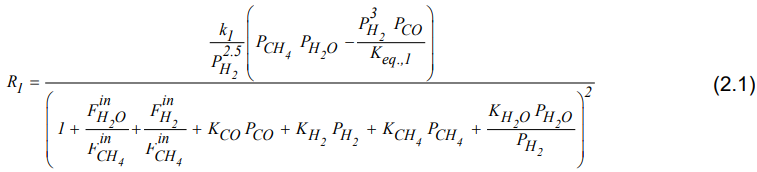

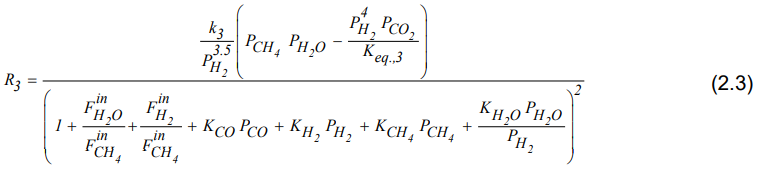
Where Rj (j = SRM, WGS, and OSRM) are the rates of reactions (1)-(3). The reaction rate coefficients (kj, j = SRM, WGS and OSRM) and the adsorption constants of gases (KCH4, KH2O, KH2, and KCO) have an Arrhenius type dependence with temperature. On the other hand, Pi (i = CH4, H2O, CO, H2 and CO2) are the partial pressures of the respective components within the catalyst. The Arrhenius expressions for the reaction rate coefficients, adsorption constants for the components CH4, H2O, H2 and CO and the equilibrium constants are listed below and can be reported by Xu and Froment (1989).
– Arrhenius expressions;



– Adsorption coefficient constants;




– Equilibrium constants.



The net rates of consumption and formation for each component in reactions (1.1), (1.2), and (1.3) were obtained using the following equation (Oliveira and Silva, 2012).




The Equation (2.15) can be used to obtain rCH4 , rH2O,rH2 ,rCO and rCO2 . The details of these net rates have given by Oliveira and Silva (2012).
2.3. Mathematical Modelling of the Membrane Reformer
The mathematical modelling and computer simulation for the CFBMR are in continuous development aiming to improve the knowledge of the phenomenological processes for this simple unit (combining both the reaction and separation). According to its applications, the CFBMRs are applied in the chemical, petrochemical and oil refining industries. For this work, an onedimensional mathematical model without axial dispersion taking into account diffusional limitations in the solid porous network was developed. This model has been projected like isothermal dynamic pseudo-homogeneous model. The mass balance equations are given by the following partial differential equation system.
2.3.1. Balance Equations for the Shell Side
The differential balances of the molar flow rates (Fi) for the model components i (i = CH4, H2O, H2, CO and CO2) in the reaction side (shell side) are given as follows.

– The initial and boundary conditions for the Equation (12a) are given as:



2.3.2. Balance Equation for the Permeation Side
The mass balance equation for the molar flow rate (FH2) of H2 in the permeation side zone (inner tube of CFBMR) is written as follows:

– The initial and boundary conditions for the Equation (13a) are given as:



2.3.3. Solution of the Model Equations
The Laplace transform methodology was applied for changing the set of the partial differential equations (PDFs) into a set of ordinary differential equations (EDOs). Then, the new set of EDOs has been integrated by a subroutine based on the Runge-Kutta Gill with automatic step size and double precision to ensure accuracy (Silva and Oliveira, 2013).
3. Results and Discussions
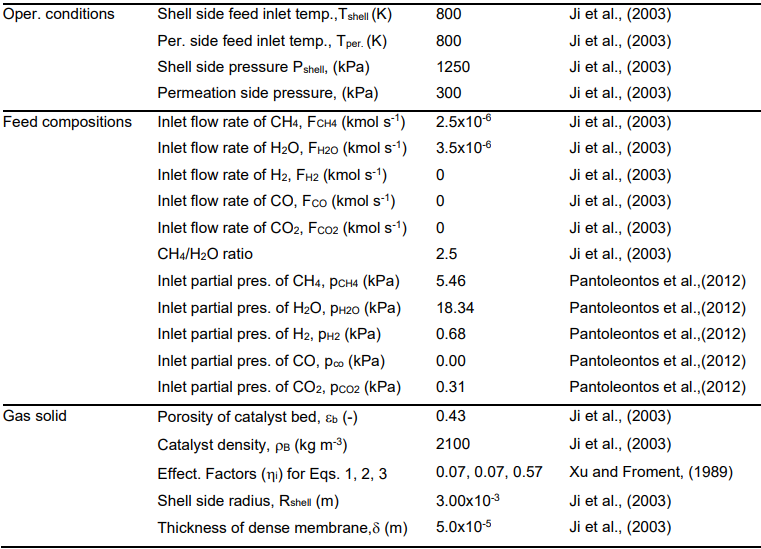
The mathematical modelling was developed to analyze the molar flow rates of chemical species (CH4, H2O, H2, CO and CO2) on the shell side zone as well as the molar flow rate of H2 into the permeation side zone. The proposed model for this work has been used to relate the evolution of the molar flow rates over space (z) along the CFBMR (shell side zone and permeation side zone). For this simulation, the computational code was fed with parameters shown in Table 2 as follows.
Table 3: Parameters for the modelling involved in steam reforming of methane.

3.1. Validation and Simulation
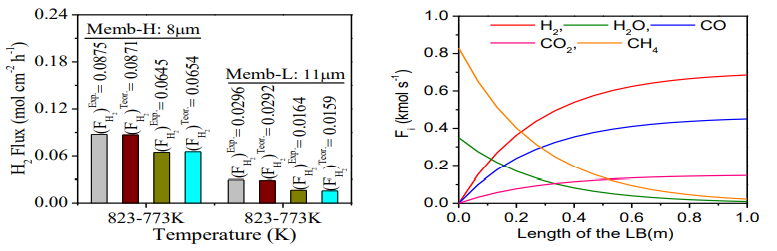
Figure (2a) shows a validation before simulating the CFBMR, the main program which is used to simulate the conventional CFBMR has been checked with data of the literature. The simulation results for conversion of CH4 and data for different authors were validated by comparison (Tong and Matsumura, 2006). Figure (2b) reports the profiles of CH4, H2O, H2, CO and CO2 versus the space variable along the CFBMR (shell side zone).
Figure 2: (a) Validation of the model, (b) Profiles of chemical species (CH4, H2O, H2, CO and CO2) along the CFBMR

3.2. Evolution of the Molar Flow Rates in Permeation Region
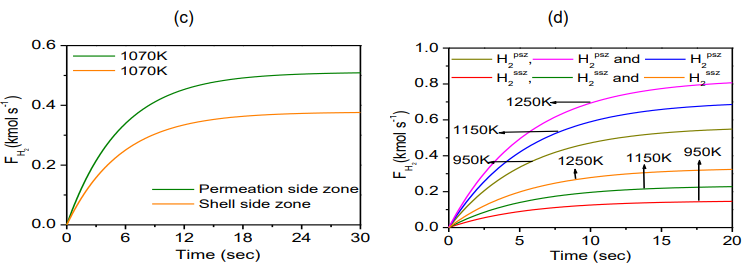
Figure (c) shows the evolution of the molar flow rates in the permeation side and shell side zones versus the time variable at the exit of the CFBMR. Figure (d) presents the evolutions of the molar flow rates of H2 at different temperatures (1250K, 1150K and 950K) in the permeation side and shell side zones.
Figure 3: (c) Evolutions of molar flow rates in the permeation side and shell side zones and (d) Evolutions of molar flow rates in the permeation side and shell side zones at different temperatures.
4. Conclusions
Conducted in the context of reforming of the line of chemical components, this research will resort numerical methodology in order to carry out the process development in an isothermal catalytic membrane reactor dynamics of fixed bed. In conditions allowed for this research, the method of Runge-Kutta Gill was used to predict the model components (CH4, H2O, H2, CO and CO2). The development of computer code to process and analyze the behavior of the variables in this research allowed the lead the following conclusions:
– The validation confirmed by comparing which the results of this research and the results obtained by different authors are good agreement;
– Consumption and production have shown the profiles of chemical species (CH4, H2O, H2, CO and CO2) along the CFBMR;
– The molar flow rates of H2 at 1070K shown an evolution with the time. Once, The amount of H2 is most in the permeation side zone than in the shell side zone;
– The molar flow rates of H2 at different temperatures (1250K, 1150K and 950K) have shown a evolution with the time. Once, the amount of H2 is most in the permeation side zone than in the shell side zone.
References
Ji P., Van Der Kooi H.J., De Swaan Arons J., 2003, Simulation and thermodynamic of an integrated process with H2 membrane CPO reactor for pure H2 production, 58, 3901-3911.
Oliveira C. C. B., Silva J. D., 2012, Dynamic modelling of the gasification region of a bubbling fluidized bed gasifier, Chemical Engineering Transactions, 29, 841846. doi: 10.3303/CET1229141.
Pantoleontos G., Kikkinides, E. S., Georgiadis, M.C., 2012, A heterogeneous dynamic model for the simulation and optimisation of the steam methane reforming reactor, 37, 16346 – 16358.
Silva J. D., Oliveira C. C. B., 2013, Mathematical modelling for the adsorption process CO2 in nanopores of catalytic particles in a fixed bed reactor using numeral Laplace transform, Chemical Engineering Transactions, 35, 829-835, doi: 10.3303/CET1335138.
Tong, J. and Matsumura, Y., 2006, Pure hydrogen production by methane steam reforming with hydrogen-permeable membrane reactor, Catalysis Today, 111, 147-152.
Xu J, Froment G. F., 1989, Methane steam reforming, methanation and water-gas shift: I. Intrinsic kinetics, Aiche Journal, 35, 88-96.
*Polytechnic School-UPE, Laboratory of Environmental and Energetic Technology
Corresponding author: E-mail address:*jornandesdias@poli.br