
CARACTERIZACIÓN BIOQUÍMICA Y POSIBLES FUNCIONES BIOLÓGICAS DE EXTRACTOS DE CAMPOMANESIA PUBESCENS – UNA REVISIÓN SISTEMÁTICA
REGISTRO DOI: 10.69849/revistaft/cs10202507212350
Jacenir Vieira da Silva1
Anahy Arruda Burigato2
Larissa Pires Mueller3
Silvia Aparecida Oesterreich4
Abstract: This systematic review aimed to synthesize the evidence available in the literature on the biochemical characterization and potential biological effects of Campomanesia pubescens. A systematic review was performed following the PRISMA protocol from the following databases: PubMed, Web of Sciences, CENTRAL and Scopus. Studies published until December, 2023, with characterization of Campomanesia pubescens compounds and/or experimental studies on the biological effects of the plant were included. The results identified 4,164 studies and 2,127 repeated articles were excluded. After the analysis process, eleven texts were included in the qualitative synthesis. This systematic review showed that different types of extracts from different parts of Campomanesia pubescens have a high content of functional compounds with antioxidant, antimicrobial and anti-inflammatory action without any evidence of toxicity and/or genotoxicity.
Keywords: Phytotherapics. Brazilian plants. Myrtaceae. Phytomedicine.
Resumen: Esta revisión sistemática tuvo como objetivo sintetizar la evidencia disponible en la literatura sobre la caracterización bioquímica y los posibles efectos biológicos de Campomanesia pubescens. Se realizó una revisión sistemática siguiendo el protocolo PRISMA de las siguientes bases de datos: PubMed, Web of Sciences, CENTRAL y Scopus. Se incluyeron estudios publicados hasta el diciembre de 2023, con caracterización de compuestos de Campomanesia pubescens y/o estudios experimentales sobre los efectos biológicos de la planta. Los resultados identificaron 4.164 estudios y se excluyeron 2.127 artículos repetidos. Luego del proceso de análisis, once textos fueron incluidos en la síntesis cualitativa. Esta revisión sistemática demostró que diferentes tipos de extractos de diferentes partes de Campomanesia pubescens tienen un alto contenido de compuestos funcionales con acción antioxidante, antimicrobiana y antiinflamatoria sin evidencia de toxicidad y/o genotoxicidad.
Palabras clave: Fitoterapéuticos. Plantas brasileñas. Mirtáceas. Fitomedicina.
1. Introduction
In the context of the Brazilian biome, an efficient strategy to develop new natural or pharmaceutical products is to explore the therapeutic potential of native species. Campomanesia pubescens (DC) O. Berg (family Myrtaceae) known as “gabiroba” or “guavira” is a native species found in the Southeast and Midwest regions of the Brazilian Cerrado (Chang et al., 2011; Pradella et al., 2021). The fruits of Campomanesia pubescens are used to make liqueurs, juices and sweets. The leaves are used in folk medicine to treat infections, bladder ailments, and gastrointestinal disorders. (Catelan et al., 2018).
Using medicinal plants as an alternative or additional therapeutic resource has significantly increased population behavior (Braga & Silva, 2021). Although synthetic drugs are usually the first choice of treatment for many diseases, they often have undesirable effects. Consequently, the acceptance of alternative medicines, such as medicinal plants and herbal medicines, has increased substantially (Braga & Silva, 2021). Among the medicinal plants, a characteristic of the genus Campomanesia is a high content of phenolic compounds and flavonoids. When ripe, the fruits of Campomanesia pubescens have a high content of vitamin C and phenolic compounds, including flavanones and chalcones (Duarte et al., 2009; J. R. M. Silva, Cardoso, et al., 2009; Villas Boas, Carvalho dos Santos, et al., 2018).
Despite the widespread use of plants as a medicine and functional food in many cultures, there is often no scientific evidence to support their pharmacological properties and toxic potential (Alves Junior et al., 2022; Guerrero et al., 2010). It is estimated that few natural products of plant origin currently marketed have the safety information that allows their proper use (Alves Junior et al., 2022). Concerning Campomanesia, this scenario is no different. Although these species are widely used as food and medicine in folk medicine, studies on the toxicity of many species still need to be made available (M. G. da Silva et al., 2021).
Therefore, this study aimed to synthesize the evidence available in the literature on the biochemical characterization and potential biological effects of Campomanesia pubescens. We used the PRISMA systematic review protocol to address current knowledge on the characterization and effect of Campomanesia pubescens.
2. Materials and methods
This systematic review followed the guidelines recommended by the PRISMA protocol (Preferred Reporting Items for Systematic reviews and Meta-Analyses)(Moher et al., 2010).
2.1 Search strategy
A systematic search of studies published until December 2023 was performed in the electronic databases PubMed, Web of Science, CENTRAL (Cochrane) and Scopus. The search strategy used was built using the following keywords: “Campomanesia pubescens” OR pubescens OR “Guavira”. No other filters to refine the search were used. Instead, a manual reference check was performed on identified studies.
2.2 Inclusion eligibility criteria
Two independent authors initially evaluated the articles identified by the search strategy and the results were compared. Disagreements were discussed and analyzed until a consensus was reached. Initially, according to the purpose of the review, the titles and abstracts of the studies were reviewed to verify that they met the following eligibility criteria. Eligibility criteria were: (1) use of Campomanesia pubescens; (2) Biochemical characterization or experimental model of the plant extract. It was not possible to use the PICOS strategy due to the broad nature of this review and the scarcity of similar studies with Campomanesia pubescens.
Studies that did not show the presence of these items when reading the full abstract were excluded. Then, the full text of potentially eligible publications was selected to assess eligibility criteria.
A manual reference check of selected studies was performed to complement study selection. This step was performed to identify potentially eligible studies. For studies with unclear information, the authors were contacted to clarify doubts. Repeat studies (duplicate, triplicate) were excluded using the Mendeley® app
2.3 Data extraction
Data were independently extracted and compared from eligible articles by two researchers. The articles were consulted again to verify the existence of any discrepancies. The following data were extracted: study setting, identified components of Campomanesia pubescens extracts and study category (experimental or characterization). Details of the experimental design were extracted; study methodology and main results. Any discrepancies identified were resolved through discussion until consensus was reached.
2.4 Data Synthesis
Methodological aspects and differences in the type of extract preparation and/or application showed great variation between studies. It is worth mentioning that the low number of reproducible studies did not allow us to carry out a mathematical synthesis approach, so we carried out a qualitative synthesis of the results, performing a theoretical integration of the results.
3. Results
3.1 Search results
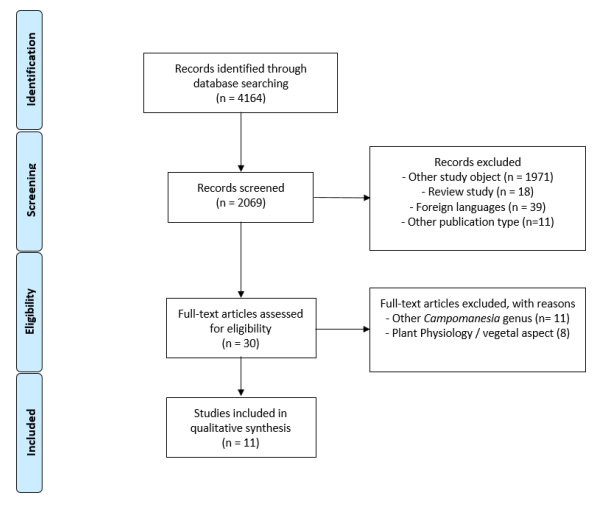
The results of the databases identified a total of 4,164 studies, of which 2,127 repeated articles were excluded. Of the 2,069 remaining studies analyzed, 2,039 were excluded and 30 full texts that matched the inclusion criteria were read in full. After exclusions, eleven studies that fully met the eligibility criteria were included. No additional studies were identified in the manual search of references in the screening process. It is worth noting that no specific review on the effect of Campomanesia pubescens was found among the excluded reviews. The entire selection process is illustrated in Fig. 1.
3.2 Biochemical characteristics of Campomanesia pubescens
Of the studies included in this review, 91% reported some biochemical characterization of the extract/product of Campomanesia pubescens (Table 1). Only one study reported the experiment’s results without any exact characterization (Pradella et al., 2021).
The type of extract varied among several possibilities, among them, the ethanolic extract of leaves (Cardoso et al., 2008; Catelan et al., 2018), ethanolic extract of fruits (Villas Boas et al., 2020; Villas Boas, Carvalho dos Santos, et al., 2018; Villas Boas, Souza de Araújo, et al., 2018) and essential oil from different parts of the plant (Chang et al., 2011; J. R. M. Silva, Cardoso, et al., 2009; J. R. M. Silva, Ré-Poppi, et al., 2009). The study by Duarte et al. (2009) was carried out with a fermented beverage (wine) and the study by Cardoso et al. (2008) was performed with hexane extracts of leaves. All these reports agree with each other with the presence of high levels of phenolic compounds and flavonoids (Table 1).
Table 1 – Biochemical characterization of studies of Campomanesia Pubescens

3.3 Potential biological effects of extracts from Campomanesia pubescens
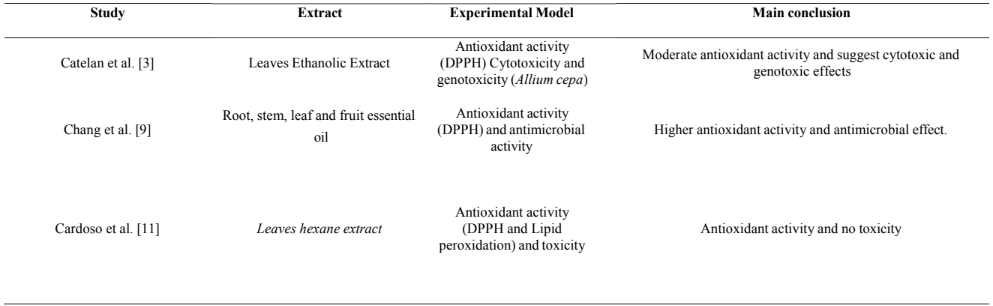
The effects division in studies with experimental models was performed in experimental and animal models (table 2 and table 3, respectively). Studies on the biological effect of Campomanesia pubescens have yet to be published despite growing national interest. Catelam et al. (2018), Chang et al. (2011) and Cardoso et al. (2008) demonstrated potential antioxidant effects of three different extract forms (Table 2).
Table 2 – Experimental Studies with Campomanesia pubescens
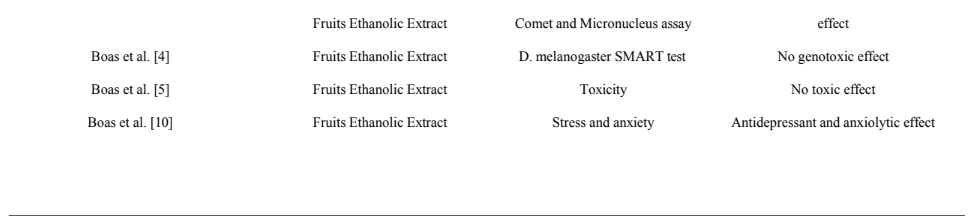
Studies with animal models are shown in table 3. All studies are in agreement with some beneficial effect of extracts from Campomanesia pubescens. Pradella et al. (2021) showed that a mixture of ethanolic leaf extract with topical gel can accelerate the healing of topical infection in Wistar rats.
Other results in Wistar models reinforce the absence of toxic effect or genotoxic effect (Villas Boas, Carvalho dos Santos, et al., 2018; Villas Boas, Souza de Araújo, et al., 2018). Boas et al. (2020) showed an antidepressant and anxiolytic effect in stress models. However, due to the scarcity of similar results that validate these findings (reproduction), these studies only show the potential effects of the plant.
Table 3 – Experimental animal models with Campomanesia pubescens

4. Discussion
According to the results, this is the first systematic review to specifically focus on the biological effects of Campomanesia pubescens extracts. Although studies are still scarce, due to the specific regionality of the species, this synthesis with the effects of extracts of Campomanesia pubescens demonstrate that the species has phytotherapeutic potential.
The extracts from different parts of the plant have as main constituents different parts, however, all of them have bioactive substances with the potential to be explored as phytotherapy (Chang et al., 2011). Duarte et al. (2009) demonstrated that the fruit pulp is rich in vitamin C (1000 mg / 100g) and hydro and fat-soluble phenolics.
Villas boas et al. (2018; 2018) demonstrated that Campomanesia pubescens fruit extract has a high content of flavonoids(56.84-58.64 mg of quercetin per gram of extract). Silva (2009) demonstrated that the essential oil of the leaves is rich in limonene (22.4%), α-pinene (13.3%), sabinene (9.5%), bicyclogermacrene (4.4%) and linalool (3.9% ). In the essential oil of the fruits, the main constituents are cryptomeridiol (14.2%), spathulenol (6.7%), globulol (6.2%), a-cadinol (5.9%) and b-caryophyllene (4, 0%) ( Silva et al., 2009). Cardoso et al. (2009) demonstrated that the main compounds of the essential oil of fresh flowers are ledol (19.8%), globulol (9.2%), a-cadinol (7.3%) and epi-a-muurolol (5.0%).
The plant as a whole has a high content of monoterpenes and sesquiterpenes (Cardoso et al., 2008; Cardoso & Ré-Poppi, 2009; Chang et al., 2011; J. R. M. Silva, Cardoso, et al., 2009; J. R. M. Silva, Ré-Poppi, et al., 2009; Villas Boas, Carvalho dos Santos, et al., 2018; Villas Boas, Souza de Araújo, et al., 2018). These compounds alone are being explored for their phytotherapeutic potential and present scientific evidence of beneficial effects on health (Barros et al., 2022; Nagoor Meeran et al., 2021; Sharma et al., 2019; Verma et al., 2019; Vieira et al., 2018; Zamyad et al., 2019).
Interestingly, the same species in different regions may present different bioactive compositions due to the interaction of plant development with the soil and climate conditions of each region (Chang et al., 2011). This result highlights the need for future research to include chemical characterization in conjunction with biological assays when using Campomanesia pubescens. Although studies with extracts of Campomanesia pubescens are still scarce, the studies included in this review show antimicrobial and antioxidant potential with evidence of low toxicity. Chang et al. (2011) verified antioxidant effects in different parts of the plant, concluding that the species can be considered a strong natural antioxidant, the same experiment showed antimicrobial potential against aerobic and anaerobic oral pathogens. Other studies reinforce these findings (Cardoso et al., 2008; Catelan et al., 2018; Villas Boas, Carvalho dos Santos, et al., 2018; Villas Boas, Souza de Araújo, et al., 2018).
Catelan et al. (2018) demonstrated that the ethanolic extract of the leaves has a high amount of phenolic compounds and an antioxidant effect – in agreement with previous studies. However, these authors suggest a potential risk due to cytotoxic and genotoxic effects observed in a genetic assay using Allium cepa L. This was the only toxicity finding identified in this research, therefore, further research on the potential cytotoxic and genotoxic effects is necessary to define a safe threshold of administration. In contrast, Villas boas et al. (Villas Boas, Carvalho dos Santos, et al., 2018; Villas Boas, Souza de Araújo, et al., 2018) showed that Campomanesia pubescens fruit extract has a high content of flavonoids (56.84-58.64 mg of quercetin per gram of extract) and via comet assay demonstrated that the extract that the compound has no genotoxic effect on blood cells of animal models, in addition to demonstrating via micronucleus assay that the extract has no clastogenic or aneugenic effects on bone marrow cells when consuming the extract for 28 days (Villas Boas, Souza de Araújo, et al., 2018). The authors highlight a possible dose-dependent threshold of cytoprotective effects and encourage further research into the plant’s phytotherapeutic effects. Doses of 2000 mg/kg body weight were considered safe due to the absence of signs of toxicity (Villas Boas, Carvalho dos Santos, et al., 2018).
Exploratory experimental models demonstrate the wide range of possible biological effects of extracts from Campomanesia pubescens. Pradella et al. (2021), using an animal model of dermal infection, demonstrated that the use of a gel extract of Campomanesia pubescens can be effective for both healing and topical/dermal infections. During the experiment, the treatment with Campomanesia pubescens was the only one to present complete epithelialization of the wound, evidencing the extract’s antimicrobial and topical healing potential (Pradella et al., 2021). Villas boas et al. (2020) demonstrated that the administration of an ethanolic extract of Campomanesia pubescens for 14 days has antidepressant effects in an animal model. The authors suggest that the effect may be due to the high flavonoid content of Campomanesia pubescens extract and its effect on the central nervous system, highlighting the potential of the extract in future developments of plant-based antidepressant agents (German-Ponciano et al., 2018; Khan et al., 2018).
Due to the increase in the consumption of Campomanesia pubescens, whether in the form of extract preparation or use in the food industry, information on chemical characteristics, therapeutic potential and risk of toxicity are relevant information for the economic and therapeutic development of the plant’s consumption. This systematic review showed that different extracts from different parts of Campomanesia pubescens have a high content of functional compounds with antioxidant, antimicrobial, and anti-inflammatory action without any evidence of toxicity and/or genotoxicity. Studies with Campomanesia pubescens still need to be made available. However, this review shows that the different extract types have a high phytomedicinal potential, and further research should be encouraged.
References
Alves Junior, A. da S., Melo, E. S. de P., Gondim, J. M. da S., & Nascimento, V. A. do. (2022). Plantas medicinais e fitoterápicos regulamentados no Brasil: risco de toxicidade por metais pesados. Research, Society and Development, 11(1), e39111124994. https://doi.org/10.33448/rsd-v11i1.24994
Barros, D. B. de, Lima, L. de O. e, Silva, L. A., Fonseca, M. C., Diniz-Neto, H., Rocha, W. P. da S., Beltrão, G. V. de M., Castellano, L. R. C., Guerra, F. Q. S., & Silva, M. V. da. (2022). Efeito antifúngico de α-pineno isolado e em associação com antifúngicos frente às cepas de Candida albicans. Research, Society and Development, 11(4), e58711427748. https://doi.org/10.33448/rsd-v11i4.27748
Braga, J. C. B., & Silva, L. R. da. (2021). Consumo de plantas medicinais e fitoterápicos no Brasil: perfil de consumidores e sua relação com a pandemia de COVID-19 / Consumption of medicinal plants and herbal medicines in Brazil: consumer profile and its relationship with the COVID-19 pandemic. Brazilian Journal of Health Review, 4(1), 3831–3839. https://doi.org/10.34119/bjhrv4n1-303
Cardoso, C. A. L., & Ré-Poppi, N. (2009). Identification of the Volatile Compounds of Flower Oil of Campomanesia pubescens (Myrtaceae). Journal of Essential Oil Research, 21(5), 433–434. https://doi.org/10.1080/10412905.2009.9700210
Cardoso, C. A. L., Silva, J. R. M., Kataoka, V. M. F., Brum, C. S., & Poppi, N. R. (2008). Assessment of antioxidant activity, toxicity and chemical composition by GC-MS of the hexane extract from the leaves of Campomanesia pubescens. Revista de Ciências Farmacêuticas Básica e Aplicada, 29(n3), 297–301.
Catelan, T. B. S., Brum, C. C. S., Heredia-Vieira, S. C., Crispim, B. A., Grisolia, A. B., Santos, R. C. S., & Cardoso, C. A. L. (2018). Cytotoxicity, Genotoxicity, Antioxidant Potential and Chemical Composition of Leaves of Campomanesia pubescens (Mart. ex DC.) O.Berg. Current Pharmaceutical Biotechnology, 19(5), 416–421. https://doi.org/10.2174/1389201019666180626102443
Chang, R., Morais, S. A. L., Nascimento, E. A., Cunha, L. C. S., Rocha, E. de O., Aquino, F. J. T., Souza, M. G. M., Cunha, W. R., & Martins, C. H. G. (2011). Essential oil composition and antioxidant and antimicrobial properties of Campomanesia pubescens O. Berg, Native of Brazilian Cerrado. Lat. Am. J. Pharm, 30(9 LB-chang2011essential), 1843–1848. Duarte, W. F., Dias, D. R., de Melo Pereira, G. V., Gervásio, I. M., & Schwan, R. F. (2009).
Indigenous and inoculated yeast fermentation of gabiroba (Campomanesia pubescens) pulp for fruit wine production. Journal of Industrial Microbiology & Biotechnology, 36(4), 557–569. https://doi.org/10.1007/s10295-009-0526-y
German-Ponciano, L. J., Rosas-Sánchez, G. U., Rivadeneyra-Domínguez, E., & Rodríguez-Landa, J. F. (2018). Advances in the Preclinical Study of Some Flavonoids as Potential Antidepressant Agents. Scientifica, 2018, 1–14. https://doi.org/10.1155/2018/2963565
Guerrero, F. M. G., Zimmerman, L. R., Cardoso, E. V, Lima, C. A. C., Perdomo, R. T., Alva, R., Carollo, C. A., & Guerrero, A. T. (2010). Investigação da toxicidade crônica das folhas de guavira (Campomanesia pubescens) em ratos machos. Revista Fitos, 5(2 LBguerrero2010investigaccao), 64–72.
Khan, H., Perviz, S., Sureda, A., Nabavi, S. M., & Tejada, S. (2018). Current standing of plant derived flavonoids as an antidepressant. Food and Chemical Toxicology, 119, 176–188. https://doi.org/10.1016/j.fct.2018.04.052
Moher, D., Liberati, A., Tetzlaff, J., & Altman, D. G. (2010). Preferred reporting items for systematic reviews and meta-analyses: The PRISMA statement. International Journal of Surgery, 8(5), 336– 341. https://doi.org/10.1016/j.ijsu.2010.02.007
Nagoor Meeran, M. F., Seenipandi, A., Javed, H., Sharma, C., Hashiesh, H. M., Goyal, S. N., Jha, N. K., & Ojha, S. (2021). Can limonene be a possible candidate for evaluation as an agent or adjuvant against infection, immunity, and inflammation in COVID-19? Heliyon, 7(1), e05703. https://doi.org/10.1016/j.heliyon.2020.e05703
Pradella, L. C., Dourado, D. M., Santos, C. H. M. dos, Fermiano, M. H., Matias, R., & Da Silva, B. A. K. (2021). Evaluation of the scientific activity of the leaf of the species Campomanesia pubescens in wound model infected by Staphylococcus aureus. Bioscience Journal, 37, e37032. https://doi.org/10.14393/BJ-v37n0a2021-42182
Sharma, S., Gupta, J., Prabhakar, P. K., Gupta, P., Solanki, P., & Rajput, A. (2019). Phytochemical Repurposing of Natural Molecule: Sabinene for Identification of Novel Therapeutic Benefits Using In Silico and In Vitro Approaches. ASSAY and Drug Development Technologies, 17(8),339–351. https://doi.org/10.1089/adt.2019.939
Silva, M. G. da, Furtado, M. M., Osório, A. T., Morais, I. C. P. da S., Amaral, M. P. M. do, Coêlho, A. G., & Arcanjo, D. D. R. (2021). A importância dos ensaios de toxicidade para o desenvolvimento e o registro de fitoterápicos no Brasil. Research, Society and Development, 10(12), e538101220137. https://doi.org/10.33448/rsd-v10i12.20137
Silva, J. R. M., Cardoso, C. A. L., & Re-Poppi, N. (2009). Essential oil composition of the leaves of Campomanesia pubescens. Chemistry of Natural Compounds, 45(4), 565–567. https://doi.org/10.1007/s10600-009-9368-0
Silva, J. R. M., Ré-Poppi, N., & Cardoso, C. A. L. (2009). Fruit Oil of Campomanesia pubescens (Myrtaceae). Journal of Essential Oil Research, 21(4), 315–316. https://doi.org/10.1080/10412905.2009.9700180
Verma, N., Yadav, A., Bal, S., Gupta, R., & Aggarwal, N. (2019). In Vitro Studies on Ameliorative Effects of Limonene on Cadmium-Induced Genotoxicity in Cultured Human Peripheral Blood Lymphocytes. Applied Biochemistry and Biotechnology, 187(4), 1384–1397. https://doi.org/10.1007/s12010-018-2881-5
Vieira, A. J., Beserra, F. P., Souza, M. C., Totti, B. M., & Rozza, A. L. (2018). Limonene: Aroma of innovation in health and disease. Chemico-Biological Interactions, 283, 97–106. https://doi.org/10.1016/j.cbi.2018.02.007
Villas Boas, G. R., Carvalho dos Santos, A., Carvalho Souza, R. I., Souza de Araújo, F. H., Traesel, G. K., Marcelino, J. M., Stefanello da Silveira, A. P., Feitosa Farinelli, B. C., Lima Cardoso, C. A., Boerngen de Lacerda, R., & Oesterreich, S. A. (2018). Preclinical safety evaluation of the ethanolic extract from guavira fruits (Campomanesia pubescens (D.C.) O. BERG) in experimental models of acute and short-term toxicity in rats. Food and Chemical Toxicology, 118, 1–12. https://doi.org/10.1016/j.fct.2018.04.063
Villas Boas, G. R., Souza de Araújo, F. H., Moreira Marcelino, J., Almeida Castro, L. H., Stefanello da Silveira, A. P., Silva Nacer, R., Rodrigues de Souza, F., Cardoso, C. A. L., Boerngen de Lacerda, R., Guterres, Z. da R., & Oesterreich, S. A. (2018). Preclinical safety evaluation of the ethanolic extract from Campomanesia pubescens (Mart. ex DC.) O.BERG (guavira) fruits: analysis of genotoxicity and clastogenic effects. Food & Function, 9(7), 3707–3717. https://doi.org/10.1039/C8FO01017J
Villas Boas, G. R., Stefanello da Silveira, A. P., Feitosa Farinelli, B. C., Lima Cardoso, C. A., Arce, E., & Oesterreich, S. A. (2020). The ethanolic extract obtained from Campomanesia pubescens (D.C.) O.BERG fruits exerts anxiolytic and antidepressant effects on chronic mild stress model and on anxiety models in Wistar rats: Behavioral evidences. Nutritional Neuroscience, 23(1), 16–26. https://doi.org/10.1080/1028415X.2018.1466513
Zamyad, M., Abbasnejad, M., Esmaeili-Mahani, S., Mostafavi, A., & Sheibani, V. (2019). The anticonvulsant effects of Ducrosia anethifolia (Boiss) essential oil are produced by its main component alpha-pinene in rats. Arquivos de Neuro-Psiquiatria, 77(2), 106–114. https://doi.org/10.1590/0004-282×20180147
1Universidade Federal da Grande Dourados, Faculdade de Ciências da Saúde, Dourados, Mato Grosso do Sul, Brasil. *Corresponding author: Jacenir Vieira da Silva jacenirsilva@ufgd.edu.br. (0000-0003-4549-2590)
2Universidade Federal da Grande Dourados, Faculdade de Ciências da Saúde, Dourados, Mato Grosso do Sul, Brasil. (0000-0001-8359-8826)
3Universidade Federal da Grande Dourados, Faculdade de Ciências da Saúde, Dourados, Mato Grosso do Sul, Brasil. (0000-0003-0134-7033)
4Universidade Federal da Grande Dourados, Faculdade de Ciências da Saúde, Dourados, Mato Grosso do Sul, Brasil. (0000-0001-5293-6618)