
REGISTRO DOI: 10.69849/revistaft/ma10202602101407
Diego Bassan Silva
Abstract
Digital transformation has emerged as a critical factor in reshaping organizational strategies and operational structures in international trade. In the context of Brazilian foreign trade, increasing data availability, regulatory complexity, and global market volatility have intensified the need for intelligent systems capable of supporting strategic decision making. This study discusses how digital transformation, driven by data analytics, business intelligence tools, and systemic integration, enhances operational efficiency and strategic capacity in Brazilian foreign trade. Drawing on established literature in information systems and strategic management, the article highlights the role of integrated analytical platforms and artificial intelligence in converting large volumes of heterogeneous trade data into actionable insights. The findings suggest that digital transformation contributes to improved transparency, risk mitigation, and decision quality, while also presenting organizational and technological challenges related to data governance, system interoperability, and analytical capabilities. The study concludes that intelligent systems are central to strengthening the competitiveness and resilience of Brazilian organizations operating in the global trade environment.
Keywords: Digital transformation; Foreign trade; Business intelligence; Strategic decision making; Operational efficiency.
Digital transformation has become a central driver of competitiveness and strategic repositioning in international trade, particularly in emerging economies such as Brazil, where structural complexity, regulatory density, and logistical challenges intensify decision-making demands. In Brazilian foreign trade, digital transformation transcends basic automation and progressively incorporates data-driven intelligence, business intelligence (BI) tools, and integrated information systems that support strategic decision making and operational efficiency. As global trade becomes increasingly volatile and information-intensive, organizations engaged in import and export activities must rely on intelligent systems capable of processing large volumes of data and converting them into actionable insights.
The growing availability of trade-related data from customs systems, logistics platforms, financial institutions, and regulatory bodies has created a fertile environment for analytical decision support. However, the strategic value of data depends not on its volume but on its integration, reliability, and analytical treatment. Business intelligence systems play a critical role in this process by consolidating dispersed data sources, enabling real-time monitoring of key performance indicators, and facilitating predictive and diagnostic analyses. According to Davenport and Harris (2007), organizations that adopt analytical approaches to decision making tend to outperform those that rely primarily on intuition, particularly in complex and uncertain environments such as international trade.
In the Brazilian context, BI platforms have been increasingly applied to foreign trade analysis, enabling the visualization of import and export flows, identification of market trends, and evaluation of tariff and logistical impacts. Empirical studies demonstrate that tools such as Power BI enhance managerial capacity by transforming official trade databases into dynamic dashboards that support strategic planning and operational control (Santos et al., 2024). These systems reduce information asymmetry and allow decision makers to anticipate market movements, optimize resource allocation, and mitigate operational risks associated with customs delays or regulatory noncompliance.
Beyond descriptive analytics, intelligent systems incorporating artificial intelligence and machine learning techniques are expanding the strategic potential of digital transformation. Such systems enable predictive modeling, anomaly detection, and scenario simulation, which are particularly valuable in foreign trade due to fluctuating exchange rates, shifting trade policies, and global supply chain disruptions. Research on digital transformation highlights that artificial intelligence enhances strategic decision making by augmenting human cognitive capabilities and enabling organizations to process complex, multidimensional data environments more effectively (Bueno et al., 2025). In this sense, intelligent systems do not replace managerial judgment but rather support it with evidence-based insights.
System integration represents another foundational pillar of digital transformation in Brazilian foreign trade. Historically, fragmented information systems have constrained efficiency and impaired decision quality by creating data silos across departments and external partners. Integrated architectures, including enterprise resource planning systems and enterprise intelligence platforms, address this challenge by unifying data flows and ensuring consistency across operational and strategic layers. Integrated systems improve coordination among logistics providers, customs brokers, financial departments, and regulatory interfaces, thereby enhancing transparency and reducing transaction costs. As noted by Chen, Chiang, and Storey (2012), integrated analytical infrastructures are essential for converting big data into sustainable business value.
The operational impacts of digital transformation in foreign trade are closely linked to efficiency gains and risk reduction. Automated data processing minimizes manual errors, accelerates document handling, and improves compliance with customs and tax regulations. These efficiencies are particularly relevant in Brazil, where bureaucratic complexity and regulatory variability often increase transaction costs. Studies on digital transformation consistently indicate that organizations adopting integrated analytical systems experience improvements in operational performance, responsiveness, and strategic alignment (Vial, 2019).
Despite these advancements, digital transformation in Brazilian foreign trade faces persistent challenges, including data governance issues, resistance to organizational change, and limitations in analytical skills. The successful adoption of intelligent systems requires not only technological investment but also institutional commitment to a data-driven culture, continuous training, and strategic alignment between technology and business objectives. Without these complementary factors, the potential benefits of digital transformation may remain underutilized.
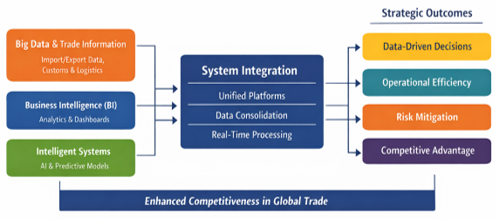
The flowchart illustrates the conceptual logic of digital transformation in Brazilian foreign trade by showing how different technological components converge to support strategic outcomes. It begins with the generation of large volumes of trade-related data from imports, exports, customs procedures, and logistics operations, which are combined with business intelligence tools that provide analytics and dashboards, and intelligent systems based on artificial intelligence and predictive models. These elements feed into a centralized system integration layer, where data are consolidated, processed in real time, and made available through unified platforms. This integration enables organizations to transform fragmented information into reliable, timely insights that support data-driven decision making. As a result, firms achieve greater operational efficiency, improved risk mitigation, and enhanced competitive advantage, ultimately strengthening their position in the global trade environment.
Figure 1. Conceptual Flowchart of Digital Transformation and Strategic Decision Making in Brazilian Foreign Trade.
Source: Created by author.
In conclusion, digital transformation is redefining strategic decision making in Brazilian foreign trade by enabling the effective use of data, business intelligence, system integration, and intelligent analytical systems. These technologies enhance operational efficiency, improve strategic foresight, and strengthen organizational resilience in an increasingly complex global trade environment. As international markets continue to evolve, the capacity to transform data into strategic knowledge will remain a critical determinant of competitiveness for Brazilian firms engaged in foreign trade.
References
Bueno, C. O., Marquez, C. S., Gonçalves, E. A., Teixeira, G. G., & Carvalho, L. B. B. (2025). Digital transformation and artificial intelligence in strategic decision making: The new profile of the administrator in the data age. Revista de Geopolítica, 16(4), 45–62.
Chen, H., Chiang, R. H. L., & Storey, V. C. (2012). Business intelligence and analytics: From big data to big impact. MIS Quarterly, 36(4), 1165–1188.
Davenport, T. H., & Harris, J. G. (2007). Competing on analytics: The new science of winning. Harvard Business School Press.
Santos, G., Camargo, C., Souza, I., & Molina, M. (2024). Power BI as an ally in extracting strategic insights and decision making in Brazilian foreign trade. e-F@tec Electronic Journal, 14(1), 89–105.
Vial, G. (2019). Understanding digital transformation: A review and a research agenda. Journal of Strategic Information Systems, 28(2), 118–144.